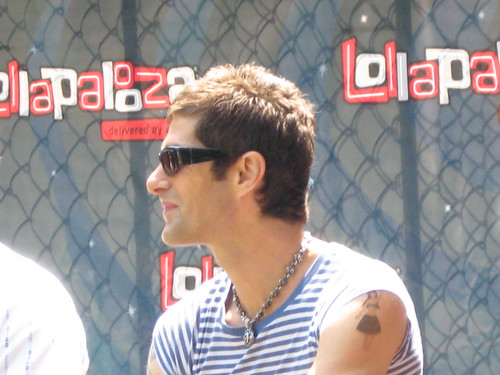
Perry Farrell is an indie-rock icon. Besides being the frontman for Jane's Addiction and Porno for Pyros, he started Lollapalooza, the grandfather of the modern American music festival scene. Besides making Lollapalooza happen every year, he's also putting out music as DJ Peretz. He's known as such a tastemaker that getting a song onto Perry's iPod is probably a surer path to fame than getting signed by a major label. He's passionate about the environment and music and sees the connection between the two, and he's definitely not afraid to speak his mind.
Perry was kind enough to give me a brief interview at Lollapalooza where we talked about the roots of his environmentalism, fancy new energy-efficient speakers, and the environmental folly of CD production. Enjoy!
Perry Farrell at the Saturday morning press conference.
Jason Turgeon: I know you've been making a lot of steps to [green Lollapalooza] over the last few years. Can you tell me a little bit more about what you've done?
Perry Farrell: In 1991, we started working with Greenpeace. Back then, I wanted to have a bit of goodness and a bit of charity and a bit of non-profit on the grands. Back then it was a table and some pamphlets and some recruits. But I started to inform myself through meeting these people and became an environmentalist and wanted to do a better and better job. Of course, as the evolution of things like the biodiesel generator came to be more practical and accessible, we installed them on the grounds, and companies began to form [to] carbon offset people's travel and energy expenditures. We were able to find those companies and work with them. I'm really really happy to report that we were a completely carbon offset company this year, save for the audience themselves. You can't force them, but we are giving them information on how they can offset themselves. [Ed. Note: At the BeGreen booth where I paid $5 to offset my travel, the volunteer working the booth told me that about 10,000 fans had chosen to participate in voluntary offsets.]
JT: So you say you became an environmentalist. What prompted that?
PF: Well, as I say, it was meeting people that were involved in the environment, number one. But number two, I'm also an extreme sport athlete. I love snowboarding and surfing, specifically. Those of that use the outdoors as a pasttime are very very aware. When you go surfing in Southern California and there's oil slicks in the water and plastic floating in there and you end up with a rash on your arm for having caught a couple of waves, you quickly become alerted to the problems and you start to look for solutions.
JT: That's happened to you, [you've gotten] rashes?
PF: You know, I don't get the rash, my friends get the rashes. But I get a little itch from time to time, and I wonder what's that from, and I go, wait a minute, I was surfing this morning. But the oil slicks, they're there, man, they're there...Every day, there's a caution. Every day, we go on surfline to see how the surf is. Water conditions: caution, hazard, caution, hazard. It's never like, nice, great, go in.
JT: So you have some bands here that are known for being very environmentally conscious. Radiohead is especially known for being very forward on this. Did they do any work with you on this festival? Did they ask you to do anything special?
PF: No, but they did ask their audience to inform themselves on the travel. I thought that was very nice, but I think that was very nice, but it was purely on their own behalf, not on Lollapalooza's behalf. They've invited the audience to do something similar to what we're doing, which is [saying] here's how to carbon offset your own travel to our shows.
JT: Did you see their light show last night?
PF: I sure did.
JT: Do you know about the light show? They designed this new LED light show that uses about 1/6th as much power, so they got rid of all their generators for the lights
PF: Yeah, we have down at Perry's [stage] sub[woofers]s and speakers now that are operating on like a 1/16th of what the power was. They don't have any amps for the speakers...The company comes out of Italy. DB speakers.
JT: Have you been happy with them so far?
PF: The sound is incredible. We're actually practically getting complaints from the neighboring stages because our subs are so fierce.
JT: You're Perry Farrell. Everyone in the industry knows you; everyone outside the industry, even if they don't know who you are, they know what Lollapalooza is. You have all of this power to change attitudes. You have kind of a bully pulpit. Are you going to be more forceful in what's coming out of you in environmental terms, with what's going on?
PF: Well, I have been outspoken. In 1995, I went and set up a show right off the grounds of the White House with Greenpeace and performed out there. I've been applying a constant pressure in the way of ecology and environmentalism. But what I can tell is this: There's a lot of people to apply pressure to. We're talking about six and a half billion people. We all have to count each other, even the people in the rainforests are our brothers and sisters. It's not going to be easy, but you do it in increments, you do it by doing what you're doing. Make awareness fun and easy. Make it easy for people, and there's usually no issue. It's when you force them to kind of reach really deep into their pockets.
Actually, the funny thing about environmentalism is, by being an environmentalist, by changing, there's a good chance you can actually save or make money. And that's the big thing that we've got to get out to people. Changing that light bulb, that light bulb lasts longer and your bill goes down. Or if you're changing your business or your factory, you're actually saving money because you're saving the energy output. I tried to change the entire music industry last year. I was signed to Sony. I said to Sony I want to put out no more CDs. There's no reason for it, I want to go completely digital. Well, they could care less. I was trying to explain to them, look, you lower your production costs, you don't have to print up anything. It takes 2.2 pounds of carbon to create a CD, and you have a distribution outlet through the internet, so what's the problem? You can lose this big building, you have all these people. They didn't want to hear it, but guess what? They're losing fucking money and they're gonna do it eventually anyway, so there you go. I put my music out now through Beatport and Beatsource, which is a purely digital distribution company that all the DJs are using. So there you go man.
Even though I'm still working on transcribing the last of my Rothbury interviews, it's time to switch gears and move up to Lollapalooza. I'm lucky enough to be onsite all weekend, and can't wait to see Radiohead and Rage Against the Machine. I'm also looking forward to checking out all the green accomplishments at the festival and digging deep to see if they live up to the hype.
Lollapalooza's had years and years to perfect its act, so I expect things to go pretty smoothly here. They have an extensive greening section on their website that gives info on the various greening initiatives around the site.
Notably, the new permanent location at Grant Park in Chicago is exceedingly public transit friendly, and it's also going to be bike friendly with a bike storage area and even a bag valet for folks using public transit/bikes to drop off their extra gear. There are two free water locations in the park and fans are encouraged to bring reusable bottles, and of course there is a full-fledged recycling program. At first glance, it looks like Lolla is at about the same green level as Bonnaroo--in other words, they were in front of the pack until Rothbury came along and blew away the competition.
Lollapalooza's frontman Perry Ferrell is known to be big on the green front, and I've managed to snag 5 minutes with him on Saturday for an interview. I'm also working on lining up a talk (or even a behind-the-scenes tour!) with Stacy Rodriguez, the new greening coordinator at C3. On the artist front, I'll be interviewing Saul Williams and others, so stay tuned for lots of good green info in the weeks to come.
One notable interview I won't be able to get is, of course, Radiohead. Getting an interview with Thom Yorke is about as easy as getting an audience with the Queen, but I tried anyway. That doesn't mean I won't try to sneak my way backstage for a look at the ultracool low-energy, battery-powered LED lightshow that the band's production manager devised just for this tour. Radiohead has done as much as anyone to green their tour, and they've been very transparent about the process on their website and blogs, so I'll dedicate a whole post to the band after the dust settles.
There are better clips of Radiohead on YouTube from a musical performance and audio quality perspective, but this is the best example I could find that highlights the LED show. Enjoy!
A few weeks ago, I brought you news that green festivals in the UK were getting some mainstream media love, notably the BBC. Now it appears that even my hometown right-wing stalwart the Boston Herald is noticing the green music movement.
A story in today's Herald by Jed Gottlieb does a pretty decent job of covering the fan transit issue. He talks about Radiohead's carbon footprint experiment, extols the virtues of this weekend's WBOS EarthFest at the Boston Hatch, and beats up a bit on the giant traffic jam we call the Tweeter Center.
Nice work, Jed!
Here's some Radiohead to make up for the brief post: