On the Sunday morning of Lollapalooza, I dragged myself out of bed at the ungodly hour of 8 AM, sulked through a shower, did some last minute research on my interview subject, and hopped on a city bus to get to Grant Park. I arrived a few minutes ahead of my scheduled 11:15 slot and found a relatively peaceful media tent. The man I was slated to interview, Saul Williams, was curled up catlike in an oversized plastic Adirondack chair, finishing up an interview with a TV crew, so I set up my laptop nearby and did a little eavesdropping.
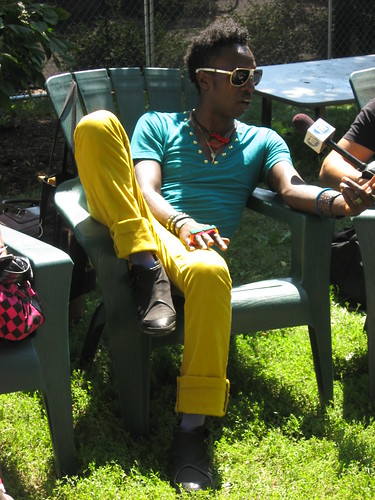
Saul Williams, dressed to impress before his mid-day set at Lollapalooza.
Williams, the slam-poet/spoken word artist/culture jammer/musician whose song "List of Demands" - nominally about reparations - made its way into a Nike commercial earlier this year and spawned legions of arguments about whether Saul Williams was selling out to Nike or conning them into distributing his message, strikes many people as angry. Hell, he wrote a song about reparations for slavery fer cryin' out loud. A song with lyrics like "I ball my fist and you're gonna know where I stand." So I, predictably, had a slam-dunk question about Saul's anger, but with a green slant.
Fortunately, the interviewer in front of me fell for the trap first. He put on his serious-question face and asked this man--this articulate, educated, unafraid black man with an almost-mohawk and tight yellow pants who is dangerously close to being the new face of black America for a media that is seemingly unable to confront or even acknowledge racial issues in this country--about his anger. And he got his ass handed to him for doing it. Williams' answer: "I don't think I'm angry. A lot of people seem to think I'm angry but I'm not sure why." Flabbergasted, the man with the microphone found a way out of it somehow and moved onto other questions. I tried to stifle a giggle and praised my luck for not having pressed snooze once more on the alarm clock, for I surely would have repeated the gaffe.
A few minutes later, while the ill-fated interview was wrapping up, I overheard a journalist with a major music television network explain to Saul's press liason that her interviewer and cameraman had apparently exhausted themselves too thoroughly at one of the afterparties around town to make it in to the press tent and conduct their scheduled interview. This is where Saul Williams' career is today. He's big enough to draw a sizeable crowd at Lollapalooza yet gets more publicity for a 30-second Nike ad than he has for his previous 10 years' worth of work, he doesn't seem to rank high enough for a television crew to get out of bed for an 11:30 AM interview because they were too busy trying to get footage of some blonde lesbian sending text messages the night before, and everyone wants to know why he's pissed off.
On the brighter side, the television defection leaves me with extra time to talk to the man of the hour. I find him to be completely relaxed and frighteningly intelligent. My first impression of Saul reminded me more of Hannibal Lecter than anyone else I can think of. He's used to being in control, charming, smart, witty, and so intensely focused that when I finally hit him with a question that grabs his interest I'm afraid I'll wilt under the pressure he puts back into his answer. Fortunately, as I find out when we begin our conversation about the greening of music, he's also a vegan, so my liver is safe.
He unintentionally draws blood early in the conversation. I've been a conflicted carnivore for the last couple of years, continuing to eat at McDonald's even after watching Super Size Me, enjoying steak even after reading The Omnivore's Dilemma, putting away Boston Market chicken like it's my job even though I read Fast Food Nation more than 3 years ago. Williams doesn't know any of this, of course, when he wraps up his discussion of the merits of veganism by saying with a laugh, "You'll hear me focus a lot on diet when we talk about the environment, because I have a really hard time interacting with environmentalists that eat meat." Inside, I'm cringing--he's pegged me for a phony, and I immediately vow to give being a vegetarian another shot for all the reasons I know that I should.
But while I know that I shouldn't eat meat because it's bad for me in the quantities consumed by a modern westerner, because I know that the way we produce meat in western society is responsible for some of the greatest environmental damage on the planet, and because I know that confined animal farming operations are grotesquely inhumane both for the animals in the system and the migrant workers who do the butchering, I'm not quite prepared for what Saul's about to drop next.
"Well," he says in response to my query about the possibility that we could raise farm animals in a more humane and environmentally friendly manner, "...as a person that's a member of a race that used to be deemed as animal, I know what it feels like to be treated as animal, and I think until we upgrade our understanding of compassion and spread it beyond human....there's racism but there's also a sense of speciesism that exists. And it's because of our arrogance as a species that we ruin...and exploit the earth the way that we do.... And so I think that we have to...connect the dots in order to experience any real change in society....if we shifted our focus on being compassionate towards wildlife and animals, then everything else would be a domino effect. That would be us treating the forests, the oceans, water supply, we'd treat everything better as a result of just focusing on animals."
That's pretty heavy stuff, and a lot of it is true on some level. I'm still not prepared to cede the point that after a few dozen millenia of us co-evolving with a handful of other species, we should just abandon those species. The vegan v. carnivore debate, however, can all too easily turn into Roe v. Wade or Brady v. Heston, so I don't pursue it much further.
What about other, less controversial green issues? Saul tells me that he did his last tour in a Dodge Sprinter powered by biodiesel, and that finding biodiesel was a bit of a challenge. Then he jumps in to discuss the music industry's least favorite topic: declining CD sales. "I believe that technology is here to free us from the constraints of history....I was able to release my album for free online digitally, meaning that I initially did not use any plastic or whatever-it is on vinyl and CDs now, in limited distribution-but we started for the first six months digitally."
Of course, he made waves when he released the album digitally for free on his website, but it's a surprise nonetheless to see him make an explicit connection to the waste generated by CD manufacturing. After all, CD sales are a big part of his bread and butter-substitute income. I ask him if he thinks artists will be able to survive in the new digital era without physical record sales to support them. His answer is refreshingly honest, and characteristically to the point:
"Artists have survived through time. Artists will always survive. Will every artist be able to live off of their art? That is never the case. But more artists today will be able to live off of their art than 10 years ago, 100 years ago. We may not all live as extravagantly as some in the past, but even those who lived extravagantly in the past, all that stuff is based on exploitation, and it's harder to exploit because people have upgraded their sense of awareness and realized their power a bit more. But we'll be fine."
He continues on with a discussion of the consumer side of the equation. "People are holding onto what has worked in the past. For some that's damning and for some, it's a lesson to be learned. We're still selling CDs, and they are selling. But digital downloads are a huge business and people are learning to value streamlining. A lot of people don't want to unwrap the plastic. But there are some in a consumer culture that don't value what they're given unless they get to unwrap it and open it and look at it and hold it in their hand. So it's an interesting time, it's a crossroads that we're at."
What about fans downloading his album on bittorrent, where I found it, or some other P2P application? Does he have a problem with that? "Not at all, I gave away my album for free, and the main reason for doing that was to honor the fact that they could do it anyway. The only thing that I gained by giving it away for free in that sense was instead of them doing it from peer-to-peer, they were able to get it directly from me, which meant that I could monitor it, that I could add some email addresses to my fanbase to, you know, press send on poems that I come up with every now and then and want to share."
Eventually, we move back around to the greening of Lollapalooza. Having just arrived in town the night before, Williams demurs to speak on specifics. But he notes without the slightest trace of detectable irony, given his breakout song deal with Nike, that Lollapalooza is heavily sponsored by multinational corporations that might not share Perry Farrell's green agenda. "The problem comes in when you start accepting money from all these different huge sources who don't have the same vision as you. There has to be a way to maintain that vision and to maintain control, but it's hard when you have all this money coming from different corporations who have their own list of demands."
And with that, I'll leave you not with List of Demands, but with one of his other anger-management classics, Grippo. Enjoy, and keep an eye out for a possible Saul Williams schwag giveaway in coming weeks.
In a weekend where I met Perry Farrell and spent 20 minutes talking to Saul Williams, the most interesting interview I got was with the owner of a backpack company. The story of how we met is a lesson in the murky waters of modern marketing theory and the new desire by corporations to portray themselves as green.
Leading up to Lollapalooza, I was bombarded with communiques from various PR firms offering interviews with the lesser-known bands. In the flurry of digital activity, I almost missed a somewhat confusing invite to a pair of events so laden with sponsor names in their titles I couldn't even figure out what they were the first time I read the message. The official titles were "The Music Lounge Presented by Metromix.com at Hard Rock Hotel Chicago for the 2008 Lollapalooza Music Festival" and the related "Eastsport Cafe and Spin Acoustic Stage." This was apparently some sort of VIP event, although the press, including random government employees moonlighting as bloggers, was also welcome. Never having been invited to any kind of VIP shindig before, I decided to check it out, even when I found out that the Hard Rock Hotel was a 20 minute hike from the press tent at Grant Park.
Once on scene, I found controlled chaos on two floors of the Hard Rock. Various cool-looking people in designer garb with three-figure haircuts milled around, listening to music, eating some very appetizing food in the cafe, and--depending on their level of importance in the music world pecking order--being "gifted" (a new verb!) with various goodies ranging from jeans to free tattoos to backpacks, which you could fill with other items you'd been gifted with. The lower floor featured the aforementioned "Eastsport Cafe and Spin Acoustic Stage," which turned out to be a place to get free food and drink and listen to a few live tunes. The whole thing was sponsored very prominently by something called Eastsport Natural and the Ben Jelen Foundation. I had no idea what was going on, except that it seemed to be some sort of mass exercise in branding and consumerism, and that Eastsport was very clearly trying to up its green cred.
The level of branding, in keeping with the overall theme at Lollapalooza (brought to you by AT&T!) was intense. I wanted to follow up on the green angle, so I asked for more info. The Fiji water given to every diner in the cafe (label carefully positioned to face outward) was green, my PR handler assured me, because the company is "carbon negative." The Fuze drinks were green, too, now that they had switched from that environmentally pernicious glass bottle to a new, easier to recycle plastic bottle. Eastsport was the most prominent green corporation there with a new line of green bags to push, with a portion of proceeds benefiting the Ben Jelen foundation. Ben, an up-and-coming singer-songwriter, was promoting his own personal green brand, too, with 6-foot-tall pictures of his face lurking around every corner.
I was ready to call bullshit greenwashing on the whole thing and leave, but the promise of free food and margaritas was too much for me. Plus, it was air-conditioned, and that first day of Lollapalooza was a bit too much like a day in Manchester, TN, to pass up a chance at climate control. I agreed to do a few interviews so I'd have something to keep myself occupied and not feel like too much of a mooch. We arranged that I would come by on the following morning to speak to a few folks. On my arrival, I stood near a tall, muscled man covered in tattoos who looked so much like a slightly younger Henry Rollins that I had to sneak a peek at the back of his neck to make sure that the telltale Rollins barcode wasn't there. Looking for a quiet spot to do interviews, I was directed to the now empty room where the private afterparty concerts were held. The only place to sit was on the stage, so I plugged in my laptop and settled down on a riser.
My first interview was with Bruce Starr of BMF Media, the promotion company that arranged the event. He explained that these VIP rooms give the glitterati a chance to get away from the masses and have a meal in relative peace, and that they were common at events like Sundance but relatively new to the music festival world. This was just one of a series of Eastsport Natural and Spin Acoustic Cafe VIP events being held at music festivals around the country, with others at festivals including SXSW. The camping festivals haven't yet reached this level of cultural importance, apparently, which is why I'd never seen one of these before. And he assured me that this was indeed a very green event, what with the recyclable plastic bottles and carbon neutrality and green backpacks and all.
Next up, I got to spend 20 minutes with Ben Jelen (pronounced yellen). He's a strikingly good-looking man in his mid-20's, with soft features and long black hair. I'm pretty sure that this is what Michael Jackson wanted to end up looking like, even though it didn't quite work out that way. He's also a lot smarter than the blog posts on his foundation's website let on. After reading his exclamation-point laden missives about compressed-air cars and the benefits of organic gardening, I hadn't really expected a mature conversation, but it turns out that he's got a degree in biology from Rutgers and knows his environmental stuff backwards and forwards. This is not a guy who's jumping on the green bandwagon, or a guy who's greenwashing. Instead, he's an astute marketer and a bit of a realist. In his own words, "I think the most important things are the consumer vote. Where you put your money in a capitalist society is going to speak loud and clear as to what you want and where you're going."
To further his desire to see the world become a better place, Ben puts his capitalist money where his mouth is. It started a few years ago, when he had early financial success with his first album. He gave a chunk of change to the NRDC, enough that they took notice and had some conversations with him. Perhaps inspired by that, he started the Ben Jelen Foundation in January of this year, with a four-point approach (education, lobbying, humanitarian relief, and investments in clean energy) that he hopes will approach the whole problem. So far, the young foundation has only raised about $12,000, but he's also partnered with Fiji water to send about a dozen New York youth to Fiji for some first-hand environmental live-and-learn activities, and he has the new partnership with Eastsport Natural, which is donating 10% of its proceeds to his foundation. Color me suitably impressed. I was beginning to get the impression that this event wasn't just so much greenwashing after all, despite the celebrity hoo-hahs and the suspect claims of carbon neutrality from Fiji water and the questionable green cred of Fuze's new plastic bottles.
But none of this really explained the Eastsport backpack connection to me. Why was a low-end bag manufacturer with 50-foot displays at every Wal-Mart in the country wrapping itself in green, and what do $20 backpacks have to do with rock music? I was assured that my final interview with the "Eastsport rep" would clear things up. As I sat there on the stage where Sharon Jones had given a private VIP-only show the night before, now my private interview room, I pulled together a few questions.
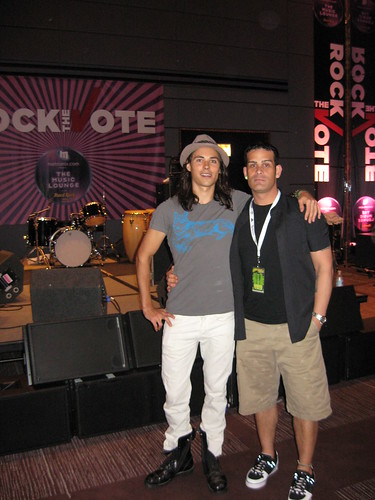
Ben Jelen (in hat) and Joseph Janus.
None of these questions ended up getting asked, though, because when I met the Eastsport "rep," I was more than a little surprised by who showed up. My interviewee was Joseph Janus, the Rollins lookalike I'd been standing next to earlier, and he wasn't a sales rep, he was the principal of the company. Beyond that, he's also the man behind Fearless Management, the artist management firm responsible for getting Ben Jelen signed on to Madonna's Maverick record label. All of a sudden, the dots started to connect.
Janus has a classic American success story. He skipped high school entirely to skateboard, but after an injury at the tender age of 13 he started JMCO, a successful blue jeans company. He eventually sold that and continued on in the world of fashion and marketing with stints at Calvin Klein and Guess. Along the way, he also picked up the Eastsport backpack company from its founder, and now the company is the number one backpack manufacturer in the world, according to Janus. But there's a problem with his manufacturing business, and he knows it: Eastsport's current manufacturing process just isn't sustainable. He's blunt about the issue: "This is a company that makes...affordable plastic backpacks...we ship like 800 million backpacks. Now, the problem with that is how do you get 800 million people to go from buying a $24 backpack to a $50 or $60 backpack? It's very difficult to be green."
But just because it's difficult, or perhaps because it's difficult, Janus hasn't given up or given in to the greenwashing I originally suspected him of. He's researched the issues thoroughly and is determined to be a part of the solution the best way he knows how--through marketing and consumer education. But after a career as a marketer, he didn't want to fall into any ethical traps. "You'll see things that are marketed as 100% organic cotton, but with the lining and the filler and everything else, it's actually 20% organic cotton. It's a big lie and it's a big marketing ploy and I didn't want to do that with Eastsport," he states defiantly. He continues on to say that "what we decided to do was come up with a line of backpacks that instead of being $19.99 or $24....was 100% biodegradable. I didn't worry about organic, because organic is not what's important [ed. because of the lack of regulations surrounding "organic" labeling]. What's important is biodegradable [and] where are these backpacks being made. They're not being made in China, they're made in the US. They're being shipped local to source. They're going into warehousing that's close to that district. I really went 100% in a way that would make this as environmentally friendly as possible, with telling the truth and not using it as a marketing ploy."
Janus, like the young environmentalist Ben Jelen whose career he helped launch, is passionate about the environment but also a realist. As he puts it, "I would love to be in a position where I could say we only make natural backpacks. That'd be great. But I'd be out of business." So Janus, the skateboarder/fashion designer/music manager/green backpack manufacturer, is breaking all the rules, seeking out biodegradable plastics manufacturers, bringing manufacturing back to the US, and trying to spur demand for green manufacturing components to a level where economies of scale can kick in and these products can be cost-competitive with more traditional ones. Right now, it's a losing proposition, financially speaking. He says that after donations to the Ben Jelen Foundation, investments in alternative energy in China, and the added expense of green components for his bags, his company doesn't make any money on the Eastsport Natural line even though it has a price tag that's 2-5 times as much as his plastic backpacks. "Because," he says, "the big, ugly story of green is how affordable is it?"
And that's the crux of this weekend. Lollapalooza is capitalism in all its ugly glory, rock and roll devoid of sex or drugs, a money-making machine as sinful and sanitized and finely tuned as the new Vegas. The festival, despite what appears to be a heartfelt desire by top management to be greener, is still all business. The stages are sponsored by MySpace and Bud Light, the entire event is underwritten by a phone company, even the green area is sponsored by Whole Foods. Despite the fact that the 3-day event cleared almost $10 million in 2007, according to Spin, any greening has to pay for itself, with the result that it's hard to tell if the festival is green or greenwashed. With a finely-honed cash cow like this, no one is taking any chances. But we need risk-takers to get out of the business-as-usual mentality, and in the vacuum of leadership from above, it's entrepreneurs like Janus who are taking charge. Eastsport, surprisingly enough, is taking a flier on the green line of bags. This isn't greenwashing, this is an entirely earnest experiment, one that combines the marketing of a young new environmentalist filling a void--the complete dearth of musicians not named Michael Franti willing to tackle the environment in their art--with the marketing of a new product line that isn't making any money, all in the hopes that the two of them together can convince consumers to go green and stay green, not just give in to green marketing.
Janus wraps up with some optimistic thoughts. "What I'm hoping is that the consumer starts wanting green products. If the demand is there, then I have to make more green backpacks and I have to find a way to make them less expensive. I can't wait for that to happen....I'm very interested in seeing a healthy planet become a reality." Let's hope he succeeds, and that he can stay true to his vision of a green product that lives up to its marketing. And as for the "carbon-negative" water...well, I'll leave that for another day.
Full disclosure: I was offered a bag, and agreed to take it, but they were all gifted out so I left empty-handed. That said, we're probably going to be giving some of the new Eastsport Green bags away on the site in the near future.
Perry Farrell is an indie-rock icon. Besides being the frontman for Jane's Addiction and Porno for Pyros, he started Lollapalooza, the grandfather of the modern American music festival scene. Besides making Lollapalooza happen every year, he's also putting out music as DJ Peretz. He's known as such a tastemaker that getting a song onto Perry's iPod is probably a surer path to fame than getting signed by a major label. He's passionate about the environment and music and sees the connection between the two, and he's definitely not afraid to speak his mind.
Perry was kind enough to give me a brief interview at Lollapalooza where we talked about the roots of his environmentalism, fancy new energy-efficient speakers, and the environmental folly of CD production. Enjoy!
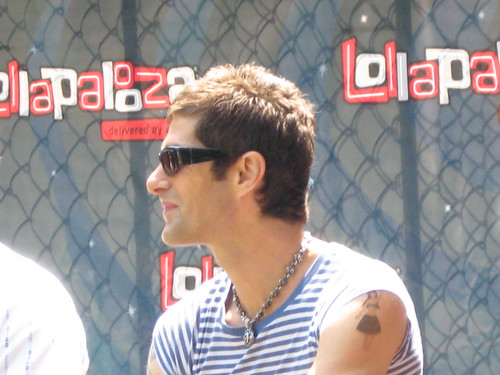
Perry Farrell at the Saturday morning press conference.
Jason Turgeon: I know you've been making a lot of steps to [green Lollapalooza] over the last few years. Can you tell me a little bit more about what you've done?
Perry Farrell: In 1991, we started working with Greenpeace. Back then, I wanted to have a bit of goodness and a bit of charity and a bit of non-profit on the grands. Back then it was a table and some pamphlets and some recruits. But I started to inform myself through meeting these people and became an environmentalist and wanted to do a better and better job. Of course, as the evolution of things like the biodiesel generator came to be more practical and accessible, we installed them on the grounds, and companies began to form [to] carbon offset people's travel and energy expenditures. We were able to find those companies and work with them. I'm really really happy to report that we were a completely carbon offset company this year, save for the audience themselves. You can't force them, but we are giving them information on how they can offset themselves. [Ed. Note: At the BeGreen booth where I paid $5 to offset my travel, the volunteer working the booth told me that about 10,000 fans had chosen to participate in voluntary offsets.]
JT: So you say you became an environmentalist. What prompted that?
PF: Well, as I say, it was meeting people that were involved in the environment, number one. But number two, I'm also an extreme sport athlete. I love snowboarding and surfing, specifically. Those of that use the outdoors as a pasttime are very very aware. When you go surfing in Southern California and there's oil slicks in the water and plastic floating in there and you end up with a rash on your arm for having caught a couple of waves, you quickly become alerted to the problems and you start to look for solutions.
JT: That's happened to you, [you've gotten] rashes?
PF: You know, I don't get the rash, my friends get the rashes. But I get a little itch from time to time, and I wonder what's that from, and I go, wait a minute, I was surfing this morning. But the oil slicks, they're there, man, they're there...Every day, there's a caution. Every day, we go on surfline to see how the surf is. Water conditions: caution, hazard, caution, hazard. It's never like, nice, great, go in.
JT: So you have some bands here that are known for being very environmentally conscious. Radiohead is especially known for being very forward on this. Did they do any work with you on this festival? Did they ask you to do anything special?
PF: No, but they did ask their audience to inform themselves on the travel. I thought that was very nice, but I think that was very nice, but it was purely on their own behalf, not on Lollapalooza's behalf. They've invited the audience to do something similar to what we're doing, which is [saying] here's how to carbon offset your own travel to our shows.
JT: Did you see their light show last night?
PF: I sure did.
JT: Do you know about the light show? They designed this new LED light show that uses about 1/6th as much power, so they got rid of all their generators for the lights
PF: Yeah, we have down at Perry's [stage] sub[woofers]s and speakers now that are operating on like a 1/16th of what the power was. They don't have any amps for the speakers...The company comes out of Italy. DB speakers.
JT: Have you been happy with them so far?
PF: The sound is incredible. We're actually practically getting complaints from the neighboring stages because our subs are so fierce.
JT: You're Perry Farrell. Everyone in the industry knows you; everyone outside the industry, even if they don't know who you are, they know what Lollapalooza is. You have all of this power to change attitudes. You have kind of a bully pulpit. Are you going to be more forceful in what's coming out of you in environmental terms, with what's going on?
PF: Well, I have been outspoken. In 1995, I went and set up a show right off the grounds of the White House with Greenpeace and performed out there. I've been applying a constant pressure in the way of ecology and environmentalism. But what I can tell is this: There's a lot of people to apply pressure to. We're talking about six and a half billion people. We all have to count each other, even the people in the rainforests are our brothers and sisters. It's not going to be easy, but you do it in increments, you do it by doing what you're doing. Make awareness fun and easy. Make it easy for people, and there's usually no issue. It's when you force them to kind of reach really deep into their pockets.
Actually, the funny thing about environmentalism is, by being an environmentalist, by changing, there's a good chance you can actually save or make money. And that's the big thing that we've got to get out to people. Changing that light bulb, that light bulb lasts longer and your bill goes down. Or if you're changing your business or your factory, you're actually saving money because you're saving the energy output. I tried to change the entire music industry last year. I was signed to Sony. I said to Sony I want to put out no more CDs. There's no reason for it, I want to go completely digital. Well, they could care less. I was trying to explain to them, look, you lower your production costs, you don't have to print up anything. It takes 2.2 pounds of carbon to create a CD, and you have a distribution outlet through the internet, so what's the problem? You can lose this big building, you have all these people. They didn't want to hear it, but guess what? They're losing fucking money and they're gonna do it eventually anyway, so there you go. I put my music out now through Beatport and Beatsource, which is a purely digital distribution company that all the DJs are using. So there you go man.
Overall Green Score: B Lollapalooza gets high marks for a location that practically demands fans use public transit, accomodates bikes, and makes use of an existing public park. The festival also scores well for giving generously to the Parkways Foundation. On the "needs improvement" front, there's no meaningful effort to engage fans in the sustainability initiatives, the waste management plan, while well-developed, needs a Rothbury-like overhaul to get to zero waste, there's no dedicated green coordinator or consultant, and the "Green Street" area is little more than a token gesture. This is a festival that needs to reevaluate its green goals to stay current but has serious potential to recapture a position of leadership if management can match its words with actions.
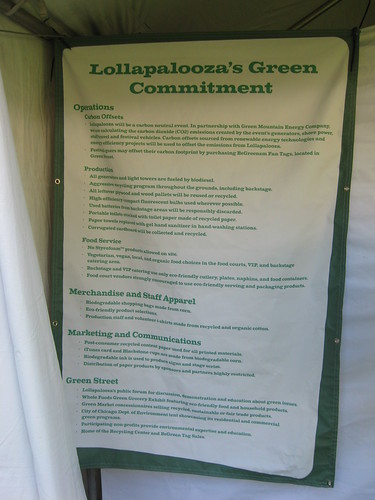
Lollapalooza's green commitment, found tucked behind a curtain in an obscure booth in the well-hidden Green Street area, reminiscent of the plans to destroy Arthur Dent's home.
Full Review:
Lollapalooza turned out to be a much more intense experience than I'd anticipated, largely because of the crowds. This year marked the festival's first sellout at Chicago's gorgeous Grant Park, with 75,000 people streaming through the gates each day. That's about the same size as the nation's other granddaddy of festivals, but on a much more compact site.
Logistically speaking, the festival operated with the precision of a Rolex. With so many years of experience, Perry Farrell and the C3 crew have had plenty of time to work out all the bugs. From the press area, head and shoulders above the press tents I've seen at other festivals, to the weather--a hot and humid but dry three day stretch sandwiched between strong thunderstorms on Friday morning and Monday--it seemed like everything was coming up Lollapalooza this weekend. The only real hangup was the waiting. When I arrived Friday about 1, I saw what is without exaggeration the longest line of people I've ever laid eyes on, a line that stretched several city blocks in both directions, with people standing 6 abreast. Once inside, lines for the chemical toilets, which remained remarkably clean throughout the weekend, often reached 30 minutes. Getting a beer could also be a challenge, especially if you didn't want a Bud Light--the line at Leiderhosen's micro-brew* beer tent was over 30 minutes.
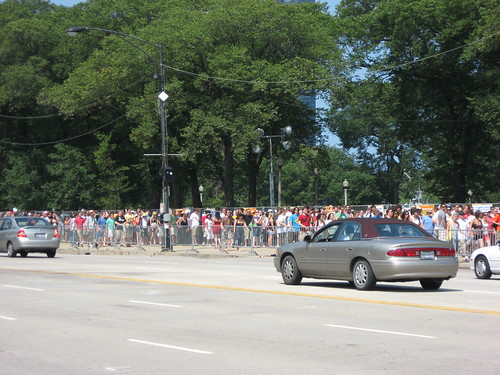
The lines on Friday stretched for blocks.
The truly remarkable thing about all of this was that despite the human queue, there was no automotive traffic associated with the event. Walking from the bus stop, I saw plenty of Lollapalooza-bound foot traffic but otherwise anyone visiting downtown would have had no idea that there was a smaller city within the city just a couple of blocks away. That's an amazing feat. Sure, some folks (myself included) arrived by taxi, and a sizable chunk of people (again, guilty as charged) flew in, but once in Chicago almost everyone used public transit. Parking lots just blocks away from the festival were empty all weekend. It's a testament to picking the ideal location for the festival--a beatiful site in a city large enough to accomodate the extra traffic, with plentiful hotel options and a robust public transit system. Other festival organizers involved in multiday noncamping city festivals should consider this as the model for what to look for in a festival location.
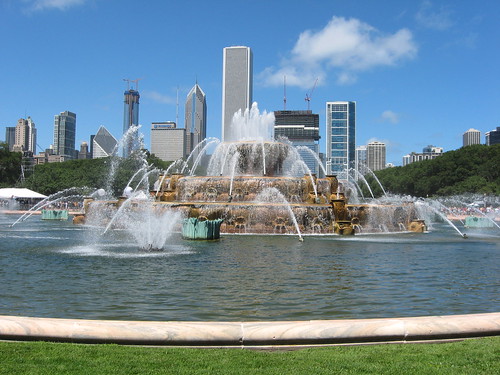
Buckingham Fountain, the centerpiece of Grant Park and the geographic center of the festival.
So organizers tackled traffic by picking a near-perfect site location, but how green was the rest of the event? To answer that question, I hoped to catch with Stacy Rodrigues, the festival's de facto greening coordinator and the replacement for Shanda Sansing, who I talked to last year. Unfortunately, despite several attempts to track her down I never got a chance to meet her, presumably because she was swamped with other details including non-greening work. C3 doesn't have a full-time greening coordinator on staff despite running three large festivals a year. That's a troubling sign, and one that showed through as I looked for signs of green life around the venue.
Lollapalooza and C3 talk a good game about greening efforts. There is a decent section of the website dedicated to green efforts, Perry Farrell and one of the C3 organizers made a special point of mentioning the green efforts at the Saturday morning press conference, and Perry even gave me 8 minutes of his time to talk about green issues. In other words, there is a strong interest in making this festival sustainable at the top levels of management. That's crucial for any greening effort, but by itself interest isn't enough. Implementation is also essential, and that's where the event fell short in places.
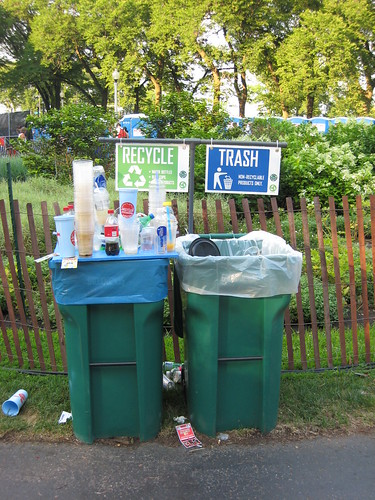
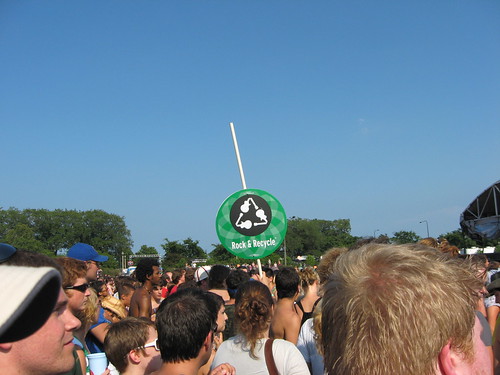
Take waste management, for example. The festival brought on Clean Vibes this year, and every waste station had a recycling bin. Over in the festival's Green Street area (more on that later), there was a Rock and Recycle stand where patrons who brought in 5 or 10 pound bags of plastic beer cups and water bottles could trade the trash for a reusable shopping bag or a T-shirt. Rock and Recycle also had teams of people walking through the crowds with bags to collect recyclable bottles and cups directly from the fans.
A waste station shows signs of strain. Roving "Rock and Recycle" teams collect bottles and plastic cups.
All of these are great steps, but the message definitely wasn't getting through to the fans. When we left after Saturday night's Rage Against the Machine show, it was like walking across a sea of crushed plastic. The sound made by 10's of thousands of us walking on so much plastic was downright eerie, and noteworthy enough to elicit lots of comments from the strangers around me. After Rothbury, with its hundreds of compost/recycle/landfill stations manned by volunteers and an impressive marketing campaign to get patrons to use them, this was a bitter crash back to business as usual.
Post-concert trash didn't always make it to the waste stations.
Speaking of composting, the Green Lolla section of the website mentions that foodware in the food service area was all compostable, but given the long lines for food and the ease of getting food outside of the festival, I never felt the need to stop by and check it out. Still, since I didn't see any composting bins anywhere in the festival grounds, I'm not sure what good having compostable foodware would be. The website also mentioned a certain amount of local and organic food, something I should have made a point of investigating, but to be honest this wasn't a food-lover's festival--there were far fewer places to get food than I would have expected, and given the distances between stages and the crowds, my group of friends tended to a certain efficiency of motion that precluded a swing over to the food area.
The press tent was plush, but the free perks generated plenty of waste.
Even though I didn't manage to sample the festival food, I did make a visit to the small "Green Street" area tucked away into a well-hidden corner. Here, fans could offset their carbon purchases for $5, learn about Chicago's well-developed citywide greening initiatives, buy a variety of recycled art from a handful of local vendors, and visit a huge display from Whole Foods. Compared to similar areas at the other festivals I've been to, this one was among the smallest and had the least information about green initiatives. It's symbolic of the festival's approach to greening--an afterthought tacked onto the event, rather than a centerpiece.
Reggie McGuire of local Chicago retailer Futurgarb shows off a handbag made of recycled Chicago Transit maps at Green Street.
The festival's other green initiatives were all fairly standard, although not unimportant. There was biodiesel (of an unknown derivation, in an unknown percentage of biodiesel to diesel) in the generators, recycled paper throughout, and a very sizable donation to the nonprofit Parkways Foundation. There was also the pledge of $1 million from organizers to renovate the magnificent Buckingham Fountain that is the centerpiece of Grant Park and of Lollapalooza.
Overall, this is a festival that seems to have reached stasis on the green front. The organizers mean well, but greening is clearly not the top priority at an event where every one of the 8 stages is named after a corporate sponsor and even the green area needs a sponsor. The greening efforts here are more than a token gesture, but they don't really seem to be looking to improve year over year, and they definitely aren't engaging the fans. Despite the enthusiasm from management, there's a general lack of green awareness throughout.
*Despite the moniker, "micro-brew" was an optimistic euphemism. There was one true small-brewery beer, Chicago's 312, but it was sold out when I got there. The other options were paragons of local craft beer like Stella Artois and Bass. Beer snobs everywhere were suitably disgusted.
I'm starting Day 3 of Lollapalooza and so far this festival has delivered big for the fans. Musically, it's a complete triumph, with a stellar performance from Rage Against the Machine last night and a very solid set from Radiohead the night before. Other highlights have included a riotous Gogol Bordello set, a high energy stomper from Cadence Weapon, and what sounded from the press tent like a tremendous set from Yeasayer. The crowds are already rolling in now for an incredibly strong final day featuring the John Butler Trio, G. Love and Special Sauce, Black Kids, and the National, but the real buzz seems to be about both Saul Williams and NIN, including a rumor that Saul and Trent will appear on stage together during the NIN set.
Speaking of Saul Williams, I grabbed an interview with him this morning and I'll have that transcribed later this week. I was also lucky enough to get a few minutes with the man himself, Mr. Perry Farrell, so look for that by week's end. I'll also have a review of the Eastsport Cafe, an offsite lounge area for artists, press, and assorted VIPs that's stationed just up the street at the Hard Rock Hotel. It turns out that Eastsport's owner is a big environmentalist and has started a new line of biodegradable bags. The brand is giving a healthy chunk of the proceeds to the Ben Jelen Foundation, the environmental charity started by the up-and-coming crooner. I have interviews with both Joseph from Eastsport and Ben Jelen to work with and when I publish the piece in about 2 weeks I hope to have a couple of the new Eastsport Natural backpacks to give away. We'll dream up some uber-clever green contest thing for you to participate in.
But while Lolla's been a success from the music and weather fronts, the Greening initiative leaves a little to be desired. It's not bad, but last night leaving Rage I walked over a sea of empty water bottles and smashed plastic cups, and after Rothbury it's kind of a letdown to go back to business as usual. I'll have a full green writeup in a day or two. For now, it's back to the music!
Even though I'm still working on transcribing the last of my Rothbury interviews, it's time to switch gears and move up to Lollapalooza. I'm lucky enough to be onsite all weekend, and can't wait to see Radiohead and Rage Against the Machine. I'm also looking forward to checking out all the green accomplishments at the festival and digging deep to see if they live up to the hype.
Lollapalooza's had years and years to perfect its act, so I expect things to go pretty smoothly here. They have an extensive greening section on their website that gives info on the various greening initiatives around the site.
Notably, the new permanent location at Grant Park in Chicago is exceedingly public transit friendly, and it's also going to be bike friendly with a bike storage area and even a bag valet for folks using public transit/bikes to drop off their extra gear. There are two free water locations in the park and fans are encouraged to bring reusable bottles, and of course there is a full-fledged recycling program. At first glance, it looks like Lolla is at about the same green level as Bonnaroo--in other words, they were in front of the pack until Rothbury came along and blew away the competition.
Lollapalooza's frontman Perry Ferrell is known to be big on the green front, and I've managed to snag 5 minutes with him on Saturday for an interview. I'm also working on lining up a talk (or even a behind-the-scenes tour!) with Stacy Rodriguez, the new greening coordinator at C3. On the artist front, I'll be interviewing Saul Williams and others, so stay tuned for lots of good green info in the weeks to come.
One notable interview I won't be able to get is, of course, Radiohead. Getting an interview with Thom Yorke is about as easy as getting an audience with the Queen, but I tried anyway. That doesn't mean I won't try to sneak my way backstage for a look at the ultracool low-energy, battery-powered LED lightshow that the band's production manager devised just for this tour. Radiohead has done as much as anyone to green their tour, and they've been very transparent about the process on their website and blogs, so I'll dedicate a whole post to the band after the dust settles.
There are better clips of Radiohead on YouTube from a musical performance and audio quality perspective, but this is the best example I could find that highlights the LED show. Enjoy!
As I get ready for Lollapalooza, I thought it would be good to repost this interview I did last year on my old blog with Shanda Sansing, the former green coordinator of C3 Presents, the production company behind Lollapalooza. Shanda's moved on to greener pastures, but her work carries on--this year's Lolla hasn't lost any green steam. Note that at the time I did this interview, the mythical Vineland festival we were discussing looked like a reality. Thanks to coordinated anti-festival neighbors and the All Points West festival starting out just one state over, Vineland didn't happen this year.
-----------repost, originally posted 12/09/07 on Melodytrip.com----------------------
Last week, I had the pleasure of spending more than an hour on the phone with Shanda Sansing, the person in charge of patron services and event greening for C3 Presents. You might not have heard of C3 Presents, but you definitely know their products. C3 is the production company behind Lollapalooza, Austin City Limits (ACL), the Big State country music festival, and one-half of the newly announced Vineland festival to be held in NJ next August.
Shanda is the driving force behind the greening of C3's events, but she's got the support of company management and Lollapalooza founder Perry Ferrell. This support has shown up in the recent greening initiatives at Lollapalooza, ACL, and to some extent at Big State. The company is actively looking to make 2008's events even greener. In our wide-ranging discussion, we talked about everything from the difficulties of using biodiesel to getting the audience to wash other people's dishes and how to best serve a plate of hot barbecue to a judge.
Perhaps the most exciting news on the greening front will come out of Vineland. Live Nation and C3 are teaming up with Festival Republic, the production company behind the UK's Glastonbury festival, perhaps the most successful festival in the world, to put on this event. Glastonbury has a long history of working towards a more just and sustainable world and has taken many steps to green its festivals over the years. Hopefully when we put the two together, we'll see something that will rival Peats Ridge in Australia in terms of its green credentials and positive social impact. One thing that really jumped out at me from this interview was just how much work goes into greening these events. It is still far easier for someone putting on a festival do go about doing things business as usual. Greening a festival that's attended by 225,000 people is a huge task, one that requires not just money but a tremendous amount of time and energy. If you're a festival goer, make sure you take the time to thank the organizers and the volunteers who help make these shows happen as sustainably as possible.
Jason Turgeon: How did you end up involved in the greening efforts at C3?
Shanda Sansing: I manage the volunteer program and access program for people with disabilities. Part of volunteer program has always been recycling, so it was an extension of that work. It also happens that I'm very interested in greening, so this was a natural fit.
JT: You got a lot of good press for your greening campaign at Lollapalooza this year. Did you do the same thing for ACL? What are your plans for Vineland?
SS: We did the same sort of things for ACL as for Lollapalooza, there just wasn't as much of a media focus. It's too soon to know what we'll do with Vineland, but I assume that we'll have the same focus. Really and truly, the stuff we did was a matter of stepping back and taking a look at how we could better produce our events. Anybody could take these actions.
JT: What are some of the challenges you've had trying to green the festivals?
SS: One of the hardest things has been dealing with waste. You have to have control over everything that comes on to the site to ensure that you can dispose of it properly.
JT: Speaking of waste, did you use compostable cups at these events?
SS: We would really have liked to use compostable cups, even though they would cost us about four cents a cup, but a beer sponsor will normally give us non-recyclable #6 cups for free. But we heard from New Belgium beer that some of the compostable cups they were using were melting in the heat. All of our events our held in the hottest part of the summer, so we couldn't take that chance. There are also disposal issues. Even with a good staff of volunteers at all the waste stations directing people how to dispose of things properly, it can get very confusing.
But Blackstone Winery used compostable cups for their wine and had no problems. We've heard that some people store the cups with the beer kegs in refrigerated storage, although that can create a logistical issue when we have many beer stations. So we're going to take another look at these cups in the future.
Instead of using compostable cups, we had recycling incentives at Lollapalooza and ACL. We served beer out of 2 kinds of cups, #1 and #5. Number 1 is the less expensive disposable cup you're used to, and #5 is the kind of white souvenir cup that you see at football stadiums. We got people to collect stacks of cups and bring them to us for t-shirts and other prizes. The #5 cups got sleeved in a plastic sheath that had printed directions which asked people to take the cups home and wash them and reuse them. We were handing people stacks of dirty cups and we couldn't keep them in stock. People loved them. It was fun. Until it happened, I didn't know whether it would work or not.
JT: Wow, you actually got festival-goers to do someone else's dirty dishes. Aside from the cups, did you have a composting program at any of this year's events?
SS: We opted not to compost at Lollapalooza because the closest facility that could take food waste was in Wisconsin and it couldn't be integrated into regular waste management system. We have been working with a Chicago-based composting entity to build more capacity. We will be looking at that in the future. There are other issues with composting. It must be staffed, and you can't have any meat, or grease, or cheese mixed in. At the very least, we might be able to do it backstage. It is easier to do with caterers. Then we could have as few as 3 stations.
JT:There is a growing movement to get people away from bottled water and into reusable bottles like Nalgenes. Are you looking at doing anything like that?
SS: The problem with the hard plastic water bottles is that they can be used as a weapon, so there is a security concern. It was a big struggle even to get people to be allowed to bring in their own Nalgenes. So for now, we don't have a good solution to that problem.
JT: Did you use biodiesel at your festivals this summer?
SS: We use Blue Sun biofuels. We started this process a couple of years ago. There was a big learning curve. Many of the vendors' generators would have had their warranties negated by biofuels, but recent industry changes have permitted B20 mix, so we now use B20. We also use as much shore power as possible.
JT: How about solar-powered stages? I know that Sustainable Waves is also located in Austin.
SS: We have not done anything with solar stages, but we have talked to Sustainable Waves. Their stages are not large enough for even the smallest stage we use--not even the kids area at ACL or Lollapalooza. The biggest stage is 16 x 24. But hopefully someday we'll get to a point where we can use a solar stage.
JT: What about your water and wastewater use and treatment at the festivals? Do you reuse any of the greywater or do anything else special?
SS: I have a strong interest in these issues because when I was a peace corps volunteer I built rainwater catchment systems in the Dominican Republic. The village I was working in had a irrigation canal, but we had to hike a mile to get clean drinking water. We do as much as we can at the festivals. The ACL production area is hooked into city water. Austin does not allow graywater reuse, because there are worries about contaminating the groundwater table. We are obligated to collect gray and black water from our vendors, as well as grease. Grease is collected by outside vendors for reuse. We still use regular portolets. We're open to anything that can help us manage our water and wastewater use.
JT: This year you held Big State, your first camping festival and your first strictly country music festival. Did you put the same amount of work into greening this festival?
SS: We did a lot of stuff behind the scenes. It was a great festival. It was in the middle of an oval race track, and we had a car race each day. We also had things like a barbecue competition. People loved it and we had a great time, but with things like a barbecue competition and car races, it was difficult to really make any big claims about being green.
One of the hardest things was the barbecue. People come to compete and they spend hundreds of dollars to be there. The way these things work is that at the last minute, everyone puts their food on styrofoam and they rush it up to the judges because they want the food to be as hot as possible. We tried as hard as we could, but we could not find a good alternative to styrofoam that would keep the judges and contestants happy, so we had to go with styrofoam plates for the competition.
There were some other things that we wanted to do but we couldn't because the festival was in Bryan College Station, a small town about 2 hours outside of Houston. There were no facilities that could offer us composting or biodiesel, for instance. But we did as much as we could. We had basic recycling. All of the beer was served in cans, which made it easier to recycle. We did carbon offsets and had a display area with greening info for the patrons.
JT: Do you talk to other production companies about what they do to green their events?
SS: Sure, we're generally on pretty good terms. It's like the corner with four car dealerships. They're competing, but they also help each other out by being there and drawing more people to the area. We've talked a little bit with the folks who run South by Southwest, but with 150 venues, it's very hard for them to manage this kind of thing. We've talked to the folks at Bonnaroo. They helped us out with the biodiesel, told us about their experiences with some of the generators shutting down at first because the biodiesel is so much cleaner it was cleaning the deposits in the engines and clogging the filters. So now we have lots of extra filters on hand.
JT: What are some other things you do to green your events?
SS: We try to integrate it into everything we do. For instance, all of our volunteer shirts were organic cotton. We wanted to support these industries, the organic cotton, the bamboo shirts. And we have things like Green Street at Lollapalooza. Green Mountain Energy handles all of our offsets for us. We offset everything we do, including the office and all of our travel.
Last week, I had the pleasure of spending more than an hour on the phone with Shanda Sansing, the person in charge of patron services and event greening for C3 Presents. You might not have heard of C3 Presents, but you definitely know their products. C3 is the production company behind Lollapalooza, Austin City Limits (ACL), the Big State country music festival, and one-half of the newly announced Vineland festival to be held in NJ next August.
Shanda is the driving force behind the greening of C3's events, but she's got the support of company management and Lollapalooza founder Perry Ferrell. This support has shown up in the recent greening initiatives at Lollapalooza, ACL, and to some extent at Big State. The company is actively looking to make 2008's events even greener. In our wide-ranging discussion, we talked about everything from the difficulties of using biodiesel to getting the audience to wash other people's dishes and how to best serve a plate of hot barbecue to a judge.
Perhaps the most exciting news on the greening front will come out of Vineland. Live Nation and C3 are teaming up with Festival Republic, the production company behind the UK's Glastonbury festival, perhaps the most successful festival in the world, to put on this event. Glastonbury has a long history of working towards a more just and sustainable world and has taken many steps to green its festivals over the years. Hopefully when we put the two together, we'll see something that will rival Peats Ridge in Australia in terms of its green credentials and positive social impact.
One thing that really jumped out at me from this interview was just how much work goes into greening these events. It is still far easier for someone putting on a festival do go about doing things business as usual. Greening a festival that's attended by 225,000 people is a huge task, one that requires not just money but a tremendous amount of time and energy. If you're a festival goer, make sure you take the time to thank the organizers and the volunteers who help make these shows happen as sustainably as possible.
Jason Turgeon: How did you end up involved in the greening efforts at C3?
Shanda Sansing: I manage the volunteer program and access program for people with disabilities. Part of volunteer program has always been recycling, so it was an extension of that work. It also happens that I'm very interested in greening, so this was a natural fit.
JT: You got a lot of good press for your greening campaign at Lollapalooza this year. Did you do the same thing for ACL? What are your plans for Vineland?
SS: We did the same sort of things for ACL as for Lollapalooza, there just wasn't as much of a media focus. It's too soon to know what we'll do with Vineland, but I assume that we'll have the same focus. Really and truly, the stuff we did was a matter of stepping back and taking a look at how we could better produce our events. Anybody could take these actions.
JT: What are some of the challenges you've had trying to green the festivals?
SS: One of the hardest things has been dealing with waste. You have to have control over everything that comes on to the site to ensure that you can dispose of it properly.
JT: Speaking of waste, did you use compostable cups at these events?
SS: We would really have liked to use compostable cups, even though they would cost us about four cents a cup, but a beer sponsor will normally give us non-recyclable #6 cups for free. But we heard from New Belgium beer that some of the compostable cups they were using were melting in the heat. All of our events our held in the hottest part of the summer, so we couldn't take that chance. There are also disposal issues. Even with a good staff of volunteers at all the waste stations directing people how to dispose of things properly, it can get very confusing.
But Blackstone Winery used compostable cups for their wine and had no problems. We've heard that some people store the cups with the beer kegs in refrigerated storage, although that can create a logistical issue when we have many beer stations. So we're going to take another look at these cups in the future.
Instead of using compostable cups, we had recycling incentives at Lollapalooza and ACL. We served beer out of 2 kinds of cups, #1 and #5. Number 1 is the less expensive disposable cup you're used to, and #5 is the kind of white souvenir cup that you see at football stadiums. We got people to collect stacks of cups and bring them to us for t-shirts and other prizes. The #5 cups got sleeved in a plastic sheath that had printed directions which asked people to take the cups home and wash them and reuse them. We were handing people stacks of dirty cups and we couldn't keep them in stock. People loved them. It was fun. Until it happened, I didn't know whether it would work or not.
JT: Wow, you actually got festival-goers to do someone else's dirty dishes. Aside from the cups, did you have a composting program at any of this year's events?
SS: We opted not to compost at Lollapalooza because the closest facility that could take food waste was in Wisconsin and it couldn't be integrated into regular waste management system. We have been working with a Chicago-based composting entity to build more capacity. We will be looking at that in the future. There are other issues with composting. It must be staffed, and you can't have any meat, or grease, or cheese mixed in. At the very least, we might be able to do it backstage. It is easier to do with caterers. Then we could have as few as 3 stations.
JT:There is a growing movement to get people away from bottled water and into reusable bottles like Nalgenes. Are you looking at doing anything like that?
SS: The problem with the hard plastic water bottles is that they can be used as a weapon, so there is a security concern. It was a big struggle even to get people to be allowed to bring in their own Nalgenes. So for now, we don't have a good solution to that problem.
JT: Did you use biodiesel at your festivals this summer?
SS: We use Blue Sun biofuels. We started this process a couple of years ago. There was a big learning curve. Many of the vendors' generators would have had their warranties negated by biofuels, but recent industry changes have permitted B20 mix, so we now use B20. We also use as much shore power as possible.
JT: How about solar-powered stages? I know that Sustainable Waves is also located in Austin.
SS: We have not done anything with solar stages, but we have talked to Sustainable Waves. Their stages are not large enough for even the smallest stage we use--not even the kids area at ACL or Lollapalooza. The biggest stage is 16 x 24. But hopefully someday we'll get to a point where we can use a solar stage.
JT: What about your water and wastewater use and treatment at the festivals? Do you reuse any of the greywater or do anything else special?
SS: I have a strong interest in these issues because when I was a peace corps volunteer I built rainwater catchment systems in the Dominican Republic. The village I was working in had a irrigation canal, but we had to hike a mile to get clean drinking water. We do as much as we can at the festivals. The ACL production area is hooked into city water. Austin does not allow graywater reuse, because there are worries about contaminating the groundwater table. We are obligated to collect gray and black water from our vendors, as well as grease. Grease is collected by outside vendors for reuse. We still use regular portolets. We're open to anything that can help us manage our water and wastewater use.
JT: This year you held Big State, your first camping festival and your first strictly country music festival. Did you put the same amount of work into greening this festival?
SS: We did a lot of stuff behind the scenes. It was a great festival. It was in the middle of an oval race track, and we had a car race each day. We also had things like a barbecue competition. People loved it and we had a great time, but with things like a barbecue competition and car races, it was difficult to really make any big claims about being green.
One of the hardest things was the barbecue. People come to compete and they spend hundreds of dollars to be there. The way these things work is that at the last minute, everyone puts their food on styrofoam and they rush it up to the judges because they want the food to be as hot as possible. We tried as hard as we could, but we could not find a good alternative to styrofoam that would keep the judges and contestants happy, so we had to go with styrofoam plates for the competition.
There were some other things that we wanted to do but we couldn't because the festival was in Bryan College Station, a small town about 2 hours outside of Houston. There were no facilities that could offer us composting or biodiesel, for instance. But we did as much as we could. We had basic recycling. All of the beer was served in cans, which made it easier to recycle. We did carbon offsets and had a display area with greening info for the patrons.
JT: Do you talk to other production companies about what they do to green their events?
SS: Sure, we're generally on pretty good terms. It's like the corner with four car dealerships. They're competing, but they also help each other out by being there and drawing more people to the area. We've talked a little bit with the folks who run South by Southwest, but with 150 venues, it's very hard for them to manage this kind of thing. We've talked to the folks at Bonnaroo. They helped us out with the biodiesel, told us about their experiences with some of the generators shutting down at first because the biodiesel is so much cleaner it was cleaning the deposits in the engines and clogging the filters. So now we have lots of extra filters on hand.
JT: What are some other things you do to green your events?
SS: We try to integrate it into everything we do. For instance, all of our volunteer shirts were organic cotton. We wanted to support these industries, the organic cotton, the bamboo shirts. And we have things like Green Street at Lollapalooza. Green Mountain Energy handles all of our offsets for us. We offset everything we do, including the office and all of our travel.
Phil Eck and Perry Farrell were mythical creatures to me as a teen. I used to doodle their names on the toes of my converse. I met Phil Eck at a bar in Seattle a few years ago and turned bright red in the cheeks and didn't say a damned thing for an entire hour because I was so nervous.
In preparing to move, I've been importing all my CDs into my ipod over the last few months and have been enjoying some nineties alternative jams--makes me wish I had some violet manic panic in my hair while writing this. I've been itching to cover this fruitful genre of music, and am kind of mad at Pitchfork for saying that there wasn't much green about the indie rock scene, so I was excited to see that Lollapalooza is stepping it up a notch in their greening efforts this year. I might just doodle Perry's name on my kicks right now!
It seems that they have partnered with Green Mountain, who is, in my mind, doing some of the most interesting projects in greening the music industry. I really like it when festivals offset the emissions associated with running the festival, but also offer ways fans can get involved.
Similar to the principle used when I ordered my zen-ned out alarm clock (which is awesome by the way), concert goers can offset the emissions associated with their travel right when they buy their tickets. A $4 Lollapalooza BeGreen (sm)Fan Tag will neutralize your impact. Four bucks, c'mon! I'll even give you the proceeds of the Yo La Tengo CD I just sold at Amoeba if you do it.
If you're planning to go to Lollapalooza, find out more about BeGreen Fan Tags here.