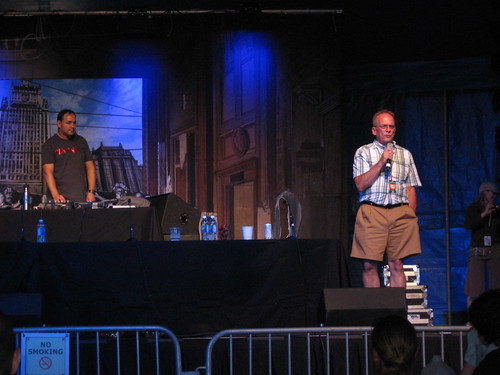
Get your mind out of the gutter. The "it" in the headline that Susan Tedeschi, currently on tour with her husband and bandmate Derek Trucks, is talking about is saving the planet. This is a family blog! But it's a great title, don't you think? Maybe if we're lucky, she'll make it the title of her next song.
Susan told me that it was time to stop talking about the planet and start doing something about it during a long, forthright, and at times very passionate interview at Rothbury on July 5. She doesn't pull any punches, and as you'll see, she tries very hard to practice what she preaches, setting up recycling stations on the tour bus, getting her home off the grid, and leading the charge for biodiesel on her tour. What she lacks in a sophisticated green touring campaign she more than makes up for in enthusiasm.
In fact, Susan's so excited about green stuff that before I could even get my first question out, she jumped in to tell me about her solar-powered home, which she shares with Derek and her two children. And when I tried to wrap things up, thinking she must be tired of talking, she turned the tables on me, asking me questions about how she could improve her touring practices. I'm still swooning!
Susan and Derek getting it on.
Susan Tedeschi: Derek and I have a solar powered home now.
Jason Turgeon: Excellent! Well, tell me about it.
ST: Derek actually is the one that knows. We looked at a bunch of different companies, but he's the one who ended up deciding because I had to go out of town. They came and they put 22 panels on the roof, at 31 degrees.
JT: Fantastic. Where is this in Florida?
ST: Jacksonville.
JT: Is it off the grid, or partially solar powered?
ST: It's tied in to the grid, so we use what we need, and the town puts it in a bank, so...
JT: So, it provides more power than you need?
ST: Yeah.
JT: Fantastic. So how about your touring--have you been doing any green touring?
ST: We have been doing a lot of discussing about it. The problem is having 23 people on tour on these buses and not having space. A lot of these buses are already pre-organized, the way the trashcan is or whatever. Our new idea is that we have a couple of drawers at the front, and I'm trying to turn those into recycle drawers. The one thing that drives me nuts more than anything on the road is water bottles and people just throwing them in the trash. Drives me nuts. I'm like, no, we're not doing that. We're putting them in the drawer, and then we're putting them in the [recycling bin]!
JT: Have you guys thought about doing the Rothbury thing where they just took away the water bottles and everyone has to bring a Nalgene?
ST: Well, we would, but we don't have time to go shopping, so people wouldn't be able to drink. You have to have water. But something else I've been thinking about is how to do biodiesel for the buses. I'm friends with Willie Nelson and his wife. Annie is really big on biodiesel. She has it for all her cars and for the tour bus. And I know Dave Mathews does, too, because I do Farm Aid with those guys. Every little bit, though, helps, anything.
JT: [Your publicist] told me that you were interested in Florida rivers.
ST: Yeah, the watersheds. I grew up in Massachusetts, and I was always part of the North River, that was the watershed [group] that I was always involved with and doing work with. And I've been getting involved with the St. John's Riverkeeper, and trying to keep that river healthy and trying to do whatever we can. Trying to write letters to everybody, mostly senators.
JT: Have you done any benefits?
ST: I have, I've done some benefits at the Cummer Museum in Jacksonville for [St. Johns Riverkeeper]. They have an oyster festival that I have done a few years. I'm trying to get more involved in it, I'm just really not home at all. I've been so busy, I haven't been home. But Derek and I have always been so curious about environmental things, always trying to look into it, that we've inspired his little sister to actually get on the phone and write letters to everybody from the mayor and governor as well as to the TV stations. She's trying to get all the public schools to recycle and also Alltel stadium, [which] doesn't recycle. So we're working on it.
JT: Have you worked with any of your other venues to get them to try and recycle?
ST: A lot of them actually have been. A lot of the venues are, and if we mention [that a venue doesn't recycle], then we'll get a trash can together and people at least start to try.
JT: Do you get a different kind of fan at your [solo shows] than you do in the festivals? Are they more of a traditional blues fan?
ST: Yeah.
JT: Are they into this stuff the same way that [this audience] is?
ST: Not as hip as the college kids or the younger kids.
JT: If you try to bring it up are they receptive to it?
ST: Some of them are, and some of them get all weird on me. "Why are you spreading your politics on me?" I get that a lot. Whenever I start talking about how we need to save the environment or be more aware. If everyone would take care of their own backyard, we wouldn't have all these problems. I try to get people to read Rachel Carson books. I'll turn 'em on to whatever I can. It's funny how people will try to label you all of a sudden, like "communist"...You're talking about things that are important and good for the planet.
JT: It sounds like you get a lot of resistance. Is it a generational thing or a regional thing?
ST: I do [get resistance]. It tends to be generational, I've noticed. It tends to be sixty and older, they're more set in their ways.
JT: So the message hasn't really sunk in.
ST: They don't believe in it. They don't think that global warming exists, they have their own arguments. It's just a different way of thinking, and I feel like I'm always trying to go up against these people that just aren't open-minded enough to it.
JT: What about when you tour with the Allman Brothers and those folks?
ST: Oh yeah, it's way easier. You know, the Grateful Dead and the Allman Brothers, they've been out pushing for these causes for 35 years. When I was out with the Dead, I remember one day [Bill] Kreutzmann [said] we've worked 30 years to get these things in place and George Bush comes in and in 2 years knocks out all the work we've done.
JT: Sometimes things have to get worse before they can get better. Sometimes that's how you get to the people who wouldn't believe it if it wasn't...
ST: Yeah, but all the way worse? Give me a break! But you're right. Some of the people who used to give me a hard time, now they're at least not...
JT: Would you say that the tide is starting to turn?
ST: I would, especially because of the George Bush years (laughing). I think that has made people rethink things.
JT: In your songs, do you have any kind of environmental message?
ST: Big time. I don't know if all of my songs are going on my record or not, because I've written a lot of songs. One song is called "Until the Earth Runs Dry." That's a song about everybody wanting it, always having it, needing it, but then all of a sudden in our life, in our generation, it's not always going to be there and it's not always affordable. Whether it's oil or water. It's one of those kind of songs. A lot of my songs are kind of political. One is called "Pack our Things and Go." It's about packing up our troops and having 'em come home and trying to take care of our own country.
JT: That's courageous. You're out there pushing that stuff even though your fans have said they don't want to hear it.
ST: Yeah, they don't want to hear it. I don't care. I have another song called "People." It's about people having a choice. One of the verses is "TV screens/corrupt magazines/a man on the radio who thinks he knows what you need/planting seeds/that just mislead/that can't be taken back." Because you have all these people that plant seeds in your head, and people start believing it. And it's not factual. You can't believe everything you read, unfortunately. You have to know who you're dealing with, what your source is. But people aren't even educated enough to know who to vote for.
JT: Do you do any stuff with Headcount or any of those groups?
ST: We used to do the Rock the Vote. We used to say come on and come to our shows and set up a table. Anybody environmental or trying to educate people to vote, that's all good.
JT: How about this festival, what do you think?
ST: I was so impressed, because when I went to catering, [they had] the utensils I love! They have the ones that are compostable, and everything was pretty much compostable or organic. It seemed like they had put thought into everything.
JT: Was that a consideration when you were booking this festival?
ST: I always want to be part of festivals like this, absolutely.
JT: Is Derek on the same page?
ST: Oh, big time. He's always picking on me, like, "OK miss environmental, you left a light on!" He's really big on making me practice what I preach. He doesn't let me get away with anything. Which is good, I like it.
JT: Anything else green you wanted to talk about?
ST: Well, I always have four or five [reusable bags] clipped onto my pocketbook. Look at China, they don't have plastic bags anymore, for a reason. I think it's good for us to be aware, but it's more important for us to actually start putting it into action. Once you start learning about what's good and what's not, let's do it. Let's stop talking about it. Let's get on it!
JT: What's the one thing you're not able to do right now that you wish you could?
ST: In my touring habits, I wish the trash, everything from the utensils--I wish we could get those on the riders. The problem is, we have to get whatever people have in their town. It would be way cooler if we could just [buy in bulk], but there's no room to store it. It would be cool if we could actually get some of those earth-friendly products in every town. I would really love it if we could make all the festivals like [Rothbury]. Some of the artists like Dave Matthews that have a big enough draw, they can make a difference if they start asking for it. It would be good if it was made more mandatory by the artists.
JT: So I think that's it.
ST: Well what can we do, as artists, to help?
JT: Keep putting the message out there. You have a lot of influence with people. Especially, you deal with an audience that's not used to it, you're not preaching to the choir. So if you can find a way to get through to them without upsetting them...it doesn't have to be a left wing/right wing thing. We all have to live on this planet.
ST: I try to move them.
JT: And if you can demonstrate things...if you do a show with refillable water bottles and a five gallon jug, and people see that you're not throwing away water bottles, even if they don't know it, you're having an influence on them.
ST: I have a jug that we got from Montana. Maybe we could get some for the whole band and we could do that.
Let's hope that next time you see Susan, she's got the whole crew switched over to refillable bottles. But even if she doesn't, make sure you see her--she puts on a great show! Here she is, belting out "Hey Jude" at their Rothbury set.
I'm still working through the backlog of interviews I did at Rothbury while simultaneously preparing for next weekend's action-packed Lollapalooza mayhem. Today, I bring you a transcription of my chat with Bud Ward on July 5.
Bud was picked to be one of the Think Tank panelists, and for good reason. He's had a long career as a journalist covering environmental issues, and the organizers at Rothbury were not at all shy about prodding those of us in the press tent to do a better job. He does things like sit on the board of the Applied Environmental Education and Communication scholarly journal, he is a former environmental commentator on NPR's Morning Edition, and he is the contest administrator for the Grantham Prize for environmental journalism, the world's most valuable (financially speaking) journalism honor. In other words, he's a big shot in the journalism world, and it was both an honor and a pleasure to get to know him. He's also not the kind of guy you would run into at any other music festival, and it was fascinating to watch guys from his world interact with people like Ken Jordan of the Crystal Method, who probably doesn't normally spend his days palling around with members of the editorial board of the AEEC. Hopefully we'll start to see the fruits of these new relationships play out in the form of a more overt environmental message from our favorite musicians and more entertaining coverage from the media.
Before we get into the meat of the interview, let me point you to the 2007 and 2008 winners of the Grantham Prize, two of the finest examples of environmental reporting you'll find, and both stellar in their use of multimedia. The 2007 piece from the LA Times covers the devastation we've unleashed on our oceans, and the 2008 winner from the NY Times dives into China's booming economy to see what the side effects are. And now, on with the show!
Bud Ward (foreground) and the Crystal Method's Ken Jordan at a Think Tank panel.
Jason Turgeon: For the readers of JamBase who probably don't know who you are, give us a brief bio.
Bud Ward: I edit a website on how the media cover global warming. That's my primary activity right now. I do a lot of training of journalists on covering climate change.
JT:And have you been happy with the way climate change has been covered the last couple of years?
BW: Well, I've been more happy in the last couple of years than I was previously. I think a big change is that the media has begun to focus on balancing evidence rather than balancing opinion. The earlier emphasis on balancing opinion gave equal time to a lot of opinion that wasn't scientifically based. I think more recently the media have begun to filter out the opinion, and particularly on covering the science issues, cover more of the evidence, not just the opinion. That's been a major change.
JT: In the music scene, we're kind of removed from this but it's finally coming to the point where we have festivals like this that are focusing on [climate change]. What can we as the media who are covering the music do to more effectively merge the two issues?
BW: I think one thing you can do is look back to the sixties. Look back to how the media covered the civil rights movement, look back to how they covered Vietnam. It's impossible for me as a sixty-year-old to think of growing up without the influence of Peter, Paul and Mary, and Woody Guthrie, and Bob Dylan and so forth. I had to laugh recently--I shouldn't say this--recently, my son-in-law and I were driving along and he mentioned Bob Seeger to me. And I said, "oh you mean Pete Seeger." And he said, "no, I mean Bob Seeger." Well I know who Bob Seeger is, but he said to me, "who's Pete Seeger." I was incredulous that he could not have heard of Pete Seeger, you know? I cut my teeth on him.
JT: Do you see any musicians that you've worked with here as being the new Pete Seegers for us?
BW: I've been very impressed with Michael Franti and Spearhead, not only with the music but the message that he delivered. Frankly, I had not been familiar with his music before. But he's the kind of artist that I've been introduced to here that I'll go back to iTunes and check out.
JT: Are you going to be able to see a show tonight?
BW: I sure am gonna be around. I'm going to catch as much of the music as I can. I enjoyed [Widespread Panic] last night. I enjoyed meeting [John Bell]. He and I were on a panel yesterday. He was very personable, very forgiving of me not having heard of his music. There again, I mentioned to my two sons-in-law, and they said if you have a choice to see Widespread Panic, definitely go. They were good.
JT: So is this your first music festival?
BW: It is the first. I missed Woodstock. Everyone my age wishes they'd gone to Woodstock. I'm not sure there will ever be another Woodstock, but this is as close as I'll ever come.
JT: Would you come back to something like this?
BW: Sure. I particularly appreciate the emphasis on a critical social issue. The global warming is phenomenally important issue. It's not only the most important environmental issue, in many ways it's the most important national security issue, it's the most important economic issue that our country faces, and it's a generational issue. My grandchildren and their grandchildren will be dealing with the aftermath if we don't handle this well and handle it quickly. It's a great issue to emphasize in this kind of forum.
JT: At an event like this, people really come here to have a good time. They don't want to be preached to. How are we doing with that? How do we strike a balance?
BW: The people who come to the workshops, the Think Tank meetings, have been kind of committed. I don't think we're converting many people, we're reinforcing them. Hopefully they'll go home with new ideas. We've tried to keep the message very upbeat and solutions oriented and opportunities oriented. The issue of global warming presents some enormous challenges, but also some enormous opportunities. So there are going to be real winners come out of this issue, and I hope many of these people here can be among the winners.
JT: If there was one thing you could tell the all these fans here, many of whom are just laymen with global warming and the environment in general, that was something doable for all these people, what would it be?
BW: I guess the first thing I would tell them is use transportation more strategically. If they have to make a trip and can combine three errands into one trip, it's a good idea. If they can walk or bicycle to it, if that's feasible for them, they should do it. If they can carpool or chainpool, that is combine errands into one trip, they should do it. There are other things that are obvious like the compact fluorescent bulbs that are clearly worth doing. Eating locally would be another key thing they could do.
JT: Are there any acts that you're looking forward to seeing?
BW: Of course I'm looking forward to seeing Dave Matthews, who I've heard so much about. That's the group I'm most familiar with. I'm also looking forward to seeing Citizen Cope. I've heard a lot about Citizen Cope, and my son-in-law won't forgive me if I miss [them]. I enjoyed the Drive-by-Truckers, I saw them yesterday and thought they were good. I especially appreciated learning about Spearhead.
JT: Is there anything you want to say to the younger, college-age community that makes up so much of this festival?
BW: Look for opportunities to combine doing well with doing good, because you can do both. This climate issue is going to be one of the biggest issues you're going to face in coming years. My generation hasn't done such a great job. We're looking for you to clean up after us. It's in your own best interests and you should do it. The other thing I wanted to do is put in a plug for Andy McKee. It's the most extraordinary technique I've ever seen. He's a spectacular guitar player and musician.
Bud put his own thoughts about Rothbury online here--they're worth checking out to see how it was perceived by someone outside of the festival scene. And how else could I close but with this a clip of Mr. McKee? Enjoy!
While I've so far struck out in my quest to get artists from Langerado to talk to me about their green actions, I did was lucky enough to spend some time on the phone the other day with Brian Allenby of Reverb, an tour greening consultancy. Founded in 2004 by Adam Gardner of Guster and his Lauren Sullivan, Reverb is a literal marriage of their joint passions for music and the environment. Before starting Reverb, Lauren worked for environmental organizations including the Rainforest Action Network, and Adam, is, well, in Guster, so this was a pretty natural extension of their twin passions. But this is way more than a pet project for a rock star's wife--Reverb has a large client list including luminaries like Dave Matthews and is growing by leaps and bounds.
Brian met Adam and Lauren when he was working for Native Energy, an outfit I profiled in my first interview for GreenBase. Before his work with Native Energy, Brian managed Star Hill, a 500 seat club in Charlottesville, VA and did other concert promotion in the area, so this position is obviously a perfect fit for him. Brian handles day-to-day management of operations for Reverb out of the company's Portland, Maine, offices. The shop has 4-5 people in the office all year, and as many as 6-8 people on the road during the summer season.
Jason Turgeon: What other acts besides Guster are you working with?
Brian Allenby: We're working with artists like John Mayer, the Fray, the Dave Matthew band, and this year, Jose Gonzalez, and Serj Tankian, the lead singer from System of a Down. We're working with a group called Sixth Man. They put out a lot of the rock cruises that go out. They do Rock Boat and Simple Man, which is a Lynard Skynard cruise. They actually book a ship back-to-back, so they end up with six weeks of cruises. The two we worked on were the Mayercraft Carrier, which is John Mayer's cruise, and Ships and Dip 3, which is Bare Naked Ladies and Guster.
JT: I hadn't realized there was such a demand for rock cruises.
BA: Yeah, they're pretty big. The boats we were on hold between 2500 and 2700 people. Cruise ships are tough. Inherently, they're not very environmentally friendly. So we did the carbon offset program, because there's no way to do biodiesel or anything like that. Last year, we were able to offset over 3000 tons of CO2 on the BNL cruise, which is the equivalent of taking over 500 cars off the road for a year. We also worked with the cruise line to do things like corn plastic straws, recycled toilet paper in the cabins, we had stony field organic yoghurt, and green mountain organic fair trade coffee.
JT: Has the cruise line been receptive?
BA: They've been very receptive. They're in a place where they can't continue to go on this way. There aren't going to be wonderful, beautiful places for them to visit if they don't help take care of it. They have an environmental officer on board each cruise and they take this seriously.
JT: So what does someone who works for you on one of the tours do in their day to day that makes the tour greener?
BA: We kind of call them our eco swat team. They're basically integrated right into the artist's crew. One of the first things they do when an artist rolls into the venue is coordinate biodiesel fuelings. They'll actually have a tanker truck come out to the venue and fuel all of the buses and trucks . It actually makes it easier for the band, because they don't have to stop through a truck stop later on when they're driving that night. They'll head on over to the catering area. A lot of the larger artists will actually have a caterer traveling with them. [A caterer we often use] already use[s] a lot of the biodegradable and compostable products like corn starch cups and potato starch bowls, that sort of thing.
JT: When you're using these products, do you actually sort them out so they don't end up back in the landfill?
BA: We try to as much as possible. A lot of venues are starting to compost, which is great. The Tweeter Center near you in Boston was one of the first. They compost everything. We walk outside the catering area and can just throw everything right in the compost. But one of the best things to do is not to use disposable products at all. That's really one thing we try to encourage. The best thing is to use china and silverware, but where we do have to use disposable stuff, we try to compost as much as possible.
[getting back to the job description] So then they'll put out the recycling bins, backstage, at the catering area, in the production offices. Then they'll work with either the promoter or a local recycling company to either drop off the recycling at the end of the show or have them come pick it up. Then during the day, it's setting up the eco-village, which is the fan interaction area. There are a number of tents we send out on the road. We'll have local and national environmental groups come out to promote, do fan carbon offsets. We try to make it as fun for people as we can, we'll have artists sign a guitar and do raffles, that sort of thing.
One of the other responsibiliites is training volunteers. On a larger tour we'll have 8-15 volunteers come out to a show, so we have to educate the volunteers.
JT: It sounds like these venues are pretty big places, like Tweeter. Do you do smaller clubs?
BA: We do some, like Jose Gonzalez this summer will be playing a lot of smaller venues. In those cases, it's hard for us to set up as much stuff just because there's not as much space, so we can't do an eco-village. We'll try to integrate our presence with their existing merchandise tables. But even though it's scaled back a bit, we're still there working on the same stuff.
JT: Do you find that venues are receptive?
BA: They're all very receptive. You'll find that venues, as we hit them two, three, four times over the course of a summer, they've started doing some of these things themselves. Live Nation's bulk paper purchases, their office paper, it's all 100% post-consumer recycled now. As they see how easy it is, they start making it part of their day-to-day operations, making it business as usual. We really haven't found anybody who is resistant to it at all.
JT: Do you find anyone that is so good that your work is done for you?
BA: We haven't found any places where there is no work to be done, but it's certainly become a lot easier. With the composting, we'll still have to provide the biodegradable products, but now there will at least be a compost bin for us to put them in. Everybody's taking steps. There's always a lot of work to do, and every time we clear one of those hurdles, we look forward and say, well what's the next thing? One thing we're really focusing on this summer is how do we encouraging carpooling and ride-sharing to a lot of these shows. Most of the shows are 20 to 30 miles outside of the population center, and there's very rarely any public transportation to these events. People don't want to have to drive 45 minutes home. It's a pain. Maybe there's an average of 2 people in a car, but that's still 10,000 cars. So we're really trying to figure out a way where we can work with the artist, with the venues, with some of the ride sharing groups. Looking at the environmental footprint of a show, probably 80% of the CO2 that's released is from fan transportation. You're looking at 10,000 cars traveling 60 miles roundtrip, that's 600,000 miles of driving. For one show.
JT: So are the fans receptive to this? Are they driving the bands to this? Or are the bands saying to the fans, "we want to be greener and so should you?"
BA: I think it's a combination of both. There are some artists who really, altruistically, feel that this is what they want to do. It's important to them, so they make that commitment to the environment, working with groups like us. It certainly doesn't hurt when there is a warm response from the fans. I think that most of the bands we work with, there is an artist, someone in the band, who goes to their management and says "we've got to do something about how we're touring." We are seeing great reactions from the fans. Just one artist on stage saying, "we're trying to take some steps to reduce our footprint on tour, go check out the eco-village," will drive huge traffic through the tents. We try to tie it in and incentivize the fans to do it as well, whether it's signed merch or some sort of thing like that to help further that connection between the artist and the fan. In the environmental action, everybody needs to be doing this together.
JT: Do you worry that people will feel like they're being preached to?
BA: We make a real effort to not preach at all. We have two sayings here. Thou shalt not be a buzzkill and thou shalt not preach. It's all about enhancing the experience, making it more fun for people. The last thing we want is an artist getting on stage and casting doom and gloom. People are there for a concert, first and foremost.
JT: What's the one challenge you keep running into over and over again?
BA: The carpooling. So many of these tours are based in these amphitheaters. What do you do about the traffic? That and keeping enough staff on board--we have so many artists coming to us, especially smaller artists, that we need to be better at educating people through our website. We're past the point now where we have to convince people to do this. Bands are coming to us now saying that they want to do this.
JT: That's a good problem to have.
BA: Exactly!
JT: How would you qualify success? What's the perfectly green tour look like to you?
BA: I want to see as many fans as I can walking away, taking at least one action in their daily lives. That's success for us. The real end goal is to educate the fans, using the artists and the media pull they have. Someone like Dave Matthews reaches three quarters of a million people on tour. Even if all of those people just change one light bulb or switch to reusable water bottles, that's a big difference. And we want to have a friendly competition between John Mayer and Dave Matthews, to see which tour can be greener.
JT: So what's in heavy rotation on your ipod?
BA: Let me tell you exactly, in itunes, I'll see what my play count is. Number one is a song "Start Anew," the artist is Watercolor off an album called Beautiful Mistakes. The artist, Joe, is in Guster as well.
Craig Minowa is a busy man. When he's not working at his day job for the Organic Consumers Association, he's running his non-profit CD-packaging business and record label, Earthology and riding a tour bus to get to shows with his band, Cloud Cult. Long-time readers might remember that we linked to an interview of him over at the inestimable Grist about 9 months ago. But with his reputation as one of the greenest musicians around, I thought we should do another interview with him for our legions of fans (that's you!).
I caught up with Craig late last week over the phone from the very pleasant sounding farm in Northern Minnesota that serves as his Batcave, complete with geothermal heating and cooling and a recording studio built from recycled bits and pieces.
Jason Turgeon: Start out by telling me how you got into the intersection of music and environmentalism.
Craig Minowa: It started out academically. I was not sure whether to go into environmental science or music. I decided to go with environmental science. It seemed like a better way to get into the green scene. Eventually that evolved into Cloud Cult and Earthology.
JT: How did Earthology start?
CM: Earthology started as a method to find an environmentally friendly cd package in the early 90's. Out of necessity, I researched the industry and found out how we could replicate cd's ourselves in an environmentally friendly way. Eventually, we started doing it for other folks.
JT: Like who? CM: There have been a lot of people. Some of the names you might recognize are Arlo Guthrie and Built To Spill for their Idaho Green album. We also do consulting for labels like Universal and rights orgs like ASCAP.
JT: Does it pay for itself?
CM: Earthology is not a moneymaker. It was built as a non-profit.
JT: What makes a CD packaged by Earthology different from a normal jewel box?
CM: In the original days, we used strictly recycled jewel cases that were donated by the thousands, collected from college campuses and individuals. People would buy CD's and put them in CD booklets and were looking for something to do with the jewel cases. We reused the ones that we could. The materials are all PVC and polycarbonate, so the unusable ones went to a landfill.
Then we branched off into looking for earth-friendly shrinkwrap. We now use LDPE, but we're branching off into corn-based cellulose. CD's in general are gradually getting into post-consumer waste. All of our printed products use vegetable based inks. More and more bands are interested in our 100% postconsumer recycled paper CD cases, although from a strictly ecological standpoint it's better to reuse a plastic case than use recycled paper. Pretty much the only thing that isn't environmentally friendly is the disc itself, which we're hoping will someday change.
JT: What else sets Earthology apart?
CM: Earthology itself is based on a farm, heated and cooled by geothermal waste. We also do things like figure out the amount of CO2 created by manufacturing and transport, etc., then we offset everything. And we plant 10 trees for every 1000 units sold.
JT: That must be a lot of trees. Do you have any idea how many?
CM: (laughing) It's a small forest by now. The trees are planted all over. We started at Earthology, planting the trees by ourselves, and then we moved into using non-profits like American Forests. It's tough to say how many we're responsible for, because we plant them in different areas and not all of the trees will survive.
JT: You also do work for the Organic Consumers Association. Tell me about your day job.
CM: I analyze new studies in different journals and put that into an easy to digest format for the common Joe and Jane out there. I focus on sustainable agriculture.
JT: And you're also a singer-songwriter with Cloud Cult. You must have a very patient boss to let you juggle all of this.
CM: Everything that I do is over the laptop and cell phone. On tour, I just do it in the van. We travel 6-8 hours a day between shows. It does mean that I don't get to rest as much in the van as I'd like.
JT: Tell me about the other members of the band. Have they been with you since the beginning, or is it a new group of people for each album and tour?
CM: A couple have stayed since the beginning, but we have had multiple bassists and violin players. The cello player and painters have been with us for a long time. The painters have been integrating themselves more musically, but predominantly focus on getting that piece of artwork finished in that 75 minute set. We auction off the art at the end of each set.
JT: You do a lot of driving. I know you use biodiesel, but there's a growing debate around the production of biofuels. What are your thoughts on this?
CM: Biodiesel is an ongoing study of its own. As we shift more towards biofuels, there is more of a debate about the agriculture behind biodiesel. With anything environmental, there is a constant struggle to make things better and making mistakes. It's the same thing with shows. You do a show, you try to do as much to make it environmentally friendly as possible, but 90% of the clubs don't have recycling.
JT: Have you been able to talk venues into doing more?
CM: It's starting to get to the point where we have a draw and get a bit more respect, but for the most part clubs don't want us telling them how to manage their venue.
JT: Are you the only one interested in green, or are the other members of the band involved?
CM: Connie, one of the painters, is my wife. For her day job, she does children's environmental health issues for indigenous people, so she's involved. The rest of the band are concerned about the environment, but not as much as we are.
JT: You do a lot of interviews. What's one thing you wish the media would discuss with you that they don't?
CM: There's still a stigma about being an environmental musician. When people read about it or hear about it, they assume you're a hippie jamband or going to be all preachy. It's actually the opposite. You can try an live your life environmentally and still be an average joe who's not wearing patchoulie. It's tiring to see reviewers who assume that we have 20-minute jams and who haven't listened to the cd. It's nice to see that start to change. Our audience is kind of the college indie-rock crowd, a lot of urban inner-city youth who were kind of cynical about what we were doing. They liked the music but they didn't care about the green stuff. That's changing, too.
JT: You say your audience is mostly urban inner-city college kids. Do you get any crossover into hip hop?
CM: We don't get much of the hip-hop audience. We do have a good variety of people coming to our shows, though. We have a lot of older people who end up coming to shows, sometimes full families. That seems to stem from the messaging behind the music. Connie and I lost our 2-year old son a few years ago. A lot of the music has stemmed from that grieving process. I think people with kids relate more to that.
JT: Filesharing is the most environmentally friendly way to distribute music. Pro or con?
CM: Digital music is the future of music and should be the future. In the early years we didn't mind the file-sharing. It's gotten to the point where we really feel it hit your pocketbook. Our last album release leaked about a month before it came out. It cost us thousands and thousands of dollars.
JT: Do you see it made up in tour revenues and t-shirts?
CM: Partially, but it's hard to say. It's my philosophy that if you listen to it a lot and you really like it, you should pay for it, but if you're just discovering it for the first time it's a good way to spread the word.
JT: What about the various proposals that have been floated to have voluntary music licensing for broadband users?
CM: I haven't heard of those. [JT describes the system.] That sounds interesting. It could work.
That wraps up the interview. Here's a very non-jamband-like video that clocks in at a mere 3:19 for the uninitiated.
Last week, I had the pleasure of spending more than an hour on the phone with Shanda Sansing, the person in charge of patron services and event greening for C3 Presents. You might not have heard of C3 Presents, but you definitely know their products. C3 is the production company behind Lollapalooza, Austin City Limits (ACL), the Big State country music festival, and one-half of the newly announced Vineland festival to be held in NJ next August.
Shanda is the driving force behind the greening of C3's events, but she's got the support of company management and Lollapalooza founder Perry Ferrell. This support has shown up in the recent greening initiatives at Lollapalooza, ACL, and to some extent at Big State. The company is actively looking to make 2008's events even greener. In our wide-ranging discussion, we talked about everything from the difficulties of using biodiesel to getting the audience to wash other people's dishes and how to best serve a plate of hot barbecue to a judge.
Perhaps the most exciting news on the greening front will come out of Vineland. Live Nation and C3 are teaming up with Festival Republic, the production company behind the UK's Glastonbury festival, perhaps the most successful festival in the world, to put on this event. Glastonbury has a long history of working towards a more just and sustainable world and has taken many steps to green its festivals over the years. Hopefully when we put the two together, we'll see something that will rival Peats Ridge in Australia in terms of its green credentials and positive social impact.
One thing that really jumped out at me from this interview was just how much work goes into greening these events. It is still far easier for someone putting on a festival do go about doing things business as usual. Greening a festival that's attended by 225,000 people is a huge task, one that requires not just money but a tremendous amount of time and energy. If you're a festival goer, make sure you take the time to thank the organizers and the volunteers who help make these shows happen as sustainably as possible.
Jason Turgeon: How did you end up involved in the greening efforts at C3?
Shanda Sansing: I manage the volunteer program and access program for people with disabilities. Part of volunteer program has always been recycling, so it was an extension of that work. It also happens that I'm very interested in greening, so this was a natural fit.
JT: You got a lot of good press for your greening campaign at Lollapalooza this year. Did you do the same thing for ACL? What are your plans for Vineland?
SS: We did the same sort of things for ACL as for Lollapalooza, there just wasn't as much of a media focus. It's too soon to know what we'll do with Vineland, but I assume that we'll have the same focus. Really and truly, the stuff we did was a matter of stepping back and taking a look at how we could better produce our events. Anybody could take these actions.
JT: What are some of the challenges you've had trying to green the festivals?
SS: One of the hardest things has been dealing with waste. You have to have control over everything that comes on to the site to ensure that you can dispose of it properly.
JT: Speaking of waste, did you use compostable cups at these events?
SS: We would really have liked to use compostable cups, even though they would cost us about four cents a cup, but a beer sponsor will normally give us non-recyclable #6 cups for free. But we heard from New Belgium beer that some of the compostable cups they were using were melting in the heat. All of our events our held in the hottest part of the summer, so we couldn't take that chance. There are also disposal issues. Even with a good staff of volunteers at all the waste stations directing people how to dispose of things properly, it can get very confusing.
But Blackstone Winery used compostable cups for their wine and had no problems. We've heard that some people store the cups with the beer kegs in refrigerated storage, although that can create a logistical issue when we have many beer stations. So we're going to take another look at these cups in the future.
Instead of using compostable cups, we had recycling incentives at Lollapalooza and ACL. We served beer out of 2 kinds of cups, #1 and #5. Number 1 is the less expensive disposable cup you're used to, and #5 is the kind of white souvenir cup that you see at football stadiums. We got people to collect stacks of cups and bring them to us for t-shirts and other prizes. The #5 cups got sleeved in a plastic sheath that had printed directions which asked people to take the cups home and wash them and reuse them. We were handing people stacks of dirty cups and we couldn't keep them in stock. People loved them. It was fun. Until it happened, I didn't know whether it would work or not.
JT: Wow, you actually got festival-goers to do someone else's dirty dishes. Aside from the cups, did you have a composting program at any of this year's events?
SS: We opted not to compost at Lollapalooza because the closest facility that could take food waste was in Wisconsin and it couldn't be integrated into regular waste management system. We have been working with a Chicago-based composting entity to build more capacity. We will be looking at that in the future. There are other issues with composting. It must be staffed, and you can't have any meat, or grease, or cheese mixed in. At the very least, we might be able to do it backstage. It is easier to do with caterers. Then we could have as few as 3 stations.
JT:There is a growing movement to get people away from bottled water and into reusable bottles like Nalgenes. Are you looking at doing anything like that?
SS: The problem with the hard plastic water bottles is that they can be used as a weapon, so there is a security concern. It was a big struggle even to get people to be allowed to bring in their own Nalgenes. So for now, we don't have a good solution to that problem.
JT: Did you use biodiesel at your festivals this summer?
SS: We use Blue Sun biofuels. We started this process a couple of years ago. There was a big learning curve. Many of the vendors' generators would have had their warranties negated by biofuels, but recent industry changes have permitted B20 mix, so we now use B20. We also use as much shore power as possible.
JT: How about solar-powered stages? I know that Sustainable Waves is also located in Austin.
SS: We have not done anything with solar stages, but we have talked to Sustainable Waves. Their stages are not large enough for even the smallest stage we use--not even the kids area at ACL or Lollapalooza. The biggest stage is 16 x 24. But hopefully someday we'll get to a point where we can use a solar stage.
JT: What about your water and wastewater use and treatment at the festivals? Do you reuse any of the greywater or do anything else special?
SS: I have a strong interest in these issues because when I was a peace corps volunteer I built rainwater catchment systems in the Dominican Republic. The village I was working in had a irrigation canal, but we had to hike a mile to get clean drinking water. We do as much as we can at the festivals. The ACL production area is hooked into city water. Austin does not allow graywater reuse, because there are worries about contaminating the groundwater table. We are obligated to collect gray and black water from our vendors, as well as grease. Grease is collected by outside vendors for reuse. We still use regular portolets. We're open to anything that can help us manage our water and wastewater use.
JT: This year you held Big State, your first camping festival and your first strictly country music festival. Did you put the same amount of work into greening this festival?
SS: We did a lot of stuff behind the scenes. It was a great festival. It was in the middle of an oval race track, and we had a car race each day. We also had things like a barbecue competition. People loved it and we had a great time, but with things like a barbecue competition and car races, it was difficult to really make any big claims about being green.
One of the hardest things was the barbecue. People come to compete and they spend hundreds of dollars to be there. The way these things work is that at the last minute, everyone puts their food on styrofoam and they rush it up to the judges because they want the food to be as hot as possible. We tried as hard as we could, but we could not find a good alternative to styrofoam that would keep the judges and contestants happy, so we had to go with styrofoam plates for the competition.
There were some other things that we wanted to do but we couldn't because the festival was in Bryan College Station, a small town about 2 hours outside of Houston. There were no facilities that could offer us composting or biodiesel, for instance. But we did as much as we could. We had basic recycling. All of the beer was served in cans, which made it easier to recycle. We did carbon offsets and had a display area with greening info for the patrons.
JT: Do you talk to other production companies about what they do to green their events?
SS: Sure, we're generally on pretty good terms. It's like the corner with four car dealerships. They're competing, but they also help each other out by being there and drawing more people to the area. We've talked a little bit with the folks who run South by Southwest, but with 150 venues, it's very hard for them to manage this kind of thing. We've talked to the folks at Bonnaroo. They helped us out with the biodiesel, told us about their experiences with some of the generators shutting down at first because the biodiesel is so much cleaner it was cleaning the deposits in the engines and clogging the filters. So now we have lots of extra filters on hand.
JT: What are some other things you do to green your events?
SS: We try to integrate it into everything we do. For instance, all of our volunteer shirts were organic cotton. We wanted to support these industries, the organic cotton, the bamboo shirts. And we have things like Green Street at Lollapalooza. Green Mountain Energy handles all of our offsets for us. We offset everything we do, including the office and all of our travel.
Kelley Stoltz and I sat down with Meet the Planet and discussed the greening of his record, Below the Branches and his plans to green his next record--due out on Sub Pop Records in a couple months. Listen here