Get your mind out of the gutter. The "it" in the headline that Susan Tedeschi, currently on tour with her husband and bandmate Derek Trucks, is talking about is saving the planet. This is a family blog! But it's a great title, don't you think? Maybe if we're lucky, she'll make it the title of her next song.
Susan told me that it was time to stop talking about the planet and start doing something about it during a long, forthright, and at times very passionate interview at Rothbury on July 5. She doesn't pull any punches, and as you'll see, she tries very hard to practice what she preaches, setting up recycling stations on the tour bus, getting her home off the grid, and leading the charge for biodiesel on her tour. What she lacks in a sophisticated green touring campaign she more than makes up for in enthusiasm.
In fact, Susan's so excited about green stuff that before I could even get my first question out, she jumped in to tell me about her solar-powered home, which she shares with Derek and her two children. And when I tried to wrap things up, thinking she must be tired of talking, she turned the tables on me, asking me questions about how she could improve her touring practices. I'm still swooning!
Susan and Derek getting it on.
Susan Tedeschi: Derek and I have a solar powered home now.
Jason Turgeon: Excellent! Well, tell me about it.
ST: Derek actually is the one that knows. We looked at a bunch of different companies, but he's the one who ended up deciding because I had to go out of town. They came and they put 22 panels on the roof, at 31 degrees.
JT: Fantastic. Where is this in Florida?
ST: Jacksonville.
JT: Is it off the grid, or partially solar powered?
ST: It's tied in to the grid, so we use what we need, and the town puts it in a bank, so...
JT: So, it provides more power than you need?
ST: Yeah.
JT: Fantastic. So how about your touring--have you been doing any green touring?
ST: We have been doing a lot of discussing about it. The problem is having 23 people on tour on these buses and not having space. A lot of these buses are already pre-organized, the way the trashcan is or whatever. Our new idea is that we have a couple of drawers at the front, and I'm trying to turn those into recycle drawers. The one thing that drives me nuts more than anything on the road is water bottles and people just throwing them in the trash. Drives me nuts. I'm like, no, we're not doing that. We're putting them in the drawer, and then we're putting them in the [recycling bin]!
JT: Have you guys thought about doing the Rothbury thing where they just took away the water bottles and everyone has to bring a Nalgene?
ST: Well, we would, but we don't have time to go shopping, so people wouldn't be able to drink. You have to have water. But something else I've been thinking about is how to do biodiesel for the buses. I'm friends with Willie Nelson and his wife. Annie is really big on biodiesel. She has it for all her cars and for the tour bus. And I know Dave Mathews does, too, because I do Farm Aid with those guys. Every little bit, though, helps, anything.
JT: [Your publicist] told me that you were interested in Florida rivers.
ST: Yeah, the watersheds. I grew up in Massachusetts, and I was always part of the North River, that was the watershed [group] that I was always involved with and doing work with. And I've been getting involved with the St. John's Riverkeeper, and trying to keep that river healthy and trying to do whatever we can. Trying to write letters to everybody, mostly senators.
JT: Have you done any benefits?
ST: I have, I've done some benefits at the Cummer Museum in Jacksonville for [St. Johns Riverkeeper]. They have an oyster festival that I have done a few years. I'm trying to get more involved in it, I'm just really not home at all. I've been so busy, I haven't been home. But Derek and I have always been so curious about environmental things, always trying to look into it, that we've inspired his little sister to actually get on the phone and write letters to everybody from the mayor and governor as well as to the TV stations. She's trying to get all the public schools to recycle and also Alltel stadium, [which] doesn't recycle. So we're working on it.
JT: Have you worked with any of your other venues to get them to try and recycle?
ST: A lot of them actually have been. A lot of the venues are, and if we mention [that a venue doesn't recycle], then we'll get a trash can together and people at least start to try.
JT: Do you get a different kind of fan at your [solo shows] than you do in the festivals? Are they more of a traditional blues fan?
ST: Yeah.
JT: Are they into this stuff the same way that [this audience] is?
ST: Not as hip as the college kids or the younger kids.
JT: If you try to bring it up are they receptive to it?
ST: Some of them are, and some of them get all weird on me. "Why are you spreading your politics on me?" I get that a lot. Whenever I start talking about how we need to save the environment or be more aware. If everyone would take care of their own backyard, we wouldn't have all these problems. I try to get people to read Rachel Carson books. I'll turn 'em on to whatever I can. It's funny how people will try to label you all of a sudden, like "communist"...You're talking about things that are important and good for the planet.
JT: It sounds like you get a lot of resistance. Is it a generational thing or a regional thing?
ST: I do [get resistance]. It tends to be generational, I've noticed. It tends to be sixty and older, they're more set in their ways.
JT: So the message hasn't really sunk in.
ST: They don't believe in it. They don't think that global warming exists, they have their own arguments. It's just a different way of thinking, and I feel like I'm always trying to go up against these people that just aren't open-minded enough to it.
JT: What about when you tour with the Allman Brothers and those folks?
ST: Oh yeah, it's way easier. You know, the Grateful Dead and the Allman Brothers, they've been out pushing for these causes for 35 years. When I was out with the Dead, I remember one day [Bill] Kreutzmann [said] we've worked 30 years to get these things in place and George Bush comes in and in 2 years knocks out all the work we've done.
JT: Sometimes things have to get worse before they can get better. Sometimes that's how you get to the people who wouldn't believe it if it wasn't...
ST: Yeah, but all the way worse? Give me a break! But you're right. Some of the people who used to give me a hard time, now they're at least not...
JT: Would you say that the tide is starting to turn?
ST: I would, especially because of the George Bush years (laughing). I think that has made people rethink things.
JT: In your songs, do you have any kind of environmental message?
ST: Big time. I don't know if all of my songs are going on my record or not, because I've written a lot of songs. One song is called "Until the Earth Runs Dry." That's a song about everybody wanting it, always having it, needing it, but then all of a sudden in our life, in our generation, it's not always going to be there and it's not always affordable. Whether it's oil or water. It's one of those kind of songs. A lot of my songs are kind of political. One is called "Pack our Things and Go." It's about packing up our troops and having 'em come home and trying to take care of our own country.
JT: That's courageous. You're out there pushing that stuff even though your fans have said they don't want to hear it.
ST: Yeah, they don't want to hear it. I don't care. I have another song called "People." It's about people having a choice. One of the verses is "TV screens/corrupt magazines/a man on the radio who thinks he knows what you need/planting seeds/that just mislead/that can't be taken back." Because you have all these people that plant seeds in your head, and people start believing it. And it's not factual. You can't believe everything you read, unfortunately. You have to know who you're dealing with, what your source is. But people aren't even educated enough to know who to vote for.
JT: Do you do any stuff with Headcount or any of those groups?
ST: We used to do the Rock the Vote. We used to say come on and come to our shows and set up a table. Anybody environmental or trying to educate people to vote, that's all good.
JT: How about this festival, what do you think?
ST: I was so impressed, because when I went to catering, [they had] the utensils I love! They have the ones that are compostable, and everything was pretty much compostable or organic. It seemed like they had put thought into everything.
JT: Was that a consideration when you were booking this festival?
ST: I always want to be part of festivals like this, absolutely.
JT: Is Derek on the same page?
ST: Oh, big time. He's always picking on me, like, "OK miss environmental, you left a light on!" He's really big on making me practice what I preach. He doesn't let me get away with anything. Which is good, I like it.
JT: Anything else green you wanted to talk about?
ST: Well, I always have four or five [reusable bags] clipped onto my pocketbook. Look at China, they don't have plastic bags anymore, for a reason. I think it's good for us to be aware, but it's more important for us to actually start putting it into action. Once you start learning about what's good and what's not, let's do it. Let's stop talking about it. Let's get on it!
JT: What's the one thing you're not able to do right now that you wish you could?
ST: In my touring habits, I wish the trash, everything from the utensils--I wish we could get those on the riders. The problem is, we have to get whatever people have in their town. It would be way cooler if we could just [buy in bulk], but there's no room to store it. It would be cool if we could actually get some of those earth-friendly products in every town. I would really love it if we could make all the festivals like [Rothbury]. Some of the artists like Dave Matthews that have a big enough draw, they can make a difference if they start asking for it. It would be good if it was made more mandatory by the artists.
JT: So I think that's it.
ST: Well what can we do, as artists, to help?
JT: Keep putting the message out there. You have a lot of influence with people. Especially, you deal with an audience that's not used to it, you're not preaching to the choir. So if you can find a way to get through to them without upsetting them...it doesn't have to be a left wing/right wing thing. We all have to live on this planet.
ST: I try to move them.
JT: And if you can demonstrate things...if you do a show with refillable water bottles and a five gallon jug, and people see that you're not throwing away water bottles, even if they don't know it, you're having an influence on them.
ST: I have a jug that we got from Montana. Maybe we could get some for the whole band and we could do that.
Let's hope that next time you see Susan, she's got the whole crew switched over to refillable bottles. But even if she doesn't, make sure you see her--she puts on a great show! Here she is, belting out "Hey Jude" at their Rothbury set.
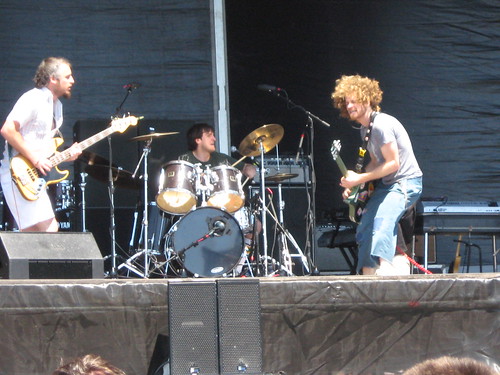
State Radio performing their new megahit "Recycle or Die" at Rothbury
I had a chance to talk to State Radio briefly at Rothbury about their upcoming bike-friendly show in Boston, the Story of Benjamin Darling, and their upcoming new megahit, Recycle or Die. To cap it off, I ran into Julie from Earphoria, who has been collecting fantastic acoustic sets backstage with musicians for the past couple of years. She got a few songs from State Radio at Langerado and was kind enough to lend me one to wrap up this post. Enjoy!
Jason Turgeon: Since we only have about 10 minutes, let's jump right in and talk about the bike thing. That was kind of out of left field for us in the Boston scene. You're known for being political but not necessarily known for being environmentally leaning. How did the whole bike thing happen?
Chad Urmston: I guess usually the political and the environment sort of go hand in hand. So we're always trying to figure out...we offset our tours and try to get our carbon footprint as minimal as possible. But Bikes Not Bombs was a way to...we know bands like Radiohead did an impact study, and the greatest footprint was from fans coming to the shows and all the carbon emissions from the vehicles, so one of the things to try to combat that was to think about different ways of transportation. Obviously, Bikes Not Bombs is a great organization and one that we felt we could team up with to try to swing the pendulum, especially as gas prices get higher and higher.
JT: Did you know those guys already, or did you approach them for this?
CU: We approached them for this. We didn't really know them. But there's going to be a bunch of things at that show, a bunch of different foundations, both politically aware and environmentally aware.
JT: Is this something you're going to try to repeat at different shows?
CU: We'll see how it goes. I think we'd like to...we just got off the justice tour with Tom Morello, and he did something where we did a service day, and then the next day we would do a show. So it's cool to have the message in the music and to have things at the merch table, but it's even cooler to actually do something.
JT: How was the venue to work with? Were they cool about it or were they resistant to it?
CU: They were totally cool.
JT: Is this the kind of thing you think they might do again after you leave?
CU: It depends. It's logistically sort of a nightmare. It's like, it's 11:00 or 11:30, and people are on their bikes and where are they going, and do people have their helmets, and do they have reflectors...I'm not sure, we'll see how it goes.
JT: I was [at Montreal Jazz Fest] and they just had bike storage all around the perimeters, gated off with big floodlights.
CU: I think the international community is way more bike aligned than we are, especially when we've been to Europe.
Mike "Mad Dog" Najarian: Wrigley Field in Chicago has got a nice bike storage center. They're pretty bike friendly there.
JT: When you do your tours, do you think "I don't want to play Tweeter because the only way for everybody to get there is to sit in traffic?" Do you look for venues that are closer to public transportation?
CU: Yeah, that's the idea. I don't think we have in the past because we haven't been big enough. We haven't had the luxury of being choosers, but as we move forward, we're trying to be as green as we can. We're traveling around now in a van, and we're getting a biodiesel fill up this afternoon. We feel like we're doing OK but we could always do better.
JT: How about [Rothbury]. Was the green side of this festival a draw for you or was it just another gig?
MD: Yeah, definitely.
JT: Are the other artists that you're talking to into this?
MD: Franti was doing a Think Tank today.
CU: He's signing his book, too.
JT: Are the fans OK with this? They obviously like hearing the political side. Do they respond to you guys when you do green stuff?
Chuck Fay: We'll see in Boston. See how many people ride their BMX down.
CU: We just found out that Ed Vedder is doing a solo show down the street, so he might ride with us.
JT: I'll put it in the blog. We're calling Eddie out!
MD: Ride with us, Eddie!
JT: Anything else that you want to talk about?
MD: I got my solar backpack (holds up bag). So I'm off the grid.
JT: So we'll switch to just music. Is there going to be a story of Benjamin Darling, Part 2? I want to find out what happens.
MD: Definitely.
CU: It's not so uplifting. But it's interesting. I felt like Part 1 is pretty uplifting, it's a nice story. But generations later, it gets worse.
JT: Do you have plans to write any environmentally-themed stuff?
CU: We have one song called "As With Gladness," we'll be playing it today. It sort of personifies the earth, sort of Mother Nature giving herself over to mankind, and how mankind sort of betrays her gift. The message is a little subtle.
CF: Which is cool, we don't want to get out there and be you know...trees!
MD: [singing} Recycle...or die!
CU: That sounded pretty good. Whoa, whoa! Is this recording?
CF: Send that over, JamBase!
CU: [singing] Recycle...or die!
JT: I'll put a little clip of that up there. The new hit from State Radio, Recycle or Die.
CU: The new megahit.
CF: ROD, as we like to call it.
That's it--thanks again to State Radio for taking the time to talk to me, and to Julie and the Earphoria.net crew for letting us share! Look for more great acoustic stuff from Earphoria as I do more interviews. Meanwhile, enjoy the music below, and first one to get me a picture of Eddie Vedder on his bike gets a free prize...
I spent a little over half of Earth Hour listening to Jose Gonzalez’s new album, In Our Nature on my battery-powered CD walkman--which is ironic because the chorus of the second song goes “don’t let the darkness eat you up, don’t let the darkness eat you up…” Well, I didn’t.
The candlelight flickered, and for a little over 33 minutes, I was transported to someplace warm and nice where people are thoughtful, proactive, and effective. Truth be told, I was probably thinking about the artist himself and reflecting on the great conversation we had regarding the greening of his tour. I had the chance to talk with him while he walked around the streets of Portland.
In January, Jose’s record label, Mute, announced the onset of his green tour. Through an innovative partnership with Reverb (see Jason’s interview with Reverb here) and Native Energy, Jose’s fans can opt to add fifty cents to their ticket price to support Reverb’s greening efforts. Similar to Andrew Bird’s tour, fans can purchase carbon offsets to green their travel to and from the show and wear a custom sticker that shows their friends what they did.
Here are some snippets from my interview with Jose: SK: How did the idea for your green tour begin? JG: It was an idea from my manager, but straight away I thought it was a good idea. I went to Reverb’s website and checked out the work they did with other artists. As a person living in Sweden, it’s very easy to recycle or take the tram or ride a bike. It’s very easy to recycle—every building has receptacles for separating litter. But, when you’re on tour it’s very difficult. Reverb worked with the venues and worked out transportation by bus and that sort of thing. They made it easy.
SK: Do you find that some countries or even cities are better about that stuff? JG: On this tour, we’ve had luck recycling bottles and paper. Before this, everything went in the same place. In Sweden, it is more common to find places to separately recycle litter.
SK: I hear you guys all have water bottles that you refill? JG: I decided not to do that. The plan was to make new bottles, and I didn’t think that it was practical. If you have your own bottle already, you can just use that. My crew gets the big water jugs and takes the water from there and we refill the jugs with tap water from the cities we go to.
SK: You’re doing quite a bit more than most artists by greening the footprint of your tour and building in a 50 cent price onto the ticket that goes towards Reverb’s greening efforts. JG: I’m not sure if this tour is completely carbon neutral, I think the ambition should be to do as much as you can.
SK: Was it a choice for you to do the greening or to write songs about being environmentally responsible? You’ve decided to lead by example instead of penning songs with lyrics about recycling or being carbon neutral… JG: (laughs) I don’t think you need to be creative to write a song about that and make it creative. In general, I try to be pretty vague about my songs. I like the idea of art being art and being able to say whatever you like and not be too moralistic—it’s about the enjoyment. I like the feeling of urgency in the music. I don’t like the part of it where you’re pointing your finger and saying how things should be.
SK: I think going about it the way you have is most effective. JG: Many other artists have done this and the more people that show they are willing to do this with economic sacrifice will get things moving in the right direction. This has an important ripple effect.
SK: Absolutely. Do you have any advice for other musicians or fans? JG: I like the idea of looking up information about things and not doing things because you have to. The environment is a really good place to exercise that and figure out what you can do without getting caught up in little details.
Jose's tour continues, check the GreenBase sidebar (upper right-hand corner) to see when he'll visit a town near you. Here is a video for my favorite track off In Our Nature, called "Down the Line."
While I've so far struck out in my quest to get artists from Langerado to talk to me about their green actions, I did was lucky enough to spend some time on the phone the other day with Brian Allenby of Reverb, an tour greening consultancy. Founded in 2004 by Adam Gardner of Guster and his Lauren Sullivan, Reverb is a literal marriage of their joint passions for music and the environment. Before starting Reverb, Lauren worked for environmental organizations including the Rainforest Action Network, and Adam, is, well, in Guster, so this was a pretty natural extension of their twin passions. But this is way more than a pet project for a rock star's wife--Reverb has a large client list including luminaries like Dave Matthews and is growing by leaps and bounds.
Brian met Adam and Lauren when he was working for Native Energy, an outfit I profiled in my first interview for GreenBase. Before his work with Native Energy, Brian managed Star Hill, a 500 seat club in Charlottesville, VA and did other concert promotion in the area, so this position is obviously a perfect fit for him. Brian handles day-to-day management of operations for Reverb out of the company's Portland, Maine, offices. The shop has 4-5 people in the office all year, and as many as 6-8 people on the road during the summer season.
Jason Turgeon: What other acts besides Guster are you working with?
Brian Allenby: We're working with artists like John Mayer, the Fray, the Dave Matthew band, and this year, Jose Gonzalez, and Serj Tankian, the lead singer from System of a Down. We're working with a group called Sixth Man. They put out a lot of the rock cruises that go out. They do Rock Boat and Simple Man, which is a Lynard Skynard cruise. They actually book a ship back-to-back, so they end up with six weeks of cruises. The two we worked on were the Mayercraft Carrier, which is John Mayer's cruise, and Ships and Dip 3, which is Bare Naked Ladies and Guster.
JT: I hadn't realized there was such a demand for rock cruises.
BA: Yeah, they're pretty big. The boats we were on hold between 2500 and 2700 people. Cruise ships are tough. Inherently, they're not very environmentally friendly. So we did the carbon offset program, because there's no way to do biodiesel or anything like that. Last year, we were able to offset over 3000 tons of CO2 on the BNL cruise, which is the equivalent of taking over 500 cars off the road for a year. We also worked with the cruise line to do things like corn plastic straws, recycled toilet paper in the cabins, we had stony field organic yoghurt, and green mountain organic fair trade coffee.
JT: Has the cruise line been receptive?
BA: They've been very receptive. They're in a place where they can't continue to go on this way. There aren't going to be wonderful, beautiful places for them to visit if they don't help take care of it. They have an environmental officer on board each cruise and they take this seriously.
JT: So what does someone who works for you on one of the tours do in their day to day that makes the tour greener?
BA: We kind of call them our eco swat team. They're basically integrated right into the artist's crew. One of the first things they do when an artist rolls into the venue is coordinate biodiesel fuelings. They'll actually have a tanker truck come out to the venue and fuel all of the buses and trucks . It actually makes it easier for the band, because they don't have to stop through a truck stop later on when they're driving that night. They'll head on over to the catering area. A lot of the larger artists will actually have a caterer traveling with them. [A caterer we often use] already use[s] a lot of the biodegradable and compostable products like corn starch cups and potato starch bowls, that sort of thing.
JT: When you're using these products, do you actually sort them out so they don't end up back in the landfill?
BA: We try to as much as possible. A lot of venues are starting to compost, which is great. The Tweeter Center near you in Boston was one of the first. They compost everything. We walk outside the catering area and can just throw everything right in the compost. But one of the best things to do is not to use disposable products at all. That's really one thing we try to encourage. The best thing is to use china and silverware, but where we do have to use disposable stuff, we try to compost as much as possible.
[getting back to the job description] So then they'll put out the recycling bins, backstage, at the catering area, in the production offices. Then they'll work with either the promoter or a local recycling company to either drop off the recycling at the end of the show or have them come pick it up. Then during the day, it's setting up the eco-village, which is the fan interaction area. There are a number of tents we send out on the road. We'll have local and national environmental groups come out to promote, do fan carbon offsets. We try to make it as fun for people as we can, we'll have artists sign a guitar and do raffles, that sort of thing.
One of the other responsibiliites is training volunteers. On a larger tour we'll have 8-15 volunteers come out to a show, so we have to educate the volunteers.
JT: It sounds like these venues are pretty big places, like Tweeter. Do you do smaller clubs?
BA: We do some, like Jose Gonzalez this summer will be playing a lot of smaller venues. In those cases, it's hard for us to set up as much stuff just because there's not as much space, so we can't do an eco-village. We'll try to integrate our presence with their existing merchandise tables. But even though it's scaled back a bit, we're still there working on the same stuff.
JT: Do you find that venues are receptive?
BA: They're all very receptive. You'll find that venues, as we hit them two, three, four times over the course of a summer, they've started doing some of these things themselves. Live Nation's bulk paper purchases, their office paper, it's all 100% post-consumer recycled now. As they see how easy it is, they start making it part of their day-to-day operations, making it business as usual. We really haven't found anybody who is resistant to it at all.
JT: Do you find anyone that is so good that your work is done for you?
BA: We haven't found any places where there is no work to be done, but it's certainly become a lot easier. With the composting, we'll still have to provide the biodegradable products, but now there will at least be a compost bin for us to put them in. Everybody's taking steps. There's always a lot of work to do, and every time we clear one of those hurdles, we look forward and say, well what's the next thing? One thing we're really focusing on this summer is how do we encouraging carpooling and ride-sharing to a lot of these shows. Most of the shows are 20 to 30 miles outside of the population center, and there's very rarely any public transportation to these events. People don't want to have to drive 45 minutes home. It's a pain. Maybe there's an average of 2 people in a car, but that's still 10,000 cars. So we're really trying to figure out a way where we can work with the artist, with the venues, with some of the ride sharing groups. Looking at the environmental footprint of a show, probably 80% of the CO2 that's released is from fan transportation. You're looking at 10,000 cars traveling 60 miles roundtrip, that's 600,000 miles of driving. For one show.
JT: So are the fans receptive to this? Are they driving the bands to this? Or are the bands saying to the fans, "we want to be greener and so should you?"
BA: I think it's a combination of both. There are some artists who really, altruistically, feel that this is what they want to do. It's important to them, so they make that commitment to the environment, working with groups like us. It certainly doesn't hurt when there is a warm response from the fans. I think that most of the bands we work with, there is an artist, someone in the band, who goes to their management and says "we've got to do something about how we're touring." We are seeing great reactions from the fans. Just one artist on stage saying, "we're trying to take some steps to reduce our footprint on tour, go check out the eco-village," will drive huge traffic through the tents. We try to tie it in and incentivize the fans to do it as well, whether it's signed merch or some sort of thing like that to help further that connection between the artist and the fan. In the environmental action, everybody needs to be doing this together.
JT: Do you worry that people will feel like they're being preached to?
BA: We make a real effort to not preach at all. We have two sayings here. Thou shalt not be a buzzkill and thou shalt not preach. It's all about enhancing the experience, making it more fun for people. The last thing we want is an artist getting on stage and casting doom and gloom. People are there for a concert, first and foremost.
JT: What's the one challenge you keep running into over and over again?
BA: The carpooling. So many of these tours are based in these amphitheaters. What do you do about the traffic? That and keeping enough staff on board--we have so many artists coming to us, especially smaller artists, that we need to be better at educating people through our website. We're past the point now where we have to convince people to do this. Bands are coming to us now saying that they want to do this.
JT: That's a good problem to have.
BA: Exactly!
JT: How would you qualify success? What's the perfectly green tour look like to you?
BA: I want to see as many fans as I can walking away, taking at least one action in their daily lives. That's success for us. The real end goal is to educate the fans, using the artists and the media pull they have. Someone like Dave Matthews reaches three quarters of a million people on tour. Even if all of those people just change one light bulb or switch to reusable water bottles, that's a big difference. And we want to have a friendly competition between John Mayer and Dave Matthews, to see which tour can be greener.
JT: So what's in heavy rotation on your ipod?
BA: Let me tell you exactly, in itunes, I'll see what my play count is. Number one is a song "Start Anew," the artist is Watercolor off an album called Beautiful Mistakes. The artist, Joe, is in Guster as well.
I was lucky enough to spend an hour with Kelly Viau, Bryan Birch, John Long, and Lucas Erickson for an interview earlier today. Kelly works for two separate companies that share several employees. Not only does she handle sponsorships for Cloud 9 Adventures, the production company behind JamCruise and Caribbean Holidaze, but she also works for Langerado, the rapidly growing music festival coming up next month at Big Cypress Seminole Reservation outside of Fort Lauderdale.
John, Bryan, and Lucas are the three founders of ZeroHero Events, an event greening service based in Fort Collins, CO, that is helping to green both Jam Cruise and Langerado. When they're not greening other people's festivals, they're dreaming up ways to make their own festival greener. Now in its 9th year, the Rocky Mountain Sustainable Living Fair is expected to draw 10,000 people and 150 vendors this summer, and the ZeroHero crew is working hard to draw a few big-name bands to the event this September. Bryan handles the education component of ZeroHero's events, John is the renewable energy guru and founder of Blue Sun Biodiesel, and Lucas works to make sure mountains of waste aren't left behind.
An hour wasn't nearly enough time for me to ask all the pressing questions I had about how the team has tackled the big job of greening these festivals, but we gave it our best shot. Our conversation ranged from the best species of mustard to use for sustainable biodiesel production to the pressing need for condoms on a tiny tropical island off the coast of Honduras. Enjoy!
Jason Turgeon:Tell me about the relationship between ZeroHero and Kelly's work.
Bryan Birch: We came on almost a year ago to help reach new heights by improving to improve the practices of the cruise ship, which was a really interesting venture. We further developed a recycling program and focused on using more sustainable products. The Jam Cruise “Leaving a Positive Legacy Program” was a huge success this year. We offloaded three pallets of school supplies for school kids in Roatan and condoms for an AIDS clinic there working with Trojan as a sponsor. Kelly helped out with pulling sponsors like Trojan in. We're trying to develop a positive legacy with JamCruise. That's also an important part of the process for us in all our work. In festivals, there's an incredible wealth of talent and resources both from artists and passengers. There's a very conscious crowd in the scene, and everyone is always willing to help out.
Kelly Viau: The greening program on JamCruise has been part of the event since the first year, and is led by the vision of Ann Kenworthy. [note: the most recent event was JamCruise 6]. For a number of years we worked with Rock the Earth. This past year we made the move to bring in ZeroHero to bring some of these programs to the next level. It's something that's sort of developed over the last six years.
Lucas Erickson: It's an evolution, it's a process, where every year we try to continue to improve what's taken place next year.
JT: How does your choice of a particular ship or cruise line impact your ability to green the JamCruise event each year?
BB: This year with MSC, they valued us a customer so much that they opened up support for us for the 5 day cruise. They gave us a great deal of access, and we had a lot of support from the cruise staff.
JT: Do you think what you're doing is carrying over to other cruises after your event is done?
KV: I think it absolutely impacts the way they approach other cruises. This will be our fourth year with MSC. We're starting to see littlle changes throughout their other cruises. They're not huge steps for people like us that think about this every day, but they're big steps for an organization that doesn't. A little bit really goes a long way. We're now starting to see at least an open conversation on using biodiesel on cruise ships.
JT: Moving on to Langerado, now that you're in Big Cypress, what do you have planned from a green perspective?
BB: We have a set of messages to help improve the event. With each message there will be a program associated with it. The ZeroHero philosophy is to help create an event that becomes green by having aware attendees. Different programs that we're working with specifically are the Leave no Trace program working with Clean Vibes, and Sustainable Product Sourcing, or SPS. Every year it gets easier. One of the biggest challenges to event greening is to get everyone on the same page.
Renewable energy is a huge program aspect this year. Every light tower, every stage, and all the generators will be powered by biodiesel. It's available to artists as well. We're also involved in fueling at Lollapalooza.
JT: Do you see artists asking for access to biodiesel?
John Long: Definitely. For some artists its pretty important, but access has always been an issue. Each year access grows for artists to be able to fill up on biodiesel. It's a real challenge to find, but pump growth and retail locations are expanding. It's becoming a lot more viable for artists and attendees to expect biodiesel at the festivals.
JT: Will you use biodiesel blends or B100?
JL: Basically we've gotten b20 approved for everything--forklifts, light towers, generators. Some of the artists are very interested in running b100 or something in between for their tour buses.
LE: We'll also be offsetting all the carbon emissions from production as well as all the trucks and buses that artists are bringing. We're partnering with an organization called Trees, Water, & People to help with offsetting. And Langerado already has an ongoing partnership with Native Energy for ticket buyers to offset part of their emissions for travel to the festival.
JT: how does Trees, Water, & People work?
LE: They support self-sustaining tree nurseries in Central America. They employ local people to keep those going, and do a good job of making sure that all the trees that they plant are going to grow up to be a mature tree. They also have a another program that's really good called the stoves program. They go into these very low income communities in Honduras and Nicaragua. They've developed these stoves that take the place of the sort of open campfires that people were cooking over in their houses. A leading cause of death in women and children in these countries is respiratory health. They also offset carbon because they use so little wood to keep these going with little pieces of biomass like twigs and pine cones instead of going out and cutting down trees.
BB: One thing that Trees, Water, & People does is hook up their tree nurseries with their stove program. They have hardwoods and fruit trees which they count towards carbon offsetting, and they also have fast growing fuel wood softwoods that they do not. They won the Ashton Award for Climate Change. One thing that's important to us when we choose an offset program is that there is a lot of transparency. This improves social health as well as the environment.
LE: A very important part of that is the economic sustainability that they offer. We're very proud to be working with them.
JT: Do you tie each of these programs into the education component?
BB: That's right. We combine each one with the idea that simple is good. We'll do a series of simple messages that relate to the attendees that will tie into one of the programs at the event. It's a way that we can tie this into things that attendees can do.
LE: It all ties together into the ecovillage that we're setting up. We're bringing a lot of non-profits and for-profits that all have an ecological goal, plus some cool artwork and really interesting workshops.
KV: We call it Greenerado. There's going to be a stage in there, too. Were going to have the Spam Allstars, the School of Rock Allstars, Trevor Hall, Steel Train, Pete Francis of Dispatch, the Wood Brothers, and the Heavy Pets.
LE: The Wood Brothers are going to be there? That's awesome!
BB: We'll be spending a lot of time in that ecovillage. (laughing)
KV: Greenerado is in the heart of the festival, and metaphorically we do consider that to be the heart. What happens there rays out into the rest of the event.
BB: We'll do some positive legacy programs as well. We're still working out some details on what those will be. We'd like to leave a positive legacy with Big Cypress after Langerado is over. Through greening specifically, we'll try to foster that.
JT: Let me ask you to respond to some of the recent criticisms surrounding biodiesel and the use of monocultures and lots of chemical fertilizers to grow crops. Some people question whether or not that's the best way to reduce our use of fossil fuels.
BB: We feel that biofuels are imporant. They're an important transition to a sustainable economy. It's on a spectrum. There are some practices that are already there, and there are some that are along the way. That's where I feel that biofuels, including ethanol, are. There are a lot of biodiesel alternatives that are coming along right now.
JL: Blue sun biodiesel has been working on this for several years to find crops and methods that are fighting monoculture and high use of chemicals in agriculture as well as irrigation, since we're out in CO, essentially in a desert environment. We've been working for six years with canellina and canola, both plants in the mustard family, that are drought tolerant so that we can move away from soy and even worse, palm, where they are basically destroying the rain forest to grow these crops. It's going to take time, it's a transition now, and it's not perfect. We're using a lot of soy in the industry now, but it's better than using corn for ethanol.
The canola is a rotation crop for winter wheat. We're targeting winter wheat farmers in the western states to grow these mustard varieties that will improve the yield and reduce their water use. Some of the varieties will grow without any additional irrigation and with much less chemical input than are needed with corn and soy. Also, they're all non-GMO varieties that we're using.
LE: The future of algae is another feedstock that's very exciting.
JL: Algae is maybe 2-5 years out, but Blue Sun is very involved with several companies that are doing research on it. Jatropha is another very exciting crop, it's a dry land shrub that's native to Central America. You can grow it in Mexico and the oil can be converted to biodiesel and used here. It can't freeze, so we can't grow it in our backyard, but growing it in Mexico, it's closer to us from a transportation standpoint than the midwest. That crop gets 8-10 times more oil/acre than soybeans do. Some of the big oil companies are using it already.
JT: Like who?
JL: BP is growing plantations in Africa and India. There's not a whole lot of production in Central America yet. It takes 2 years for the plantation to mature. That 2 years is the only time that they need any irrigation. After that, the plant needs no water or chemical input, it grows like a weed. Basically it's a living fence, a six-foot high fence.
JT: Considering your new home is in Big Cypress, and the Big Cypress and Everglades areas are really suffering from a history of poor water management, are you going to focus at all on water at Langerado?
LE: As part of the Leaving a Positive Legacy Program, we will be trying to improve the everglades in some way. We're still working out how.
KV: We will do something positive with the greywater from the event. The uncontaminated water will be used for spraying on the roads to cut down on dust.
JT: I guess it's about time to wrap up. Before we finish, do you mind telling me who you're most excited about seeing at Langerado this year?
JL: I'm old school--I'm psyched for the Beastie Boys!
LE: I'm really excited about the Wood Brothers.
JT: I heard you mention them earlier. Who are they?
LE: It's Chris Wood from Martin, Medeski, and Wood, and his brother Oliver. I'm especially excited now that I know they'll be on the green stage. They're amazing, but not very many people know about them, because they're fairly new to the music scene.
KV: I'm most excited about the bands that I've never heard of, the unknowns and the up and comings. That's what I always like best, finding some new bands that I hadn't heard before and getting to know them.
JL: That's very diplomatic of you, Kelly.
LE: Kelly for President! (laughing)
And there you have it. I wish we'd had more time to spend on this interview, as this was a really knowledgeable bunch of people with some great ideas on greening events. Until next time, here's a little video of the soon-to-be-famous Wood Brothers doing their thing.
Craig Minowa is a busy man. When he's not working at his day job for the Organic Consumers Association, he's running his non-profit CD-packaging business and record label, Earthology and riding a tour bus to get to shows with his band, Cloud Cult. Long-time readers might remember that we linked to an interview of him over at the inestimable Grist about 9 months ago. But with his reputation as one of the greenest musicians around, I thought we should do another interview with him for our legions of fans (that's you!).
I caught up with Craig late last week over the phone from the very pleasant sounding farm in Northern Minnesota that serves as his Batcave, complete with geothermal heating and cooling and a recording studio built from recycled bits and pieces.
Jason Turgeon: Start out by telling me how you got into the intersection of music and environmentalism.
Craig Minowa: It started out academically. I was not sure whether to go into environmental science or music. I decided to go with environmental science. It seemed like a better way to get into the green scene. Eventually that evolved into Cloud Cult and Earthology.
JT: How did Earthology start?
CM: Earthology started as a method to find an environmentally friendly cd package in the early 90's. Out of necessity, I researched the industry and found out how we could replicate cd's ourselves in an environmentally friendly way. Eventually, we started doing it for other folks.
JT: Like who? CM: There have been a lot of people. Some of the names you might recognize are Arlo Guthrie and Built To Spill for their Idaho Green album. We also do consulting for labels like Universal and rights orgs like ASCAP.
JT: Does it pay for itself?
CM: Earthology is not a moneymaker. It was built as a non-profit.
JT: What makes a CD packaged by Earthology different from a normal jewel box?
CM: In the original days, we used strictly recycled jewel cases that were donated by the thousands, collected from college campuses and individuals. People would buy CD's and put them in CD booklets and were looking for something to do with the jewel cases. We reused the ones that we could. The materials are all PVC and polycarbonate, so the unusable ones went to a landfill.
Then we branched off into looking for earth-friendly shrinkwrap. We now use LDPE, but we're branching off into corn-based cellulose. CD's in general are gradually getting into post-consumer waste. All of our printed products use vegetable based inks. More and more bands are interested in our 100% postconsumer recycled paper CD cases, although from a strictly ecological standpoint it's better to reuse a plastic case than use recycled paper. Pretty much the only thing that isn't environmentally friendly is the disc itself, which we're hoping will someday change.
JT: What else sets Earthology apart?
CM: Earthology itself is based on a farm, heated and cooled by geothermal waste. We also do things like figure out the amount of CO2 created by manufacturing and transport, etc., then we offset everything. And we plant 10 trees for every 1000 units sold.
JT: That must be a lot of trees. Do you have any idea how many?
CM: (laughing) It's a small forest by now. The trees are planted all over. We started at Earthology, planting the trees by ourselves, and then we moved into using non-profits like American Forests. It's tough to say how many we're responsible for, because we plant them in different areas and not all of the trees will survive.
JT: You also do work for the Organic Consumers Association. Tell me about your day job.
CM: I analyze new studies in different journals and put that into an easy to digest format for the common Joe and Jane out there. I focus on sustainable agriculture.
JT: And you're also a singer-songwriter with Cloud Cult. You must have a very patient boss to let you juggle all of this.
CM: Everything that I do is over the laptop and cell phone. On tour, I just do it in the van. We travel 6-8 hours a day between shows. It does mean that I don't get to rest as much in the van as I'd like.
JT: Tell me about the other members of the band. Have they been with you since the beginning, or is it a new group of people for each album and tour?
CM: A couple have stayed since the beginning, but we have had multiple bassists and violin players. The cello player and painters have been with us for a long time. The painters have been integrating themselves more musically, but predominantly focus on getting that piece of artwork finished in that 75 minute set. We auction off the art at the end of each set.
JT: You do a lot of driving. I know you use biodiesel, but there's a growing debate around the production of biofuels. What are your thoughts on this?
CM: Biodiesel is an ongoing study of its own. As we shift more towards biofuels, there is more of a debate about the agriculture behind biodiesel. With anything environmental, there is a constant struggle to make things better and making mistakes. It's the same thing with shows. You do a show, you try to do as much to make it environmentally friendly as possible, but 90% of the clubs don't have recycling.
JT: Have you been able to talk venues into doing more?
CM: It's starting to get to the point where we have a draw and get a bit more respect, but for the most part clubs don't want us telling them how to manage their venue.
JT: Are you the only one interested in green, or are the other members of the band involved?
CM: Connie, one of the painters, is my wife. For her day job, she does children's environmental health issues for indigenous people, so she's involved. The rest of the band are concerned about the environment, but not as much as we are.
JT: You do a lot of interviews. What's one thing you wish the media would discuss with you that they don't?
CM: There's still a stigma about being an environmental musician. When people read about it or hear about it, they assume you're a hippie jamband or going to be all preachy. It's actually the opposite. You can try an live your life environmentally and still be an average joe who's not wearing patchoulie. It's tiring to see reviewers who assume that we have 20-minute jams and who haven't listened to the cd. It's nice to see that start to change. Our audience is kind of the college indie-rock crowd, a lot of urban inner-city youth who were kind of cynical about what we were doing. They liked the music but they didn't care about the green stuff. That's changing, too.
JT: You say your audience is mostly urban inner-city college kids. Do you get any crossover into hip hop?
CM: We don't get much of the hip-hop audience. We do have a good variety of people coming to our shows, though. We have a lot of older people who end up coming to shows, sometimes full families. That seems to stem from the messaging behind the music. Connie and I lost our 2-year old son a few years ago. A lot of the music has stemmed from that grieving process. I think people with kids relate more to that.
JT: Filesharing is the most environmentally friendly way to distribute music. Pro or con?
CM: Digital music is the future of music and should be the future. In the early years we didn't mind the file-sharing. It's gotten to the point where we really feel it hit your pocketbook. Our last album release leaked about a month before it came out. It cost us thousands and thousands of dollars.
JT: Do you see it made up in tour revenues and t-shirts?
CM: Partially, but it's hard to say. It's my philosophy that if you listen to it a lot and you really like it, you should pay for it, but if you're just discovering it for the first time it's a good way to spread the word.
JT: What about the various proposals that have been floated to have voluntary music licensing for broadband users?
CM: I haven't heard of those. [JT describes the system.] That sounds interesting. It could work.
That wraps up the interview. Here's a very non-jamband-like video that clocks in at a mere 3:19 for the uninitiated.
Treehugger.com posted a fantastic interview with Allen Schaeffer, the Executive Director of Diesel Technology Forum. Mr. Scaheffer describes clean diesel as "as cleaner engines and the pieces of engines that make it clean, like turbochargers and other things within the engine. We also think about cleaner fuels--ultra low sulfur diesel as well as renewable diesels fuels. And lastly, there is the emissions control technology, the stuff that reduces emissions out of the tailpipe." Think of it as Biowillie's conventional cousin.
As JamBase reported, Jose Gonzalez's next tour will be green! The Sweedish popster, who I learned about from his soft as cashmere cover of the Knife's anthemic Heartbeats, will soften the blow of the carbon footprint associated with his upcoming tour.
Jose's record label, Mute, announced: "Jose Gonzalez' Green Tour of North America in the spring....in partnership with Reverb, a non-profit organization designed to educate and engage music fansand promote environmental sustainability. They work closely with artists to create earth-friendly events and tours. As part of the greening of Gonzalez' upcoming tour, his rider will include biodegradable catering products, and a reduction of plastic water bottles will be facilitated by providing his crew with re-usable water bottles to carry throughout the tour. In addition, Gonzalez and Reverb will calculate the CO2 footprint of the tour and neutralize emissions from venue energy use, ground transportation, flights and hotel accommodations by supporting clean renewable energy projects.
There will be a 50 cent add on to general ticket purchases that will support Reverb's greening efforts. Pre-sale ticket purchasers via Ticketstoday.com will also have the option to add an additional 50 cents to Native Energy's CO2 Offset program. At the shows, fans will have the opportunity to purchase a custom Jose Gonzalez sticker, the money from which will be used to purchase carbon offsets generated from travel to/from the show."
Incubus joins the ranks of the real rock stars out there who are rocking the green tour. They partnered up with Music Matters for their latest concert series, the 2007 North American Light Grenades Tour. Among the green highlights of their tour:Incubus is riding in a biodiesel-powered bus from stop to stop on their tour and are offsetting the emissions associated with their touring with carbon offsets. The band is encouraging ramped up recycling measures at the venues where they play, and most impressive to me are the groupies they are bringing along with them….just kidding...sort of...their company on the road are representatives from Surfrider, Heal The Bay, Environmental Defense, Rock The Earth, Sierra Club, Ocean Conservancy and PIRGS to tell you how to green your life and support important environmental projects. Not to be missed is the sustainable merch stand complete with organic cotton, pesticide-free tee shirts and carbon offset stickers from Native Energy.


 I spent a little over half of Earth Hour listening to Jose Gonzalez’s new album, In Our Nature on my battery-powered CD walkman--which is ironic because the chorus of the second song goes “don’t let the darkness eat you up, don’t let the darkness eat you up…” Well, I didn’t.
 Incubus joins the ranks of the real rock stars out there who are rocking the green tour. They partnered up with Music Matters for their latest concert series, the 2007 North American Light Grenades Tour. Among the green highlights of their tour: Incubus is riding in a biodiesel-powered bus from stop to stop on their tour and are offsetting the emissions associated with their touring with carbon offsets. The band is encouraging ramped up recycling measures at the venues where they play, and most impressive to me are the groupies they are bringing along with them….just kidding...sort of...their company on the road are representatives from Surfrider, Heal The Bay, Environmental Defense, Rock The Earth, Sierra Club, Ocean Conservancy and PIRGS to tell you how to green your life and support important environmental projects. Not to be missed is the sustainable merch stand complete with organic cotton, pesticide-free tee shirts and carbon offset stickers from Native Energy.


