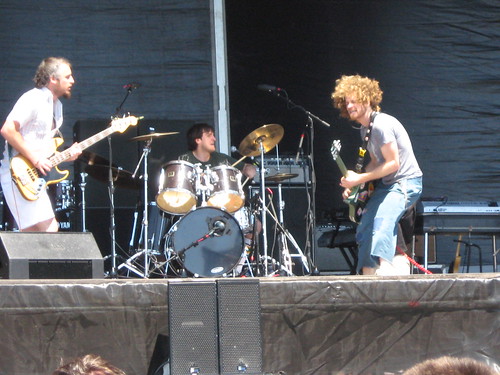
State Radio performing their new megahit "Recycle or Die" at Rothbury
I had a chance to talk to State Radio briefly at Rothbury about their upcoming bike-friendly show in Boston, the Story of Benjamin Darling, and their upcoming new megahit, Recycle or Die. To cap it off, I ran into Julie from Earphoria, who has been collecting fantastic acoustic sets backstage with musicians for the past couple of years. She got a few songs from State Radio at Langerado and was kind enough to lend me one to wrap up this post. Enjoy!
Jason Turgeon: Since we only have about 10 minutes, let's jump right in and talk about the bike thing. That was kind of out of left field for us in the Boston scene. You're known for being political but not necessarily known for being environmentally leaning. How did the whole bike thing happen?
Chad Urmston: I guess usually the political and the environment sort of go hand in hand. So we're always trying to figure out...we offset our tours and try to get our carbon footprint as minimal as possible. But Bikes Not Bombs was a way to...we know bands like Radiohead did an impact study, and the greatest footprint was from fans coming to the shows and all the carbon emissions from the vehicles, so one of the things to try to combat that was to think about different ways of transportation. Obviously, Bikes Not Bombs is a great organization and one that we felt we could team up with to try to swing the pendulum, especially as gas prices get higher and higher.
JT: Did you know those guys already, or did you approach them for this?
CU: We approached them for this. We didn't really know them. But there's going to be a bunch of things at that show, a bunch of different foundations, both politically aware and environmentally aware.
JT: Is this something you're going to try to repeat at different shows?
CU: We'll see how it goes. I think we'd like to...we just got off the justice tour with Tom Morello, and he did something where we did a service day, and then the next day we would do a show. So it's cool to have the message in the music and to have things at the merch table, but it's even cooler to actually do something.
JT: How was the venue to work with? Were they cool about it or were they resistant to it?
CU: They were totally cool.
JT: Is this the kind of thing you think they might do again after you leave?
CU: It depends. It's logistically sort of a nightmare. It's like, it's 11:00 or 11:30, and people are on their bikes and where are they going, and do people have their helmets, and do they have reflectors...I'm not sure, we'll see how it goes.
JT: I was [at Montreal Jazz Fest] and they just had bike storage all around the perimeters, gated off with big floodlights.
CU: I think the international community is way more bike aligned than we are, especially when we've been to Europe.
Mike "Mad Dog" Najarian: Wrigley Field in Chicago has got a nice bike storage center. They're pretty bike friendly there.
JT: When you do your tours, do you think "I don't want to play Tweeter because the only way for everybody to get there is to sit in traffic?" Do you look for venues that are closer to public transportation?
CU: Yeah, that's the idea. I don't think we have in the past because we haven't been big enough. We haven't had the luxury of being choosers, but as we move forward, we're trying to be as green as we can. We're traveling around now in a van, and we're getting a biodiesel fill up this afternoon. We feel like we're doing OK but we could always do better.
JT: How about [Rothbury]. Was the green side of this festival a draw for you or was it just another gig?
MD: Yeah, definitely.
JT: Are the other artists that you're talking to into this?
MD: Franti was doing a Think Tank today.
CU: He's signing his book, too.
JT: Are the fans OK with this? They obviously like hearing the political side. Do they respond to you guys when you do green stuff?
Chuck Fay: We'll see in Boston. See how many people ride their BMX down.
CU: We just found out that Ed Vedder is doing a solo show down the street, so he might ride with us.
JT: I'll put it in the blog. We're calling Eddie out!
MD: Ride with us, Eddie!
JT: Anything else that you want to talk about?
MD: I got my solar backpack (holds up bag). So I'm off the grid.
JT: So we'll switch to just music. Is there going to be a story of Benjamin Darling, Part 2? I want to find out what happens.
MD: Definitely.
CU: It's not so uplifting. But it's interesting. I felt like Part 1 is pretty uplifting, it's a nice story. But generations later, it gets worse.
JT: Do you have plans to write any environmentally-themed stuff?
CU: We have one song called "As With Gladness," we'll be playing it today. It sort of personifies the earth, sort of Mother Nature giving herself over to mankind, and how mankind sort of betrays her gift. The message is a little subtle.
CF: Which is cool, we don't want to get out there and be you know...trees!
MD: [singing} Recycle...or die!
CU: That sounded pretty good. Whoa, whoa! Is this recording?
CF: Send that over, JamBase!
CU: [singing] Recycle...or die!
JT: I'll put a little clip of that up there. The new hit from State Radio, Recycle or Die.
CU: The new megahit.
CF: ROD, as we like to call it.
That's it--thanks again to State Radio for taking the time to talk to me, and to Julie and the Earphoria.net crew for letting us share! Look for more great acoustic stuff from Earphoria as I do more interviews. Meanwhile, enjoy the music below, and first one to get me a picture of Eddie Vedder on his bike gets a free prize...
1E and the Alliance to Save Energy put out an interesting study last week that said that if 104 million American workers would have shut off their computers before heading out on the holiday season, the could have saved 474 million pounds of CO2 from escaping into the atmosphere. Kind of amazing when you think about it. So, your computers need a rest, too. Give 'em a nice nap and let them hibernate or sleep if you can't shut them off outright. If you notice your coworkers leave their machines on, give them a heads up, or tell your IT department about 1E's new power management software that forces computers within a company to enter sleep mode.
Commuting also lends its fair share to the impact of your work day, so here is an enlightning video that shows how to bike to work and look like you didn't---summer is here, the weather is great, so no excuses!
I recommend the Lavendar Essential Oil wipes from Herban Essentials--I've been using them for years to clear the grime of a hot day. The wipes themselves are biodegradable.
When I saw this picture--I salivated--may have been because I missed breakfast, or I was thinking about some grilled hallumi, or I was excited that my BBQ guilt will soon go down a notch. Check this out--a BBQ pack that 's better for the environment AND easier for you to clean up--who says caring is hard?!
Check it out, lighter fluid (crazy chemicals--holla!) is gross-and you injest it every time you eat BBQ. And, no, the ighter fluid isn't what makes it taste so good. In this design, the coals are housed compactly in the Firepack, the device uses them more efficiently and regulates the amount you need--so you don't overpour. Apparently, you just light the bottom of the pack made from 100% recycled paper and presto--in 15 minutes you have a roaring bbq.
By now, I bet you want one, so here, dear readers, is where you get one.
Every year around this time, pretty much every magazine, newspaper, and blog editor with a pulse churns out a list of the the Top 10 ways readers can act to save the planet. Hey, who are we to buck such a venerable trend. Here's our take on the Top 10 list, cleverly broken up into seven things fans can do and three things we want to saddle those poor, overworked rock stars with.
Fans: Hey, you guys are the lifeblood of the industry. We mean that. The stars may get all the press, but consider this: without music fans, Jack Johnson would be stuck in a cubicle somewhere. And since there are so many more of you than there are rock stars, your small individual actions can add up in a big way. So please, put aside the cynicism this summer concert season and take a couple of minutes to do something--anything!--to lighten your load on the planet. It's really not that hard. Here are some ideas. And just think of the alternative...
7: Hydrate responsibly! Look, we get it. It's July. It's hot. You've been imbibing. You need to stay hydrated, and marching all the way across the field to some bubbler (er, water fountain for you non-Bostonians) with a 20-minute line just isn't going to cut it. You need clean, portable, potable water, and you want it to taste good. Hey, lucky for you we live in America, where we have an abundant supply of fresh drinking water available from every tap in the land. So before you shell out another $3 for a pint of spring water in a plastic bottle, please, please, PLEASE consider bringing in a refillable plastic (or aluminum, or stainless steel) container if your chosen venue allows it. Not only will you save yourself some scratch, but you'll also be saving the planet from the waste caused by producing the bottle and the energy used to ship the water (it's heavy!) by truck over long distances, not to mention avoiding the dire ethical dilemma caused by giving water away for pennies a gallon, usually sourced from poor communities desperate for any source of income at all, to corporations that resell it at 10000% markups.
6: Recycle. This is an easy one. Pretty much every festival has recycling bins, and more and more venues are getting in on the act. But they don't work if you don't use them the right way. So for crying out loud, it's not that hard--the cans and bottles go in the recycling bin, not the trash can. Got it? We thought so. Great work!
5: Read. You want to save the environment. Really, you do. That's why you're here, reading this. So take it from us. The best way to make a difference is by educating yourself first. Got some free time this summer, maybe on that 20-hour drive to Bonnaroo? Try Natural Capitalism or The Omnivore's Dilemma, both great starting points for the journeyman environmentalist. Just looking to slack off during work? Head over to Worldchanging.org or Treehugger.com. And of course, don't forget about us. We're chock full o' green goodness for your eyeballs. Really.
4: Ask. Some people might say that we mean "nag" with this one, but we don't want you to do that. We just want you to ask questions, politely and respectfully. What kind of questions? Well, say your chosen outdoor venue doesn't allow you to bring in refillable water bottles or provide drinking water. Ask them to reconsider. Or perhaps your favorite nightclub doesn't recycle. Ask them to convert a couple of their trash cans to recycling bins. And if you want to know what your personal guitar heroes are doing to ease the burden of their tour, pop the question to them on their forums. You might not get an immediate response, but trust us, the people in charge are paying attention to the fans. And hey, if talking directly to the man is too much for you, ask us to ask them for you. Just leave your question and the person it's directed at right here in the comments and we'll work our journalistic magic, 60 Minutes style.
3: Spend wisely. It's the music business, get it? The people organizing the festivals, running the venues, selling the T-shirts...they're all in it for the money. And you control the purse strings. So don't just spend that hard-earned cash on any old thing. Let it talk for you! Spend it on an organic cotton T-shirt. Spend it on a souvenir Nalgene that you can refill again and again. Spend it at a festival that tries hard to do the right thing.
2: Find a better way to get there. It may seem like one little road trip won't ruin the planet, but when you see a long line of cars sitting idle waiting to get into a festival only half-full of passengers, it's pretty lame. Do your homework beforehand and see if the festival has carpooling, shuttles, or even a public transportation stop close by. It'll probably save you some scrilla while you're at it.
1: Vote. This is the single most important thing you can do. If you are still unsure of which candidate is right for you, visit this quiz. It does a really good job of asking you about where you stand on the issues and tells you which candidate feels the most like you do. That's what it's all about, right?
For bands:
3: Tour riders. You can build small things into tour riders that make a big difference like: insisting the stage lights be turned off between sets; making sure your catering comes from local sources and that your water isn't bottled if the tap water is drinkable. We'd love to see artists ban plastic cups from venues...please impress us!
2: Consultants. Many of the success stories we reported on got by with a little help from a consultant. Reverb is the most well respected in the industry. Check them out here.
1: Venue selection. If you've got a booking agent, make sure they're aware of your commitment to the environment. Try to get them to book your band at least one green venue per tour. See if other green bands have toured a certain venue before and contact their management to see what worked and what didn't. Live Nation venues are a great place to start.
The dudes from Call and Response told me about a tour van rental company in the Bay Area that rents vans with video gaming consoles built in--pretty great for those long drives across Wyoming after the scenery doesn't do it for you anymore. On a related note, BoingBoing, posted a solar-powered gaming device today that would be great to stick next to the window of your van and use to play video games or charge your phone or ipod. From the pictures, it looks a little like a Speak-n-Spell, but hopefully sounds better.
"This knock-off "MP4 Player" not only plays music and video, it can emulate the NES and Game Boy Color. But even better, it can be recharged with built-in solar panels. That's right: you can play Faxanadu until the sun explodes.
It comes with 2GB of memory built in, which is plenty for NES and GB ROMs, although perhaps not music and movies, and can be expanded up to another 2GB with an SD card. Oh, and it's got a USB out to which other gadgets can be connected—not for data, but to be recharged from the solar panel."
Where do musicians go for internships? Kelley Stoltzinterned for Jeff Buckley as a fan mail sorter, but I doubt he learned how to use a Tascam 388 there......
Looks like some pretty sought-after dudes are filling the holes. David Byrne gives some candid advice to musicians in Wired (Brian Eno chimes in, too!), and Thom Yorke tells it like it is in the Independent. Good reading for musicians and music fans alike--and you don't have to commit .
For the past five years, I've been a faithful Stendig calendar user. 2008 is no different. This morning I took down my old calendar and put up a new one. As I took the remnants of my old calendar to the recycling bin, I marveled at the small strip of waste I was throwing into the bin.
The calendar is great because it's huge (4ft by 3ft) and you tear off each month (a 4ft by 3ft sheet of paper) to reveal the next month. I use the old calendar pages as wrapping paper or scratch paper (see above) . Get yours here.
Yes. I'm as bad as your neighborhood drug store--there are still Thanksgiving leftovers in your refrigerator and there's still quite a bit left of your long weekend, and here I am pushing you to go out and spend moola to revive our sputtering economy. Cue song.
I just ordered some decorations (I did my part for our GDP), and got to thinking about what I would hang the little lovelies on this year. Is the more sustainable choice a real tree or an artificial one? The image and lovely aroma of a fresh tree is definitely a warm fuzzy, however the good feelings exit quickly when these images flash through my mind.
Trees
I was pleased to read that there are many benefits to natural trees over artificial ones. Artificial trees are produced with petroleum-based products and require quite a bit of energy to manufacture. They also are often manufactured in China which means transportation from the factory to you produces a considerable amount of emissions versus your locally grown tree.
In contrast, real trees come from Christmas tree farms which means a lumberjack doesn't go into an old growth forest and chop one down. Christmas tree farms are usually cited in areas where not much else grows, so their time is put to use well lowering emissions before they come to be decorated in homes for the holidays.
While artificial trees can be used year after year, real trees can be used but once...or can they? For those in temperate climates with outdoor space, an option might be to go with a potted tree instead of a cut one.
For city dwellers who have but a square of fire escape at their disposal, most metropolitan areas have great recycling programs for trees---complete with mulching services that help nourish city parks. Earth 911 has compiled a great resource for this here. My personal favorite is Mulchfest in NYC. Can someone please turn this into a concert? Please?! How great would it be if your ticket was your sad old holiday tree? Mulchfest could give Coachella a run for its money, for sure!
Lights
Take a cue from Rockefeller Center, go LED. The U.S. Department of Energy says if everyone switched their normal holiday light strings with the LED variety, at least two billion kilowatt-hours of electricity (i.e. a whole lot) would be saved in a month. Please listen to them. They are smart. Here are some LED options.
I just moved. Whoa. Glad it's over...that's all I'll say about that.
Post move, my stuff is all where it should be, but I'm left with a ridiculous amount of perfectly usable moving boxes. Enter Freecycle--it's a free service that teams users up with those that have and those that need. It's similar to the Craigslist.org free section, and it's a great way to get rid of stuff you don't want without contributing to landfills and making someone else very happy. There are Freecycle networks in most major cities. Check it out!
I'm sitting in the middle of a field in rural Tennessee, and it feels like it's got to be 110 degrees out. Somehow I've forgotten about my sweat-lined brow and muddy shoes; instead, I'm focused on listening to Bonnaroo's head press guy, Ken Weinstein of Big Hassle Media, talk about the music festival's ongoing efforts to put on a greener event. "No one likes to be trendy," he says. "But as trends go, this greening shit is pretty cool."
The "greening shit" he's referring to is certainly a growing trend among music festivals. From dishing out organic food on compostable dishware to using recycled toilet paper in the port-o-potties to powering stages with solar energy or biodiesel, festivals around the country are getting creative in their efforts to be green. Some, like Bonnaroo and Lollapalooza, are even devoting venue space to the issue, inviting artists and fans to participate in educational activities and visit informational booths staffed by nonprofits (like Grist).
But can a music festival ever truly be green? An hour in a line of idling vehicles waiting to reach Bonnaroo's entry gates answered that question for one Grist staffer. Certainly any event requiring masses of people to travel is already in the red when it comes to being green. Whether an event is in an urban center or in the center of a field starts to matter big-time when you're aiming for sustainability.
The sheer volume of trash generated by one of these multi-day events is also a massive issue. Last year's Bonnaroo festival produced more than 1 million pounds of waste, but recycling, composting, and reuse efforts kept more than half of it from ever reaching a landfill.
As cities across the world this week begin preparing for the climate-change-focused Live Earth concerts on 7/7/07 (an event that has come under fire itself), I decided to take a closer look at what some of the major music festivals in the U.S. are doing (or have done) this year to address climate issues.
I've graded them based on overall intent and six specific factors: ubiquity of recycling bins; use of green power sources like solar, biodiesel, and wind; presence of green exhibits or educational aspects; purchase of carbon offsets; direction of donations or proceeds to green causes; and availability of organic and local food options.
Unfortunately (for the music fan in me, but probably fortunately for the planet), I haven't been able to travel to all of these festivals and judge them firsthand. Instead, I've relied on the festival websites, press releases, media coverage, and event organizers themselves when possible -- not as good as being there, but it does help indicate how well the festivals are communicating green initiatives to fans.
South by Southwest Where: Austin, Texas When: March 9-18, 2007 Who: 27,000 attendees The scoop: In addition to offsetting energy use at concert venues during the festival, SXSW organizers accounted for energy used all year at their offices. They also boosted mass-transit options for festivalgoers and assisted in local tree-planting efforts. The score: B-
Coachella Where: Indio, California When: April 27-29, 2007 Who: 100,000 attendees The scoop: Apart from a partnership with youth-focused eco-group Global Inheritance that resulted in an alternative-energy display and carpooling incentives, this Hollywood-heavy festival showed little green initiative. The score: C-
Sasquatch! Where: The Gorge, George, Washington When: May 26-27, 2007 Who: 22,000 attendees The scoop: Via Sustainable Energy Partner's Carbon Harmony program, the event was over 100 percent offset, but that's about as green as it got. Aside from the Global Inheritance TRASHed Recycling Store, there was nary a recycling bin in sight. The score: D
Bonnaroo Music & Arts Festival Where: Manchester, Tennessee When: June 14-17, 2007 Who: 80,000 attendees The scoop: The jam-band festival's ongoing efforts to be greener this year include use of non-VOC paints, organic cotton T-shirts, recycled toilet paper, a festival-wide composting program, and a solar-powered stage. The score: B+
Lollapalooza Where: Grant Park, Chicago When: Aug. 3-5, 2007 Who: 165,000 attendees The scoop: Former Jane's Addiction frontman Perry Farrell has worked hard to green this fest, which this year will use biodiesel to power vendor stands and solar energy to power a small stage. Additionally, a Green Street area will feature nonprofit-staffed booths to educate concertgoers on eco-issues, and 'Palooza proceeds will benefit Chicago's Parkways Foundation. The score: A-
Bumbershoot Where: Seattle, Washington When: Sept. 1-3, 2007 Who: 150,000 attendees The scoop: This long-established nonprofit music festival is aiming to fully integrate green initiatives into its operations and hopes to get festivalgoers on board by offering rewards (like cash!) for recycling. Because of its urban location (read: limited parking), bikers and carpoolers will also be encouraged with incentives. The score: B-
Austin City Limits Music Festival Where: Zilker Park, Austin, Texas When: Sept. 14-16, 2007 Who: 165,000 attendees The scoop: Festival promoters helped jumpstart an Austin Parks & Rec plan to install an irrigation system on the Zilker Park grounds, providing healthier grass for concertgoers and park users year-round. ACL will also feature a special area within festival grounds to highlight various environmental nonprofit groups. The score: B+


 When I saw this picture--I salivated--may have been because I missed breakfast, or I was thinking about some grilled hallumi, or I was excited that my BBQ guilt will soon go down a notch. Check this out--a BBQ pack that 's better for the environment AND easier for you to clean up--who says caring is hard?!
 The dudes from Call and Response told me about a tour van rental company in the Bay Area that rents vans with video gaming consoles built in--pretty great for those long drives across Wyoming after the scenery doesn't do it for you anymore. On a related note, BoingBoing, posted a solar-powered gaming device today that would be great to stick next to the window of your van and use to play video games or charge your phone or ipod. From the pictures, it looks a little like a Speak-n-Spell, but hopefully sounds better.


 Music festivals across the country aim to lessen their footprint


