The award is awarded in three categories: "improving," "outstanding," and the standard "Greener Festival" award which falls between the two. The organizers of the award, UK non-profit A Greener Festival, said that they were particularly pleased that 12 festivals had won the "outstanding" award in 2009, including repeat winners Rothbury and Bonnaroo in the US. The Award is based on a 56 part questionnaire which covers office management, greenhouse gas emissions, supporting green initiatives, travel and transport, waste and recycling, water management, environmental protection and noise reduction.Almost all the festivals were visited by an independent auditor to assess their green efforts.
Auditors were pleased this year by Bonnaroo, which also won an "outstanding" award in 2008. The festival auditor noted that in 2009, Bonnaroo concentrated on a "Buy Local" message, and improved their energy footprint by installing new electrical capabilities. This allowed them to plug directly into the local power grid and reduced their energy consumption in the process. Other on site features include permanent water wells, a composting pad and the newly planted Bonnaroo Victory Vegetable Garden. Bonnaroo's many areas of education include the necessity of carbon reduction, the need for composting, reducing bottle water usage, viable uses of solar energy, recycling everything possible, and reducing the use of unnecessary items.
Not to be outdone, Michigan's Rothbury Festival, also a 2008 "outstanding" award winner, scooped up the same award in 2009. The festival, which heavily promotes its green credentials, impressed its auditor with its effective promotion of alternatives to bottled water, impressive rates of composting and recycling, and a commitment to sourcing products locally that stretched all the way to the stages, where several local bands were given the chance to play to new audiences. According to Sarah Haynes, President of the Spitfire Agency, Rothbury's greening consultant, "Rothbury works hard to have the minimum impact on the planet while having the maximum impact on its people. We always 'green' with transparency in the hopes that others will take notice and join us in this most important mission."
Two other US festivals won the award for the first time in 2009. California's West Beach event, held on the beach in Santa Barbara, joined the Atlanta Jazz Fest in garnering the awards.
All winning festivals will receive a special trophy designed by Sade Goddard from Keswick School in Cumbria, England. Goddard designed the award as part of a competition among UK school children. Her winning design features a Red Kite motif and is made from recycled plastic bottles, crushed CDs and remolded "Wellington" boots, a necessity at the perennially muddy Glastonbury festival.
The winner of the overall Greener Festival Award 2009 will be announced at the UK Festival Awards which will be held at the O2 Arena in London on November 19th 2009.
A Greener Festival co-founder Ben Challis said “We were worried that in a year when the recession bit hard we might see Festivals shying away from their ongoing commitment to green issues, but we have been generally pleased with the efforts of festivals around the world to keep sustainability high on their own agenda and to promote environmental awareness to fans. We had more ‘outstanding’ winners in 2009 and a 20% rise in applications from 2008, with more international applications than ever including five winners from Australia, four from the USA and four from mainland Europe.
The Greener Festival Awards are supported by insurance brokers Robertson Taylor.
So just in case there's anyone still out there checking in, I'll be reactivating the blog for Rothbury and in order to publish a couple of other pieces.
Post Rothbury, the blog will probably go dark again for a while, but you never know...
This is a repost of the Panjea article that went up today on the JamBase features section at: http://www.jambase.com/Articles/15330/GreenBase--Panjea's-World-Community Visit the JamBase version for links, pictures, and comments.
"Considering that I was just out [listening to Snoop Dogg] there and he was saying, get stoned, get drunk, and fuck, and he had like thousands of people singing with him, I think maybe the political lyrics might not be as popular, but it's not going to deter me. I have to feel good about what I'm singing when I'm out there and the band has to feel good about what they're playing behind," says Chris Berry, leader of Panjea. "It's what I have to do; it's not a choice. It's not whether or not I even contemplate whether it's making it successful or not, it's just what we have to do." Berry is ruminating on the difficulties of being a political band in an era where politics and music don't always mix while Snoop Dogg finishes up his 4:20 p.m. festival set.
It's not often that you run into a band like Panjea that has a mission statement. Sure, past decades have yielded still-touring acts with strong political overtones going back to Bob Dylan, U2 and Rage Against the Machine. But the more recent wave of acts, with rare exceptions like Michael Franti and State Radio, have opted to leave politics out of their music. Enter Panjea, an Afro-pop collaborative with big goals. Specifically, the group is a "project set on healing the world." The band takes its name from the supercontinent Pangea, and their goal is to use music to unite people as closely as the continents were once united.
GreenBase was lucky enough to catch up with the band over the summer at Rothbury (read the Roth review here), where for most of the weekend band members were scattered all over the giant festival, sitting in with Railroad Earth and State Radio, assisting with the art installations and even teaching the crowd how to play a giant flying monkey drum set. With band members living in New York, Boulder and San Francisco and constantly on tour with their various other projects, it's not often that they all get together in one place. Over the course of an hour, we talked about the fragile political situation in Zimbabwe, the challenges facing the next U.S. President and the opportunities for music to have a positive impact on people and the environment.
The collective, made up of a core group of about six musicians but often exceeding a dozen people in its rare stage appearances, blends political sensibilities with insanely catchy African rhythms and instruments. Listening to the group perform at Rothbury, it was hard to believe that anything this melodic and danceable could be a song of protest. That's partly by design, according to trumpet player and keyboardist Danny Sears.
Panjea "I read a lot of the fan mail that comes in, the forums and the MySpace page, and I can tell you that seeing what people write in, they're very moved by it," says Sears. "I think the people that we do affect are affected in a very positive way. The people who want to be reached, are reached. Some people are swayed in the right direction, but you're always gonna have people who are just not into it but maybe they enjoy the grooves and they feel the music and we can reach them that way."
Sears, like everyone in the band, is truly a musician's musician and definitely knows a thing or two about grooves. Casual music fans might not know these names, but they probably know the bands that Panjea's members have played with. When he's not jamming with Panjea, Sears frequently appears with Railroad Earth, Guster and The String Cheese Incident.
The String Cheese Incident, not coincidentally, is one of the reasons for Panjea's initial success. SCI mandolin and violin player Michael Kang is the most famous member of Panjea. Like almost everyone else in the band, the South Korean-born artist has spent plenty of time outside the U.S., and these experiences have informed both his politics and his music. SCI fans accustomed to the apolitical nature of that band might be a bit surprised to hear Kang speak so passionately about issues like globalization and its effect on the environment.
"Our way of life transcends national boundaries. It's coming to the time where we are not going to have to look at what's going on in our backyards but recognize that the planet is our backyard," says Kang. "It's a matter of just recognizing, being grateful for what we have. The first thing that we all have the power to do is just conserve the stuff that we use."
The band's political and environmental messages have strong roots in Zimbabwe and southern Africa, where Berry spent nearly a decade learning the mbira, a traditional African thumb piano, as well as the ngoma drum. Berry became a star in Africa by the time he was 23 and soon started to impress musicians on this side of the Atlantic. A chance meeting in New York sometime around 2002 or 2003 with current band saxophonist Chris Cuzme soon led to the introduction of Berry and Sears and the beginnings of Panjea. In 2006, Berry and Kang traveled to Africa for several months and they returned for a second trip in 2007. It was while living in Zimbabwe that Berry met Zimanai Masanago, Panjea's guitar player. Masanago, a bandleader and songwriter in his own right, also pens political songs written in his native Shona dialect. "Shona culture uses a lot of proverbs," says Masanago. "When elders talk to each other and to children, they use proverbs and very simple things to talk about very big things. That's the way I approach the songs that I write in Shona for our band, Pachedu."
Chris Berry - Panjea "I think the main issue is economic and political survival on a daily basis, just keeping your head above water," says Masanago about southern Africa. "People are trying to survive, so the issue of environmental awareness is really a secondary issue." In places like Mali, the fourth-poorest country in the world with a per capita income of about one dollar a day, economic and social issues take priority over environmental issues, although he maintains that "people are really connected naturally to their environment." But these issues don't stop people from having a good time, even in the face of poverty so extreme that bands can't afford the gas to go on tour. But, he points out going on tour isn't really necessary. "Most of the countries like Zimbabwe are really small. So people just go play and come back home."
Coming home is a bit of an issue at times for some of the band members. Several of them, like Martinique-born bassist Patrice Blanchard, have spent so much time on the road that "home" has become somewhat of a nebulous concept. And although all of the band members are currently based in the U.S., some of them are worried about the political future of the country they now call home.
"I'm not American, but I'm so concerned about your next election," says Blanchard. "If you guys [make] the right choice, the American President being very influential, that could change the whole landscape. Bush could have been one of the most important presidents for starting the green revolution, but he decided not to. The next one has to. Otherwise, I think I'll move. I'll go to Australia, where the environment is a big issue. I'll go there [laughs]."
Kang, on the other hand, isn't having any of this talk of moving.
"I'm not a [U.S.] citizen either," he says. "I've chosen to stick around and become a part of the solution. When I [traveled] to Africa, it made me realize this is why I've spent so much time in the States, because there's actually something we can do about it. That led me to want to get involved with becoming part of the solution in whatever way [I can]. If we're not going to do it, nobody else is. I'm not going to count on any politician to do it for me. We can find ways to do a lot of this in our communities."
Community is a reoccurring theme throughout the band's conversations and music. Panjea is, after all, a band focused on transcending geographic and political boundaries and bringing people together. In a world where we are increasingly disconnected from each other despite the ease of being connected at all times, the band is using its music to bring us together. So, it's not surprising that Berry wraps up our conversation with a message to JamBase readers about community.
"I just want to say how thankful I am to JamBase and all the fans who are a part of it, because it's really a forum in which musicians can be empowered. It feels like we're taking the power back to the people through JamBase. It's a real forum for us to communicate directly to the fans, as I like to call them."
Panjea play this Friday and Saturday (12/12 & 12/13) in San Francisco and two nights in Colorado for New Years. Complete dates available here).
Panjea recently re-released their entire catalog digitally through reapandsow. You can check it out here.
Get your mind out of the gutter. The "it" in the headline that Susan Tedeschi, currently on tour with her husband and bandmate Derek Trucks, is talking about is saving the planet. This is a family blog! But it's a great title, don't you think? Maybe if we're lucky, she'll make it the title of her next song.
Susan told me that it was time to stop talking about the planet and start doing something about it during a long, forthright, and at times very passionate interview at Rothbury on July 5. She doesn't pull any punches, and as you'll see, she tries very hard to practice what she preaches, setting up recycling stations on the tour bus, getting her home off the grid, and leading the charge for biodiesel on her tour. What she lacks in a sophisticated green touring campaign she more than makes up for in enthusiasm.
In fact, Susan's so excited about green stuff that before I could even get my first question out, she jumped in to tell me about her solar-powered home, which she shares with Derek and her two children. And when I tried to wrap things up, thinking she must be tired of talking, she turned the tables on me, asking me questions about how she could improve her touring practices. I'm still swooning!
Susan and Derek getting it on.
Susan Tedeschi: Derek and I have a solar powered home now.
Jason Turgeon: Excellent! Well, tell me about it.
ST: Derek actually is the one that knows. We looked at a bunch of different companies, but he's the one who ended up deciding because I had to go out of town. They came and they put 22 panels on the roof, at 31 degrees.
JT: Fantastic. Where is this in Florida?
ST: Jacksonville.
JT: Is it off the grid, or partially solar powered?
ST: It's tied in to the grid, so we use what we need, and the town puts it in a bank, so...
JT: So, it provides more power than you need?
ST: Yeah.
JT: Fantastic. So how about your touring--have you been doing any green touring?
ST: We have been doing a lot of discussing about it. The problem is having 23 people on tour on these buses and not having space. A lot of these buses are already pre-organized, the way the trashcan is or whatever. Our new idea is that we have a couple of drawers at the front, and I'm trying to turn those into recycle drawers. The one thing that drives me nuts more than anything on the road is water bottles and people just throwing them in the trash. Drives me nuts. I'm like, no, we're not doing that. We're putting them in the drawer, and then we're putting them in the [recycling bin]!
JT: Have you guys thought about doing the Rothbury thing where they just took away the water bottles and everyone has to bring a Nalgene?
ST: Well, we would, but we don't have time to go shopping, so people wouldn't be able to drink. You have to have water. But something else I've been thinking about is how to do biodiesel for the buses. I'm friends with Willie Nelson and his wife. Annie is really big on biodiesel. She has it for all her cars and for the tour bus. And I know Dave Mathews does, too, because I do Farm Aid with those guys. Every little bit, though, helps, anything.
JT: [Your publicist] told me that you were interested in Florida rivers.
ST: Yeah, the watersheds. I grew up in Massachusetts, and I was always part of the North River, that was the watershed [group] that I was always involved with and doing work with. And I've been getting involved with the St. John's Riverkeeper, and trying to keep that river healthy and trying to do whatever we can. Trying to write letters to everybody, mostly senators.
JT: Have you done any benefits?
ST: I have, I've done some benefits at the Cummer Museum in Jacksonville for [St. Johns Riverkeeper]. They have an oyster festival that I have done a few years. I'm trying to get more involved in it, I'm just really not home at all. I've been so busy, I haven't been home. But Derek and I have always been so curious about environmental things, always trying to look into it, that we've inspired his little sister to actually get on the phone and write letters to everybody from the mayor and governor as well as to the TV stations. She's trying to get all the public schools to recycle and also Alltel stadium, [which] doesn't recycle. So we're working on it.
JT: Have you worked with any of your other venues to get them to try and recycle?
ST: A lot of them actually have been. A lot of the venues are, and if we mention [that a venue doesn't recycle], then we'll get a trash can together and people at least start to try.
JT: Do you get a different kind of fan at your [solo shows] than you do in the festivals? Are they more of a traditional blues fan?
ST: Yeah.
JT: Are they into this stuff the same way that [this audience] is?
ST: Not as hip as the college kids or the younger kids.
JT: If you try to bring it up are they receptive to it?
ST: Some of them are, and some of them get all weird on me. "Why are you spreading your politics on me?" I get that a lot. Whenever I start talking about how we need to save the environment or be more aware. If everyone would take care of their own backyard, we wouldn't have all these problems. I try to get people to read Rachel Carson books. I'll turn 'em on to whatever I can. It's funny how people will try to label you all of a sudden, like "communist"...You're talking about things that are important and good for the planet.
JT: It sounds like you get a lot of resistance. Is it a generational thing or a regional thing?
ST: I do [get resistance]. It tends to be generational, I've noticed. It tends to be sixty and older, they're more set in their ways.
JT: So the message hasn't really sunk in.
ST: They don't believe in it. They don't think that global warming exists, they have their own arguments. It's just a different way of thinking, and I feel like I'm always trying to go up against these people that just aren't open-minded enough to it.
JT: What about when you tour with the Allman Brothers and those folks?
ST: Oh yeah, it's way easier. You know, the Grateful Dead and the Allman Brothers, they've been out pushing for these causes for 35 years. When I was out with the Dead, I remember one day [Bill] Kreutzmann [said] we've worked 30 years to get these things in place and George Bush comes in and in 2 years knocks out all the work we've done.
JT: Sometimes things have to get worse before they can get better. Sometimes that's how you get to the people who wouldn't believe it if it wasn't...
ST: Yeah, but all the way worse? Give me a break! But you're right. Some of the people who used to give me a hard time, now they're at least not...
JT: Would you say that the tide is starting to turn?
ST: I would, especially because of the George Bush years (laughing). I think that has made people rethink things.
JT: In your songs, do you have any kind of environmental message?
ST: Big time. I don't know if all of my songs are going on my record or not, because I've written a lot of songs. One song is called "Until the Earth Runs Dry." That's a song about everybody wanting it, always having it, needing it, but then all of a sudden in our life, in our generation, it's not always going to be there and it's not always affordable. Whether it's oil or water. It's one of those kind of songs. A lot of my songs are kind of political. One is called "Pack our Things and Go." It's about packing up our troops and having 'em come home and trying to take care of our own country.
JT: That's courageous. You're out there pushing that stuff even though your fans have said they don't want to hear it.
ST: Yeah, they don't want to hear it. I don't care. I have another song called "People." It's about people having a choice. One of the verses is "TV screens/corrupt magazines/a man on the radio who thinks he knows what you need/planting seeds/that just mislead/that can't be taken back." Because you have all these people that plant seeds in your head, and people start believing it. And it's not factual. You can't believe everything you read, unfortunately. You have to know who you're dealing with, what your source is. But people aren't even educated enough to know who to vote for.
JT: Do you do any stuff with Headcount or any of those groups?
ST: We used to do the Rock the Vote. We used to say come on and come to our shows and set up a table. Anybody environmental or trying to educate people to vote, that's all good.
JT: How about this festival, what do you think?
ST: I was so impressed, because when I went to catering, [they had] the utensils I love! They have the ones that are compostable, and everything was pretty much compostable or organic. It seemed like they had put thought into everything.
JT: Was that a consideration when you were booking this festival?
ST: I always want to be part of festivals like this, absolutely.
JT: Is Derek on the same page?
ST: Oh, big time. He's always picking on me, like, "OK miss environmental, you left a light on!" He's really big on making me practice what I preach. He doesn't let me get away with anything. Which is good, I like it.
JT: Anything else green you wanted to talk about?
ST: Well, I always have four or five [reusable bags] clipped onto my pocketbook. Look at China, they don't have plastic bags anymore, for a reason. I think it's good for us to be aware, but it's more important for us to actually start putting it into action. Once you start learning about what's good and what's not, let's do it. Let's stop talking about it. Let's get on it!
JT: What's the one thing you're not able to do right now that you wish you could?
ST: In my touring habits, I wish the trash, everything from the utensils--I wish we could get those on the riders. The problem is, we have to get whatever people have in their town. It would be way cooler if we could just [buy in bulk], but there's no room to store it. It would be cool if we could actually get some of those earth-friendly products in every town. I would really love it if we could make all the festivals like [Rothbury]. Some of the artists like Dave Matthews that have a big enough draw, they can make a difference if they start asking for it. It would be good if it was made more mandatory by the artists.
JT: So I think that's it.
ST: Well what can we do, as artists, to help?
JT: Keep putting the message out there. You have a lot of influence with people. Especially, you deal with an audience that's not used to it, you're not preaching to the choir. So if you can find a way to get through to them without upsetting them...it doesn't have to be a left wing/right wing thing. We all have to live on this planet.
ST: I try to move them.
JT: And if you can demonstrate things...if you do a show with refillable water bottles and a five gallon jug, and people see that you're not throwing away water bottles, even if they don't know it, you're having an influence on them.
ST: I have a jug that we got from Montana. Maybe we could get some for the whole band and we could do that.
Let's hope that next time you see Susan, she's got the whole crew switched over to refillable bottles. But even if she doesn't, make sure you see her--she puts on a great show! Here she is, belting out "Hey Jude" at their Rothbury set.
I'm still working through the backlog of interviews I did at Rothbury while simultaneously preparing for next weekend's action-packed Lollapalooza mayhem. Today, I bring you a transcription of my chat with Bud Ward on July 5.
Bud was picked to be one of the Think Tank panelists, and for good reason. He's had a long career as a journalist covering environmental issues, and the organizers at Rothbury were not at all shy about prodding those of us in the press tent to do a better job. He does things like sit on the board of the Applied Environmental Education and Communication scholarly journal, he is a former environmental commentator on NPR's Morning Edition, and he is the contest administrator for the Grantham Prize for environmental journalism, the world's most valuable (financially speaking) journalism honor. In other words, he's a big shot in the journalism world, and it was both an honor and a pleasure to get to know him. He's also not the kind of guy you would run into at any other music festival, and it was fascinating to watch guys from his world interact with people like Ken Jordan of the Crystal Method, who probably doesn't normally spend his days palling around with members of the editorial board of the AEEC. Hopefully we'll start to see the fruits of these new relationships play out in the form of a more overt environmental message from our favorite musicians and more entertaining coverage from the media.
Before we get into the meat of the interview, let me point you to the 2007 and 2008 winners of the Grantham Prize, two of the finest examples of environmental reporting you'll find, and both stellar in their use of multimedia. The 2007 piece from the LA Times covers the devastation we've unleashed on our oceans, and the 2008 winner from the NY Times dives into China's booming economy to see what the side effects are. And now, on with the show!
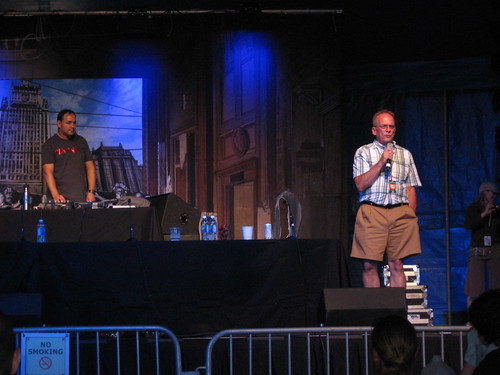
Bud Ward (foreground) and the Crystal Method's Ken Jordan at a Think Tank panel.
Jason Turgeon: For the readers of JamBase who probably don't know who you are, give us a brief bio.
Bud Ward: I edit a website on how the media cover global warming. That's my primary activity right now. I do a lot of training of journalists on covering climate change.
JT:And have you been happy with the way climate change has been covered the last couple of years?
BW: Well, I've been more happy in the last couple of years than I was previously. I think a big change is that the media has begun to focus on balancing evidence rather than balancing opinion. The earlier emphasis on balancing opinion gave equal time to a lot of opinion that wasn't scientifically based. I think more recently the media have begun to filter out the opinion, and particularly on covering the science issues, cover more of the evidence, not just the opinion. That's been a major change.
JT: In the music scene, we're kind of removed from this but it's finally coming to the point where we have festivals like this that are focusing on [climate change]. What can we as the media who are covering the music do to more effectively merge the two issues?
BW: I think one thing you can do is look back to the sixties. Look back to how the media covered the civil rights movement, look back to how they covered Vietnam. It's impossible for me as a sixty-year-old to think of growing up without the influence of Peter, Paul and Mary, and Woody Guthrie, and Bob Dylan and so forth. I had to laugh recently--I shouldn't say this--recently, my son-in-law and I were driving along and he mentioned Bob Seeger to me. And I said, "oh you mean Pete Seeger." And he said, "no, I mean Bob Seeger." Well I know who Bob Seeger is, but he said to me, "who's Pete Seeger." I was incredulous that he could not have heard of Pete Seeger, you know? I cut my teeth on him.
JT: Do you see any musicians that you've worked with here as being the new Pete Seegers for us?
BW: I've been very impressed with Michael Franti and Spearhead, not only with the music but the message that he delivered. Frankly, I had not been familiar with his music before. But he's the kind of artist that I've been introduced to here that I'll go back to iTunes and check out.
JT: Are you going to be able to see a show tonight?
BW: I sure am gonna be around. I'm going to catch as much of the music as I can. I enjoyed [Widespread Panic] last night. I enjoyed meeting [John Bell]. He and I were on a panel yesterday. He was very personable, very forgiving of me not having heard of his music. There again, I mentioned to my two sons-in-law, and they said if you have a choice to see Widespread Panic, definitely go. They were good.
JT: So is this your first music festival?
BW: It is the first. I missed Woodstock. Everyone my age wishes they'd gone to Woodstock. I'm not sure there will ever be another Woodstock, but this is as close as I'll ever come.
JT: Would you come back to something like this?
BW: Sure. I particularly appreciate the emphasis on a critical social issue. The global warming is phenomenally important issue. It's not only the most important environmental issue, in many ways it's the most important national security issue, it's the most important economic issue that our country faces, and it's a generational issue. My grandchildren and their grandchildren will be dealing with the aftermath if we don't handle this well and handle it quickly. It's a great issue to emphasize in this kind of forum.
JT: At an event like this, people really come here to have a good time. They don't want to be preached to. How are we doing with that? How do we strike a balance?
BW: The people who come to the workshops, the Think Tank meetings, have been kind of committed. I don't think we're converting many people, we're reinforcing them. Hopefully they'll go home with new ideas. We've tried to keep the message very upbeat and solutions oriented and opportunities oriented. The issue of global warming presents some enormous challenges, but also some enormous opportunities. So there are going to be real winners come out of this issue, and I hope many of these people here can be among the winners.
JT: If there was one thing you could tell the all these fans here, many of whom are just laymen with global warming and the environment in general, that was something doable for all these people, what would it be?
BW: I guess the first thing I would tell them is use transportation more strategically. If they have to make a trip and can combine three errands into one trip, it's a good idea. If they can walk or bicycle to it, if that's feasible for them, they should do it. If they can carpool or chainpool, that is combine errands into one trip, they should do it. There are other things that are obvious like the compact fluorescent bulbs that are clearly worth doing. Eating locally would be another key thing they could do.
JT: Are there any acts that you're looking forward to seeing?
BW: Of course I'm looking forward to seeing Dave Matthews, who I've heard so much about. That's the group I'm most familiar with. I'm also looking forward to seeing Citizen Cope. I've heard a lot about Citizen Cope, and my son-in-law won't forgive me if I miss [them]. I enjoyed the Drive-by-Truckers, I saw them yesterday and thought they were good. I especially appreciated learning about Spearhead.
JT: Is there anything you want to say to the younger, college-age community that makes up so much of this festival?
BW: Look for opportunities to combine doing well with doing good, because you can do both. This climate issue is going to be one of the biggest issues you're going to face in coming years. My generation hasn't done such a great job. We're looking for you to clean up after us. It's in your own best interests and you should do it. The other thing I wanted to do is put in a plug for Andy McKee. It's the most extraordinary technique I've ever seen. He's a spectacular guitar player and musician.
Bud put his own thoughts about Rothbury online here--they're worth checking out to see how it was perceived by someone outside of the festival scene. And how else could I close but with this a clip of Mr. McKee? Enjoy!
For most of us, the only way to get to a show is to drive there. Even in my hometown of Boston, which has many fantastic small venues easily accessed by public transportation, the larger acts tend to go to car-only spots like the TweeterComcast Center some 20 miles south of town. Traffic into and out of the shows is a nightmare, and if, like me, you don't have a car, you have to bum a ride off someone. And never mind getting to shows at other places, like the Cape Cod Melody Tent or the Hampton Beach Casino Ballroom.
Enter the internet. A slew of rideshare services have popped up to help riders like me find empty seats in cars going the same general direction--Rothbury listed 10 services on the festival website. But the problem is that until recently, none of them has focused on the music and events markets. Instead, most of them have been going after the commuter market or the casual rider group. But with so many options to choose from, no one service has gained a critical mass.
Pickuppal.com set out to change that earlier this year. After an initial success as the official carpooling site of Coachella, other events and touring acts quickly gravitated to the site. Pickuppal.com is now the official carpooling partner of the Dave Matthews Band, John Mayer, and All Points West. The site offers a turnkey, branded carpooling option to any festival or musician that wants to offer this kind of a service. I had a chat with founder Eric DeWhirst recently to see how things are going.
Jason Turgeon: You've had a long and varied career in web startups and the environment, but this seems like a bit of a new direction for you. What prompted you to get so interested in car-sharing?
Eric DeWhirst: I worked on doing the carbon accounting system for Natural Resources Canada. I got really involved in talking with all the scientists about planting more trees. What they were saying was what we need to do is focus on all this driving. My partner John called me up and said why don't we do this in a way that makes sense with the internet.
JT: There is suddenly a lot of competition in the car-sharing space online. Going after the music market makes a lot of sense, since it's one of the most common situations where people will be looking for a ride. How did you get into this segment of the market? Are any of your competitors actively targeting this same space?
EDW: Music is definitely one of our target verticals. Whenever people come in and out of a place, for casual ridesharing, we're focusing on it. To get two people who don't know each other to ride together, there has to be some kind of affinity, and if I know that you like the Black Crowes, too, you must be a cool dude. It's a big part of the push for tours and venues to geet people to rideshare. We think we can have a big impact here. I haven't seen any competitors cropping up with the zest that we have. We have a dedicated sales team that is contacting all the festivals and we're going after it pretty hard.
JT: You recently made your service 100% free for users. Most other car-sharing sites collect gas money for the drivers and take a cut. What's your new business model now that you don't have a revenue stream?
EDW: We're going to introduce advertising on the site in 2009. We're looking at partnerships with green advertisers and we think that that is our client base. We don't want a bunch of ringtone and punch the monkey advertisers all over the place. We dropped [the fee] because it's a barrier to entry. What we want people to do is to rideshare together. If we really do a great job and a lot of people do it, we're going to make a difference. Looking at more social networking stuff, linking them off to their facebook profile, then we can showcase that these are real people and you don't have to be scared of them. One thing that is not on the table is selling out our email lists. If we contact you it's because someone is looking to ride with you or once or twice a year we have some big announcement about the site.
JT: You've been working with Reverb, a great organization that's been spending a lot of time trying to figure out how to cut down on fan travel to venues. How did you get involved with them? Are you working with them on any tours besides John Mayer and DMB?
EDW: It was a total cold call. They had talked with other people as well, but I talked with Elliot May and just laid it on the line. As far as other bands, yes [there will be some new partnerships], but I'm not allowed to disclose [those] just yet. What we're seeing is that people have talked about it, but said "OK, how are we going to do that?" To take the next step is kind of new territory for some of these groups. We're [also] talking with [Major League Baseball].
JT: What's been the biggest challenge to you in trying to get music fans to carpool?
EDW: There's a lot of people showing the intent and getting into it, but it's still a new thing. People are comfortable riding with other people they know, but they're getting used to riding with strangers. But there is an overwhelming intent. We have thousands of people registering and as they have positive experiences it's like a snowball. For some people it's because the band is telling them to do it, for some it's because they're younger and don't have the dough to drive out there.
JT: How many of these events have you done so far? Which have been the most successful?
EDW: Since Coachella, I would say that we've probably done 15 events off the top of my head. The most successful was Dave Mathews, then the Vans Warped Tour.
JT: How do you measure success? Can you share any numbers with me?
EDW: We measure people and miles saved. The stats [for Dave Mathews Band] as of [July 16] are 1395 registered fans [with a ] total distance of ride requests of 63,817 kilometers.
JT: Rothbury decided against using pickuppal because of perceived liability issues, and I've seen other comments on various sites expressing concern over the safety aspect of this service, especially for women traveling alone with strangers they meet through your service. How are you addressing this kind of safety concern?
EDW: We talk quite a bit in our blog about safety. We have a set of 12 guidelines that you can do. When we contacted Rothbury, we hadn't had anybody. But Coachella took a chance with us, and as soon as we had that, it was good enough for everybody else. Their legal department reviewed it and went through it and the reality is that there is no increased liability for the venue at all. Also, you usually go with your buddy or your girlfriend. It's getting those other two seats filled.
JT: The Magnetic Hill Festival just announced that anyone who wants to park on site must both use your service and pay a $10 fee. What if someone was able to line up a full car with their existing friends? Is there a way for them to print out a parking pass without going through the hassle of having all of their friends join pickuppal?
EDW: Magnetic Hill reserved 1700 parking spots for us. The only way to get in is if you use pickuppal. We're finding that people are really trying hard to pack their car. This is also coinciding with record high gas prices.[If a group has filled a car without pickuppal], they contact us and we do a little due diligence to see if they're legit. If they arrive at the gate with no one in their car, they'll be turned away, but otherwise we'll let them in. This not something you did a year ago. I know that people like Live Nation are looking at it too, with some pretty cool incentives. Front of the line in and out, that kind of stuff. And it introduces you to the concept of ridesharing for other purposes.
JT: Do you get to go to all of these events? What are some of the bands you've seen?
EDW: Well, I have a wife and three kids, so I don't get to do a lot of traveling to all of the festivals. Locally here I went and saw Primus and I saw the Black Crowes, and I'm going to see Oasis and Foo Fighters.
JT: Are you doing anything else musically that we should know about?
EDW: We teamed up with Gibson and for the Virgin Music Festival and said we want to give away a prize. We said you know what would be really wicked? A flying V. So we called up Gibson and we got them to give us some flying Vs. We're having a best rock star pose contest that people are going to vote on and the winner gets a flying V.
Thanks, Eric, for your time. Hopefully we'll start seeing a lot fewer cars at concerts and festivals over the coming years. Meanwhile, here's some footage a giant flying V. Enjoy!
State Radio performing their new megahit "Recycle or Die" at Rothbury
I had a chance to talk to State Radio briefly at Rothbury about their upcoming bike-friendly show in Boston, the Story of Benjamin Darling, and their upcoming new megahit, Recycle or Die. To cap it off, I ran into Julie from Earphoria, who has been collecting fantastic acoustic sets backstage with musicians for the past couple of years. She got a few songs from State Radio at Langerado and was kind enough to lend me one to wrap up this post. Enjoy!
Jason Turgeon: Since we only have about 10 minutes, let's jump right in and talk about the bike thing. That was kind of out of left field for us in the Boston scene. You're known for being political but not necessarily known for being environmentally leaning. How did the whole bike thing happen?
Chad Urmston: I guess usually the political and the environment sort of go hand in hand. So we're always trying to figure out...we offset our tours and try to get our carbon footprint as minimal as possible. But Bikes Not Bombs was a way to...we know bands like Radiohead did an impact study, and the greatest footprint was from fans coming to the shows and all the carbon emissions from the vehicles, so one of the things to try to combat that was to think about different ways of transportation. Obviously, Bikes Not Bombs is a great organization and one that we felt we could team up with to try to swing the pendulum, especially as gas prices get higher and higher.
JT: Did you know those guys already, or did you approach them for this?
CU: We approached them for this. We didn't really know them. But there's going to be a bunch of things at that show, a bunch of different foundations, both politically aware and environmentally aware.
JT: Is this something you're going to try to repeat at different shows?
CU: We'll see how it goes. I think we'd like to...we just got off the justice tour with Tom Morello, and he did something where we did a service day, and then the next day we would do a show. So it's cool to have the message in the music and to have things at the merch table, but it's even cooler to actually do something.
JT: How was the venue to work with? Were they cool about it or were they resistant to it?
CU: They were totally cool.
JT: Is this the kind of thing you think they might do again after you leave?
CU: It depends. It's logistically sort of a nightmare. It's like, it's 11:00 or 11:30, and people are on their bikes and where are they going, and do people have their helmets, and do they have reflectors...I'm not sure, we'll see how it goes.
JT: I was [at Montreal Jazz Fest] and they just had bike storage all around the perimeters, gated off with big floodlights.
CU: I think the international community is way more bike aligned than we are, especially when we've been to Europe.
Mike "Mad Dog" Najarian: Wrigley Field in Chicago has got a nice bike storage center. They're pretty bike friendly there.
JT: When you do your tours, do you think "I don't want to play Tweeter because the only way for everybody to get there is to sit in traffic?" Do you look for venues that are closer to public transportation?
CU: Yeah, that's the idea. I don't think we have in the past because we haven't been big enough. We haven't had the luxury of being choosers, but as we move forward, we're trying to be as green as we can. We're traveling around now in a van, and we're getting a biodiesel fill up this afternoon. We feel like we're doing OK but we could always do better.
JT: How about [Rothbury]. Was the green side of this festival a draw for you or was it just another gig?
MD: Yeah, definitely.
JT: Are the other artists that you're talking to into this?
MD: Franti was doing a Think Tank today.
CU: He's signing his book, too.
JT: Are the fans OK with this? They obviously like hearing the political side. Do they respond to you guys when you do green stuff?
Chuck Fay: We'll see in Boston. See how many people ride their BMX down.
CU: We just found out that Ed Vedder is doing a solo show down the street, so he might ride with us.
JT: I'll put it in the blog. We're calling Eddie out!
MD: Ride with us, Eddie!
JT: Anything else that you want to talk about?
MD: I got my solar backpack (holds up bag). So I'm off the grid.
JT: So we'll switch to just music. Is there going to be a story of Benjamin Darling, Part 2? I want to find out what happens.
MD: Definitely.
CU: It's not so uplifting. But it's interesting. I felt like Part 1 is pretty uplifting, it's a nice story. But generations later, it gets worse.
JT: Do you have plans to write any environmentally-themed stuff?
CU: We have one song called "As With Gladness," we'll be playing it today. It sort of personifies the earth, sort of Mother Nature giving herself over to mankind, and how mankind sort of betrays her gift. The message is a little subtle.
CF: Which is cool, we don't want to get out there and be you know...trees!
MD: [singing} Recycle...or die!
CU: That sounded pretty good. Whoa, whoa! Is this recording?
CF: Send that over, JamBase!
CU: [singing] Recycle...or die!
JT: I'll put a little clip of that up there. The new hit from State Radio, Recycle or Die.
CU: The new megahit.
CF: ROD, as we like to call it.
That's it--thanks again to State Radio for taking the time to talk to me, and to Julie and the Earphoria.net crew for letting us share! Look for more great acoustic stuff from Earphoria as I do more interviews. Meanwhile, enjoy the music below, and first one to get me a picture of Eddie Vedder on his bike gets a free prize...
My lengthy posts on the greening of Rothbury might have scared off the casual reader. Not to worry, "everything Michigan" website MLive.com had some excellent coverage of Rothbury before, during, and after the event. Jonathon Hiskes, whom I had the pleasure to meet in the press tent, posted a great Green/Not Green story on Rothbury that's much shorter and, erm, maybe a bit easier to read than mine, but still makes many of the same points.
In my last post, I drew some parallels between Rothbury and Bonnaroo. That was fun, but let's get to the point--what did Sarah and the gang actually do to make this festival so green? Follow me on a behind the scenes tour through the festival as we dig deep and dig dirty into the nuts and bolts of setting up a temporary city in a green fashion.
Rothbury's attendance came out at somewhere around 35,000-40,000, roughly the same size as Burlington, VT, so it's not a stretch when I say that this really is a temporary city. And just like any other city, festival organizers have to deal with real city issues: waste management, providing clean drinking water and decent sanitation services, community relations with neighboring municipalities, transportation issues, and so on. At Rothbury, they also took on the decidedly city-like tasks of education and public art. We'll cover each of these issues one-by-one in this post. Ready? Let's go!
Transportation: Getting There
One of the problems of a camping festival is that it's pretty hard to find a site that's easily accessible on any kind of decent public transportation. By and large, people drive to these things, with the exception of us uber-polluters who really burn some carbon and fly there. I flew in, feeling vaguely guilty about my vastly inflated carbon footprint, but at least I was able to catch the shuttle offered by Mr. Busdriver and come in car-free.
Mr. Busdriver is a relatively new service, run by a frenetic but cheerful madman named Rick. He's going after the festival market in a big way by organizing bus transportation to and from these festivals. I got to meet him at the festival and he's an all around good guy, but he seemed frighteningly disorganized at times. I think all 7 of us on the special van he chartered to pick up the stragglers at the airport got 4 or 5 phone calls and emails from him in the days before the festival and on our arrival day itself. But he managed to keep it all together and after a 90-minute wait at the airport we got in our van. The driver he hired was good enough to stop at a local grocery store so we could buy some essentials before we got sequestered into the land of expensive festival general stores, so I was able to load up on PBR and cheap gin. In comparison to the nightmarish ride I had in to Langerado, this was pure luxury. I just hope that next time around, he's a little bit more organized.
Our ride in was fast and traffic-free, and as promised we ended up at a special back entrance close to the main gate. Things briefly fell apart there, though. By now it was 9:30, a full 4.5 hours after I'd arrived at the airport 75 miles away, and all of us were anxious to get into the festival. But for some reason, security wouldn't let us in, so we had to cool our heels in the parking lot of a nearby school while Rick frantically negotiated with the guards. Eventually, a compromise was reached, and we were allowed to walk through the gates. This meant unloading all of our bags and groceries, walking through security, and loading our gear back up into a separate van on the other side of the gates for a brief ride to car-free camping.
Once there, we were informed that we would need to be on a 7AM shuttle bus on the way out Monday morning, even though most of us had afternoon flights. Apparently, the 10AM bus had sold out, but at this point we all just wanted to get in. Car-free camping turned out to be great, a beautiful lawn just a 3-minute walk from the main gate and near the general store and merch tents, with a lightly-used (hence always clean) bank of well-lit portapotties right next to us and showers and water station a few minutes beyond.
It's worth mentioning that the organizers planted grass on hundreds of acres of camping areas and on the festival grounds themselves to make things more comfortable for us, and it's a good thing, too. Before we arrived, there were several inches of rain, but there were only a couple of muddy spots. Compared to Phish's IT and Coventry festivals and Bonnaroo 2004, all muddy disasters, this was a fantastic experience.
Of the people I talked to who drove in, not one had any complaints of significant traffic jams on the way in. That's not just a fan-pleaser, but an environmentally good thing. Having thousands of fans sit in traffic for 6 or more hours, as seems to be the case at most festivals, is a huge waste of fuel and a terrible thing for local air quality, never mind the CO2.
Speaking of CO2, the festival offered fans the chance to offset their CO2 in transit for a paltry $3 via the Bonneville Environmental Foundation, with an upgrade to a $7 package that also supported a very large solar project on the school where we cooled our heels. A nice touch was that we could buy these offsets on site if we didn't do it when we purchased tickets. Since my ticket was comped by the festival, this gave me a way to offset my own travel. Organizers reported that about 20% of the fans chose to offset, a huge number in the world of offsets, and the vast majority of those contributed to the school's solar panels.
So what went right and what went wrong with transportation? Well, the lack of traffic jams was a huge plus, although I'm not sure whether to credit this to the size of the crowd or the organizers. The push for offsets and the ease of buying them was also a good thing. Organizers went to great lengths to get people out of their cars and promote carpooling, offering incentives like the fantastic car-free camping and options like Mr. Busdriver. On the down side, the interface between Mr. Busdriver and the festival was poorly done. It's to the festival's benefit to get more people to come in by bus, so they need to better integrate ordering bus tickets into the Rothbury website, work with Rick to set up a schedule of bus service that makes sense and help him fill as many buses as possible, and most importantly make sure that nothing like our horrible welcome by security ever happens again.
The festival also needs to pick one carpooling partner and funnel all the ridesharing to that central location. Pickuppal.com is making a play to be the music-related rideshare organization of choice, but when I spoke with management there, they told me that Rothbury had declined an offer to go exclusive with them because of perceived liability issues. Pickuppal is the official rideshare partner of both Dave Matthews and John Mayer, so it would have made sense to use the service for Rothbury instead of directing us to no fewer than 10 rideshare sites, ensuring that no one site got a critical mass going.
To finish on a more positive note, the festival did a good job of partnering with Amtrak and the local ferry services, and it would be really wonderful to see them expand and better promote these in future years. With some sources predicting $7 a gallon gas by next summer, anything Rothbury can do to help customers get to the site will be sure to pay back with increased attendance.
Waste Management
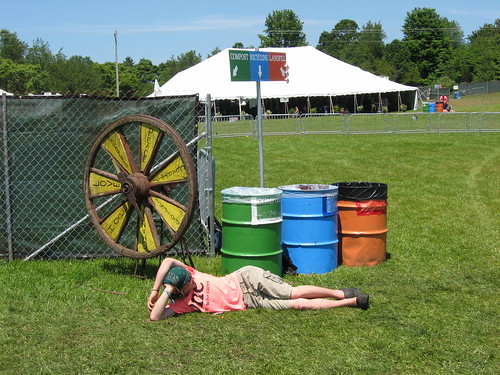
Rothbury really shined when it came to taking out the trash, mostly by doing everything they could to make sure there wasn't nearly as much trash in the first place. A crew of more than 500 volunteers manned hundreds of waste stations, each with three different-colored bins for compost, recyclables, and landfill.
A volunteer hard at work manning the waste stations.
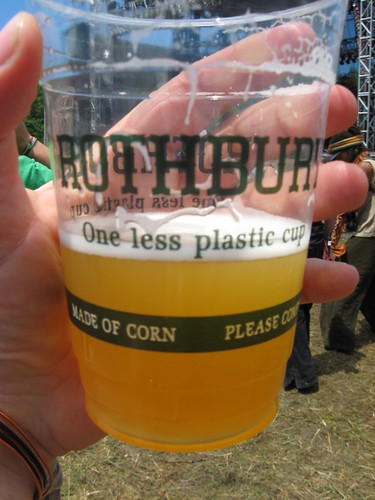
The volunteers were there to make sure that patrons knew which bins to use for things that might not normally be associated with compost. Every vendor was required to purchase compostable cups made from corn, compostable plates made from wheat, and compostable silverware made from rice. All of the beer was either draft or served in aluminum bottles (and by the way, having a couple of non-Bud options was a well-received plus). There were at least 3 or 4 sources of free water in the grounds and patrons were encouraged to bring refillable water bottles. Those of us who chose to purchase $3 bottles of water were served Earth Water, which gives 100% of profits to the UN Refugee Agency to provide clean drinking water to the developing world. And outside of food and beverage items, what is there really to dispose of inside the festival gates?
As the picture above indicates, the volunteers manning the bins looked pretty bored most of the time because organizers made sure from the get-go that everyone knew the deal. The back of the folded festival guide/map, which was itself far smaller than the books given out at other festivals and presumably printed on postconsumer recycled paper, was entirely devoted to a simple graph detailing what belonged in each bin, and once people had been gently instructed by the first volunteer what they should do, they pretty much got it.
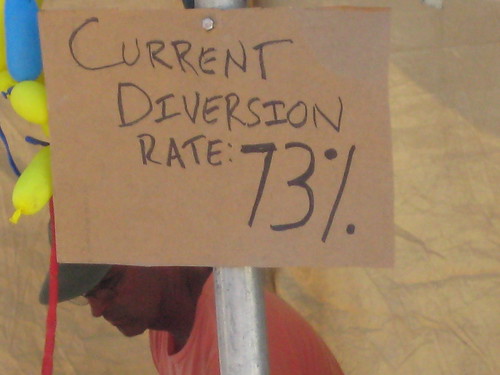
All this attention to managing waste paid off, as Sarah gleefully announced a diversion rate of more than 80% at a press conference dedicated to the green aspects of the festival. When we visited the waste collection area the next day, this was down slightly to 73%. Sarah explained that as they moved between waste collection in the campgrounds and the festival grounds, the figure fluctuated but that they were hoping to end up with over 80% of the waste diverted. Speaking of campground waste, the festival collected all of the discarded tents, coolers, shoes, and anything else of value and donated them to local charities instead of tossing them.
While the volunteers manning the waste stations were happily underworked, the volunteers behind the scenes at the waste station couldn't make any such claims. When a small army of journalists showed up in golf carts to check out composting in action, we found about 10 very industrious volunteers laboriously sorting the contents of every bag of trash, recycling, and compost to make sure that everything ended up in the right pile. The workers seemed to be in high spirits, with Phish blaring from a boombox and once-per-shift cash prizes given to the lucky winner who found the most unusual or humorous piece of refuse. One thing that surprised me was that the compost pile didn't smell nearly as bad as I expected it would, although it certainly wouldn't have passed for perfume. Unfortunately, we were too early to see the giant grinder Sarah had commissioned to mulch the compost arrive to perform its work.
Sarah Haynes in front of the compost pile, holding a bottle of Earth water.
Even the bags that held the compost are biodegradable!
Perhaps the best part about all of this was that the festival grounds were always spotless after fans left. People really seemed to get into the spirit, and there were far fewer discarded water bottles and cups than I've come to expect at the end of most sets. I even had a volunteer walk up to me while I was chatting with one of the festival artists after a set and relieve me of a beer cup I'd been planning to compost later. The crew at Madison House told me that they needed far fewer people to clean up after each set than at other festivals--as few as 7 in one instance, compared to perhaps 150 at a similar event elsewhere. And it showed--in the picture below, you won't see anything at all, not a cup or bottle or even a bottle cap. The organizers even handed out matchbox-sized personal ashtrays, which while certainly not 100% effective might have helped a bit.
Not a speck of trash!
So what went right and what went wrong? This is an easy one--waste collection and diversion was the festival's most visible and obvious success. The only hiccup I found was that we weren't given either trash bags or recycling bags when we entered the festival, although that might have been related to the whole snafu when we entered the festival.
Water and Sanitation
One of the things that can make or break a festival is adequate drinking water and decent restroom facilities. The water stations at this year's Langerado were abysmal on the one occasion when I could actually find water, and the toilets at the 2004 Bonnaroo were among the most disgusting things I've ever witnessed in a long and depraved career, Fear Factor times 10 (the toilets at last year's Bonnaroo were much improved).
So I was very pleased to see that the water stations in the campgrounds seemed to be well laid out. They used the shipping container approach that Bonnaroo pioneered, with trough sinks and a floor to keep you out of the mud, and all the water going to a big frac tank. Showers, reportedly sometimes hot, could be had for $10 with very short lines, and there were a smattering of free water stations inside the festival gates.
The restrooms, standard plastic portolets, were in general as clean as I've seen them at any festival, although we were a bit spoiled by our underused car-free camping restrooms. Some of the restrooms even had mirrors and a shelf for your beer! I can't recall waiting more than one minute for a restroom at any point during the weekend, and by and large the restrooms were located under a light source, one of those simple but often-overlooked touches that really helps keep the filth quotient down.
All in all, the festival did a nice job with these essentials. What went right? Good water services in the campgrounds, free water refills in the festival, and clean and numerous toilets. I can't say anything went wrong, but I'd really like to see the festival break new ground in the US festival scene and push for some really nice compostingtoilets. I'd also like to see a sink of some sort outside some of the larger banks of restrooms for handwashing, or at least a tub of antibacterial gel. I'd also like to see a few more drinking water stations scattered around the festival grounds.
Feeding the Masses
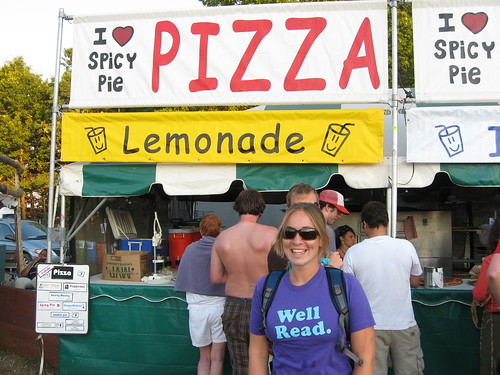
What would a festival be without Spicy Pie? The food here was more of the same--$10 burritos, $5 slices, and so on, but I can't really complain. It was hot and fresh and to be honest, I really do love Spicy Pie.
Anna Whalen lovin' the pie.
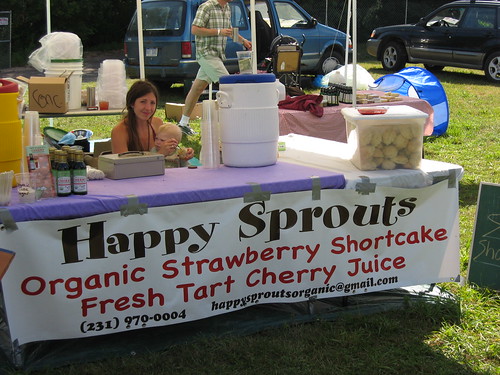
But still, I was hoping for more. After all, we were promised Michigan's largest organic Farmers' Market! And while there was, it's true, a farmers' market, it was tucked off in an out of the way corner, behind the ecovillage and well off the beaten path. Some of the farmers seemed a little non-plussed by their location. After talking to Madison House staff, it seems that two factors contributed to the situation. First, they had to reconfigure the main gates after heavy rains the day before the show opened, and this left the market out of the original flow of traffic. Second, this was the first festival experience for most of the farmers, who didn't want to stay later than perhaps 11:30 PM. This meant that they had to group the farmers' booths in a place where it wouldn't look like the festival was closing up shop early--no one wants to walk by a bunch of tarped up booths during a 24-hour party.
The real disappointment was that the farmers brought stuff that might make sense at a normal farmers' market--things like loaves of fresh bread, quarts of fresh strawberries, and blocks of cheese. But they were located INSIDE the festival grounds, not in the campgrounds. What on earth is a person about to spend six or eight hours bouncing around from Thievery Corporation to Michael Franti to Primus to Dave Matthews (I know, they didn't play in that order) supposed to do with a quart of strawberries or some raw milk cheese that needs immediate refrigeration? I was begging for a really delicious sandwich made from fresh local ingredients, but all I got were instructions to buy a loaf of bread, a round of cheese, and some meat and make my own sandwich. Not exactly what I had in mind.
About the only portable food at the farmers' market.
In the general store, which I had been assured would have all of my camping needs and plenty more at prices below that of Whole Foods, I found dozens of loaves of fresh, locally made "English Muffin Bread" for $5 each, along with (glass) jars of jam from a local purveyor, also for $5. Unfortunately, the bread was all marked "best when toasted," and I'm guessing that even in RV-Land, there weren't many toasters to be found here. Otherwise, prices were a bit higher than I'd been promised--$2 for an apple or banana on the first day (later marked down to $1), $3 for a bag of ice, and so on. But they weren't too far out of line, and they also had locals in the general store serving what looked like really good coffee to appreciative caffeine-freaks.
So what went right and what went wrong? Well, we didn't starve, and they never ran out of spicy pie. But I had hoped for much better integration of the farmers' market, and slightly lower prices in the general store. Chalk it up to inexperience on the part of the farmers and first-year jitters. Hopefully, next year farmers will get the message that they should have portable food, like sandwiches, ready for our consumption and be ready to stay late or partner with other vendors who are already planning on all-night service. Another option might be to move the market out to the campgrounds and integrate it into the general store. All in all, a great idea that I hope to see again, but one that needs a bit more polish to be fully functional.
Education
One of the most important things a festival like this can do is introduce green concepts to the masses. Demystifying green issues like composting or solar power can go a long way to fostering change in the public at large. Unfortunately, most festivals have relegated their green efforts to poorly done "green villages" filled with leftover hippies and other sixties burnouts selling patchouli and handing out photocopied fliers railing against the evils of cell phones. Maybe you make a tour through the green area, sign a petition, get preached to a bit, and move on to have some fun, but that's about the extent of it.
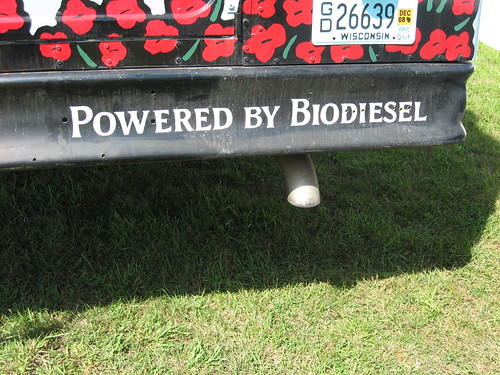
Rothbury, on the other hand, took its educational opportunities to heart. Sure there was something of an ecovillage, with info on solar panels, a biodiesel powered school bus, and a bookstore run by the most excellent Better World Books selling books on climate change. But there was nary a hippie to be seen in the ecovillage, and hip organizations like RVL7 selling some pretty fashionable t-shirts kept people engaged. As far as ecovillages go, it wasn't bad.
But my problem with ecovillages -- even good ones like this -- is that they marginalize the green movement. If we're going to get this whole sustainability thing down, we're going to need a lot more integration into the mainstream. And that's where Rothbury really ramped things up. After all, it billed itself as a "party with a purpose." It's not like fans didn't arrive knowing they were going to be expected to think about sustainability for at least a few minutes. And Rothbury did a good job of trying to expand the boundaries of what a fun weekend could be with lots of intimate Think Tank sessions. These sessions, curated by Dr. Steven Schneider, one of the IPCC Nobel laureates, covered a really broad array of topics and all involved at least one of the musicians performing at the festival. It was somewhat incongruous to see Hunter Lovins of Natural Capitalism fame sharing a stage with Ken Jordan from the Crystal Method, but it somehow worked. All of the seats at the event I attended were full, and the audience seemed interested and was asking some good questions when I ran off to get to my next show.
Award-winning journalist Bud Ward and Ken Jordan of the Crystal Method
But that was the problem--as interesting as the Think Tank sessions looked, they were up against some top quality music, music that people had paid hundreds of dollars and travelled thousands of miles to see. Even a dedicated greenie like me could only find time to attend two of the events during the weekend, partly because the sheer size of the festival grounds made it impractical to keep bouncing back to the venue at the main gate where many of the Think Tank events were held. So as sincere as the effort was, I'm not sure how much difference it made. Still, kudos to the organizers for going with a risky idea--lectures at a music festival? -- and for getting some really top-notch names to participate.
One area that seemed more successful was in artist education. All of the Think Tank sets had at least one musician, which speaks to the level of commitment that many of these performers on the festival circuit have for the environment. And in my conversations with artists backstage, every single one of them was happy to be part of a festival that was promoting a good social cause. I could see the lightbulbs going off for some artists when I was asking them about greening their tours, while other artists seemed really relieved that a festival organizer was finally getting to their level of thinking on these issues. At the end of the day, artists will have far more sway with the general public than organizers at a festival, so it was really heartening to see such a positive response to the message from the performers.
What went right? The overall mainstreaming of the message was a definite success. Artists and fans both seemed to get into the green theme, and Think Tank sessions seemed well attended despite some ferocious competition. Again, I can't say that anything went wrong, but in future years I'd like to see the Think Tanks placed in a more central location and/or scheduled earlier than the music so that we don't have to make such tough choices. I'd also like to see the ecovillage concept, like the farmers' market it shared a space with, moved to a more visible area.
Public Art
Um, yeah.
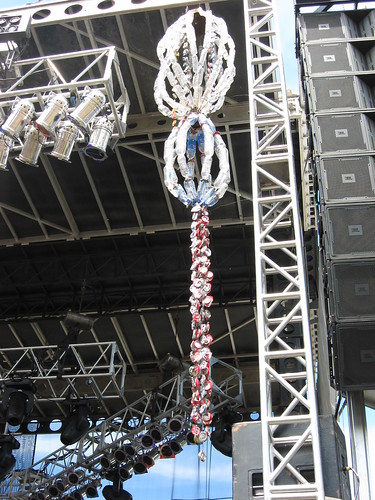
I'll keep this one short, since I know least about it. We were told that all of the art was made of reclaimed or otherwise green materials, and my observations seemed to bear this out. But what was more refreshing was that there was a pretty significant amount of public art in the first place. Some of it, like the giant chandelier-like effects made of plastic water bottles and cans at the Sherwood Court stage, didn't quite work. But on the other hand, the piece de resistance for the entire festival was without a doubt Sherwood Forest, a truly magical place covered in lights, hammocks, a secret stage, with lots of paths to draw you in and places to get lost (but not too lost!). Sherwood Forest, more than any one performance, was the highlight of the festival for me, and I suspect for many others, too. Kudos to the artists who put it together, and I hope that you're able to do something even more exciting with the space next year!
The forest was most impressive at night, but it was also very difficult to photograph. This rather jittery YouTube clip does it a bit of justice, though. Still, you absolutely had to be there. I'm told by my Burning Man friends that this was as close to that event as anything they'd been to.
What went right? Sherwood Forest! What went wrong? Really, nothing--I can't wait to see what they dream up next year!
Community Relations
Big festivals like Rothbury and Bonnaroo have to make sincere and significant efforts to make friends in their host communities from the very beginning or risk being banished. Done right, it can be a real win-win. Done wrong, it can end up with the festival not happening at all--does anyone really think Vineland still has a chance now that the neighbors have formed an alliance dedicated to stopping it?
Rothbury took its green message to the village of Rothbury in some significant ways. The most visible was the donation of $50,000 of solar panels to a nearby school. The panels, put up by Black Rock Solar of Burning Man fame in collaboration with a Michigan-based solar installer, will be augmented by more panels funded by the voluntary $4 donations that thousands of fans chipped in. And Rothbury went to great lengths to make sure that the money that would have gone to paying the electric bill stays in the school to make life better for the students.
The festival also bent over backwards to find local sources for as much as possible, including a local biodiesel company that produced the fuel from local waste animal products, the farmers in the farmers' market, and even semi-local artists like Betty Lavette, who gave one of the most inspired performances of the weekend.
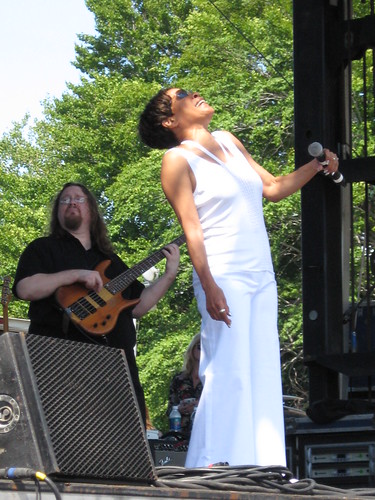
Betty Lavette belting it out.
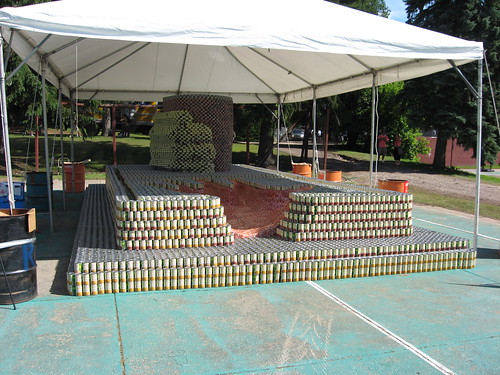
Beyond that, the festival worked with Conscious Alliance on a food drive and organized a new world-record for the largest canned food sculpture ever, with more than 50,000 cans in the shape of one hand giving a can to another. I heard through the grapevine that the food drive was the most successful ever for the group, with more than 40 bins of food collected the first day alone. All of the food collected went to local food banks.
This is what 50,000 cans of beans look like.
Finally, as I mentioned above, the festival worked diligently to keep useful goods left behind by patrons out of the landfill, setting up a "free yardsale" for local charities to reuse the myriad of shoes, chairs, and tents left behind.
Wrap up
All-in-all, it was a fantastic weekend. The music was perfect, the vibe was uber-relaxed and friendly, and people really seemed into the idea of a socially conscious festival. Aside from a few very minor quibbles, everything went flawlessly, and all I can say is that I can't wait to go back next year!
It's been 5 days now since Rothbury ended, and I'm still caught up in the post-festival bliss that you get from a really great out-of-mind-and-body experience. This was my sixth big camping festival, and the first one where I felt that just about everything right. I had more fun at this event than I've had at any of the past festivals, even Phish's IT festival. But this is a green review, not a review of the festival in general, so let's begin. If you want to read more about the music and see some much higher-quality photos of the event, check the official JamBase review here.
Back in April, I interviewed Sarah Haynes of the Spitfire Agency about the greening of Rothbury. I've done interviews with plenty of festival organizers in the past, and they all talk a good game, so I was a bit skeptical when she told me everything that the festival would be doing. But as we got closer and closer to the festival, the press releases just kept rolling out. Solar schools, a food drive, fans offsetting their emissions, seminars on environmental issues. I started to get excited a few weeks ago. Would it all work out as Sarah had promised me?
Sarah Haynes in front of the compost pile at Rothbury.
In a word-yes! That's not to say there weren't some wrinkles, but they were all entirely forgiveable, especially considering that this was a first year festival. We'll get to the minor quibbles later, but for now let me repeat what I wrote on Sunday--congrats to Sarah, AEG, Madison House, the Double JJ Ranch, and all the hard-working green volunteers for pulling off what may go down as the first ever really green festival, especially at this scale.
Some people, especially folks who are familiar with some of the great work that has been done by Bonnaroo, may ask what made Rothbury different from other festivals. After all, Rothbury is not the first festival to use biodiesel, or compostable cups, or offer free water, or work with the Conscious Alliance to do a food drive, or do most of the other things that happened here. So here's my take: the difference between Rothbury and its closest competitor, Bonnaroo, is one of marketing and commitment. And since comparisons to Bonnaroo were rampant throughout the festival from just about everyone I talked to, I'll address the issue head-on.
Bonnaroo has long been the green festival leader, especially in behind the scenes activities, but outside of their green village, they've kept their greenness under wraps, well hidden from the fans. People come to Bonnaroo to party, and while they're there, maybe they'll recycle their beer cans. Superfly has gone to great lengths to green the event--when I last visited Manchester in 2007, the event featured compostable cups and plates, compost stations, organic cotton T-shirts, high-quality carbon offsets, and lots of work with the local community to make sure that Manchester saw tangible benefits from hosting North America's biggest party. But practically no one knew about this stuff. It wasn't until my second day at the festival that someone at the tiny green info booth told me the cups were compostable, and the compost stations were scarce and poorly explained. None of my friends, most of whom were decidedly non-green thinkers, knew or cared about the green aspects of the festival, and the whole green agenda, despite a very real and sincere effort from management, never really caught the attention of the hard-partying crowd. To me, that's a failure of marketing.
On the other hand, while Superfly is committed at the top levels of the organization to greening the event, greening still seemed to me to be of secondary importance to putting on a great festival, as if music and the environment were somehow mutually exclusive. I guess the best way to say it is that Superfly is committed to greening Bonnaroo, but not 100% fully committed, willing to bet the farm (as it were) on the idea. To me, it seems that management has some fear that the fans might react badly if Bonnaroo came out too visibly in support of a green agenda and the festival would get labeled as "too left of center," if that's possible. So much of the good green work that Bonnaroo has done - and there is a tremendous amount of great work being done there - goes unheralded, relegated to a page on the website instead of being brought out front and center for the fans while they're at the festival. At the same time, it doesn't feel to me like Laura Sohn, Bonnaroo's greening coordinator, has been given the same kind of free reign that AEG gave to Sarah Haynes. This isn't to say that Laura isn't as good at her job or doesn't care as much--it's just that to me it seems there is definitely a point at which Superfly is willing to say "that particular green product or idea is cool, but it's going to cost too much." It's a different attitude from Madison House, who might approach the same product or idea with "that's cool and it's important that we do it, so we'll figure out a way to make it work in our current budget."
As an example of my point about the difference in the levels of marketing and commitment between these two very green festivals, let's compare the mission statements of the two. Rothbury bills itself as a "party with a purpose" and on the website, they give us the following mission statement:
That's pretty strong stuff, but talking about something on your website isn't really the same as taking action. I was pleased to see that they had this mission statement posted in at least one very prominent location in the center of the festival grounds, where the largest possible number of fans would be sure to see it. To me, that's marketing and commitment. As for Bonnaroo--well, I know from personal experience and conversations with the crew that they believe strongly in this stuff. But they don't really let it show, either on the website or at the festival, outside of the hippie feeling Planet Green. So it shouldn't be surprising that try as I might, I couldn't find a mission statement for Bonnaroo.
If you were to draw a matrix and compare all of the things that Bonnaroo and Rothbury actually DO--the compostable cups, the extraordinarily high waste diversion rates, the efforts to involve their respective communities, the offsets and carpooling and contracts with Mr. Busdriver, and all the other good stuff, you'd be hard-pressed to pick a leader. But while they're neck and neck on paper, Rothbury wins hands down when you actually go there to experience it, because the festival really seems to have captured the attention of the audience, or at least a big portion of it. And as we'll see in the interviews I did at the festival (transciptions coming soon, I promise!), many of the bands also climbed on board the big green bandwagon. For me, that's where the difference really lies--the fans and artists at Rothbury really seemed to get it, and they seemed to enjoy it, too. At Bonnaroo, I couldn't even get my own friends to separate their recyclables.
And with that, I'll finish my comparison of the two. Lest you think that I am being unfair to Bonnaroo or overly glorifying Rothbury, let me leave you with this thought: As a concerned environmentalist and an avid music fan who wants desperately to see the music scene get greener, it's in my best interest to see festivals and artists competing visibly to see who can be the greenest. And as a journalist, one of the things I can do is help spur that kind of competition. In other words, it's round 1 for Rothbury, but I fully expect Bonnaroo to strike back hard next year and I can't wait to see what Laura and the Superfly crew dream up now that the gauntlet has been thrown. You've got 11 months, gang--git'r'done!
In my next post, I'll dig into the nitty gritty of the greening efforts at Rothbury. I hope you like the smell of compost!
Sadly, we're on the last band of the weekend. I'll have plenty of in-depth material about the greening of Rothbury, the mood of the festival, interviews with artists, photos of big stinky compost piles, and much more in the days and weeks to come.
But before I get to all that, let me say one thing: Congratulations! Congrats to Madison House, AEG, and the Double JJ ranch, congrats to the volunteers and artists, and especially congratulations to Sarah Haynes of Spitfire. This festival was an unqualified success on every level. Rothbury delivered on the music, the greening, the location, the weather, the art, and the vibe. I don't think I heard a negative comment all weekend, and I for one can't wait to come back next year.
So what do you need to know about this festival? You need to know that despite a couple of minor first-year jitters, it sets a new bar for green festivals in the U.S. You need to know that the artists and fans I talked to, without exception, were excited about the greening and social justice aspects of the festival and anxious to learn more--which means that the competition now has to aim higher. Everyone who went to this festival, with its spotless grounds, clean restrooms, completely integrated greening, and overt but not annoying social messages, is going to notice when the next festival they attend doesn't match up.
You also need to know that Rothbury set the bar high, but not so high that there isn't room for improvement. I fully expect future versions of this festival to fine tune the great work that started with this year, with changes both big and small coming along. And you need to learn the name Sarah Haynes, who with this festival has cemented her place at the top of her game, perhaps matched only by the folks behind Live Earth and the Reverb crew. Sarah's already working on greening certain aspects of Burning Man and the Virgin Music Festivals, and you should expect even more bigger things from her in years to come.
If you're a Phish fan, you need to know that as expected, Mike Gordon came out to join Trey at the end of Trey's set, where they introduced two new songs and did a slow, instrumental version of "Chalk Dust Torture," then stole the entire audience from Gov't Mule for a more electric set with Mike Gordon hosting Trey on another stage.
Finally, you need to know that until you have seen Thievery Corporation from the front row, you haven't lived. Sorry, Dave fans--this weekend's top show was stolen by the boys from DC.
Stay tuned in the coming days and weeks for pictures, analysis, and interviews.