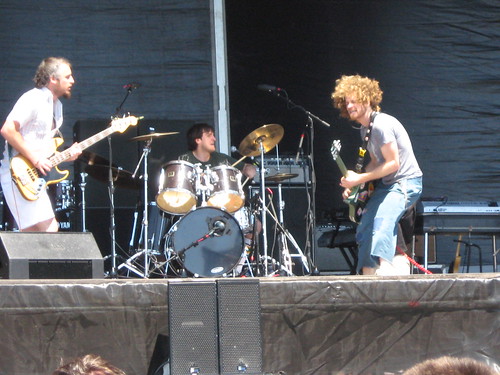
State Radio performing their new megahit "Recycle or Die" at Rothbury
I had a chance to talk to State Radio briefly at Rothbury about their upcoming bike-friendly show in Boston, the Story of Benjamin Darling, and their upcoming new megahit, Recycle or Die. To cap it off, I ran into Julie from Earphoria, who has been collecting fantastic acoustic sets backstage with musicians for the past couple of years. She got a few songs from State Radio at Langerado and was kind enough to lend me one to wrap up this post. Enjoy!
Jason Turgeon: Since we only have about 10 minutes, let's jump right in and talk about the bike thing. That was kind of out of left field for us in the Boston scene. You're known for being political but not necessarily known for being environmentally leaning. How did the whole bike thing happen?
Chad Urmston: I guess usually the political and the environment sort of go hand in hand. So we're always trying to figure out...we offset our tours and try to get our carbon footprint as minimal as possible. But Bikes Not Bombs was a way to...we know bands like Radiohead did an impact study, and the greatest footprint was from fans coming to the shows and all the carbon emissions from the vehicles, so one of the things to try to combat that was to think about different ways of transportation. Obviously, Bikes Not Bombs is a great organization and one that we felt we could team up with to try to swing the pendulum, especially as gas prices get higher and higher.
JT: Did you know those guys already, or did you approach them for this?
CU: We approached them for this. We didn't really know them. But there's going to be a bunch of things at that show, a bunch of different foundations, both politically aware and environmentally aware.
JT: Is this something you're going to try to repeat at different shows?
CU: We'll see how it goes. I think we'd like to...we just got off the justice tour with Tom Morello, and he did something where we did a service day, and then the next day we would do a show. So it's cool to have the message in the music and to have things at the merch table, but it's even cooler to actually do something.
JT: How was the venue to work with? Were they cool about it or were they resistant to it?
CU: They were totally cool.
JT: Is this the kind of thing you think they might do again after you leave?
CU: It depends. It's logistically sort of a nightmare. It's like, it's 11:00 or 11:30, and people are on their bikes and where are they going, and do people have their helmets, and do they have reflectors...I'm not sure, we'll see how it goes.
JT: I was [at Montreal Jazz Fest] and they just had bike storage all around the perimeters, gated off with big floodlights.
CU: I think the international community is way more bike aligned than we are, especially when we've been to Europe.
Mike "Mad Dog" Najarian: Wrigley Field in Chicago has got a nice bike storage center. They're pretty bike friendly there.
JT: When you do your tours, do you think "I don't want to play Tweeter because the only way for everybody to get there is to sit in traffic?" Do you look for venues that are closer to public transportation?
CU: Yeah, that's the idea. I don't think we have in the past because we haven't been big enough. We haven't had the luxury of being choosers, but as we move forward, we're trying to be as green as we can. We're traveling around now in a van, and we're getting a biodiesel fill up this afternoon. We feel like we're doing OK but we could always do better.
JT: How about [Rothbury]. Was the green side of this festival a draw for you or was it just another gig?
MD: Yeah, definitely.
JT: Are the other artists that you're talking to into this?
MD: Franti was doing a Think Tank today.
CU: He's signing his book, too.
JT: Are the fans OK with this? They obviously like hearing the political side. Do they respond to you guys when you do green stuff?
Chuck Fay: We'll see in Boston. See how many people ride their BMX down.
CU: We just found out that Ed Vedder is doing a solo show down the street, so he might ride with us.
JT: I'll put it in the blog. We're calling Eddie out!
MD: Ride with us, Eddie!
JT: Anything else that you want to talk about?
MD: I got my solar backpack (holds up bag). So I'm off the grid.
JT: So we'll switch to just music. Is there going to be a story of Benjamin Darling, Part 2? I want to find out what happens.
MD: Definitely.
CU: It's not so uplifting. But it's interesting. I felt like Part 1 is pretty uplifting, it's a nice story. But generations later, it gets worse.
JT: Do you have plans to write any environmentally-themed stuff?
CU: We have one song called "As With Gladness," we'll be playing it today. It sort of personifies the earth, sort of Mother Nature giving herself over to mankind, and how mankind sort of betrays her gift. The message is a little subtle.
CF: Which is cool, we don't want to get out there and be you know...trees!
MD: [singing} Recycle...or die!
CU: That sounded pretty good. Whoa, whoa! Is this recording?
CF: Send that over, JamBase!
CU: [singing] Recycle...or die!
JT: I'll put a little clip of that up there. The new hit from State Radio, Recycle or Die.
CU: The new megahit.
CF: ROD, as we like to call it.
That's it--thanks again to State Radio for taking the time to talk to me, and to Julie and the Earphoria.net crew for letting us share! Look for more great acoustic stuff from Earphoria as I do more interviews. Meanwhile, enjoy the music below, and first one to get me a picture of Eddie Vedder on his bike gets a free prize...
I'm fresh back from a weekend in sunny South Florida, where I spent four days at Langerado in its new location at Big Cypress. It was a great trip, with a (mostly) outstanding lineup, fantastic performances, and a secluded site. But was it as green as the organizers had promised when I interviewed them last month?
The short answer: not really. But that doesn't mean that they gave up on greening, or were greenwashing the festival. It just means that this was a festival that is trying to be green, not a green festival. It was hard to tell what was going on behind the scenes. More to the point, it seemed at times as though the organizers were a bit over their heads in a festival of this size, and while scrambling to keep up, the greener details got lost in the shuffle.
So what were the green aspects?
To start, there was Greenerado, envisioned as a green educational "ecovillage" located at the center of the festival, complete with a small stage. It was a nice idea, but this village was really just a couple of eco-themed merch tents--organic skin care (free sunblock, though-nice move!) and bamboo shirts, along with a "sustain your soul" tent I never quite got the gist of and a sparsely populated silent auction.
There was also a tent set up for topics with titles like "Living the Scene: Sustainability in Music, Activism, and Politics of Sustainability," but when I showed up, there was no one there. I managed to find Bryan Birch of ZeroHero, the event's greening consultant, who told me that they'd had trouble getting artist participation. This shouldn't be too surprising--given the stellar lineup and the crowds, I'm sure the artists had other things on their mind. I know the fans certainly did. The non-profit tents seemed to be limited to an Audobon Society exhibit on the Corkscrew Wildlife Sanctuary and a tent dedicated to destroying Florida Power and Light. The inside of this second tent had a collection of photcopied handouts with titles like "Work Sucks" and "Cell Phones Suck." The first one, at least, seemed to resonate with the crowd.
On the other hand, the Greenerado stage was bigger than the solar stage at Bonnaroo and had legit performances by really good bands. I found myself there at least a half-dozen times over the course of the weekend, not for the green aspect but for the music. If the organizers can beef up the content at Greenerado in future years and keep the quality of music on stage there the same, they should be able to really draw some people in to the greener side.
Outside of Greenerado, there were recycling bins at every trash station, which the crowd seemed to be using as they were intended. And Bryan told me that they'd managed to fuel every single generator at the show with 100% biodiesel, which we later clarified to mean 100% B20 (20% biodiesel). While there's a growing backlash against certain forms of biodiesel, it's still better to get vendors accustomed to it now and open up the door for truly sustainable biofuels that are coming down the pipe, like algal biofuels.
During my pre-show interview, I'd been told about the "positive legacy program." If there was any work done on this front to leave Big Cypress and the Seminole Tribe better off than they started, it wasn't well publicized. Similarly, there was supposed to be work done on "sustainable product sourcing." Outside of the compostable (but not actually composted) cups at the VIP beer tents and the ludicrous water pouches described below, I'm not sure what the sustainable products were.
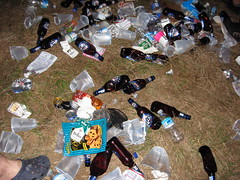
On the waste management front, Clean Vibes was out in force doing its usual bang-up job of keeping the festival grounds picked up. There were recycling bins at every trash station, and it seemed like most festival goers were using them properly. But I didn't get any trash or recycling bags when I walked in off the bus, and several of the folks who drove in told me they didn't get them, either. The result was that the camping areas were pretty well trashed when I left on Monday morning. I couldn't find any evidence of a composting program. I did see a couple of people walking around with compostable beer cups, which were apparently in use at the VIP tent, but without composting facilities these don't do much good.
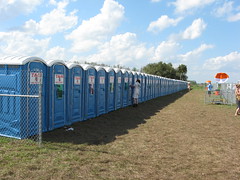
Speaking of composting, the festival toilets were standard composting toilets, not the new composting toilets springing up in Europe and Australia. Hopefully we'll see a lot more composting coming to US festivals in the next couple of years. A location like Langerado--normally used for pasture, with thin soil, would be a perfect spot to compost a mix of food scraps, compostable plates, etc., and humanure. And quite frankly, just about anything would be preferable to the current festival toilet situation.
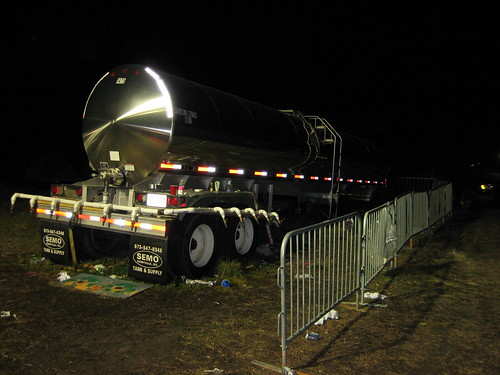
Food was standard fare--I saw nothing touted as organic. There was definitely nothing local, not even fresh citrus products. But food wasn't the real issue. The biggest logistical problem at the festival was the lack of water. To be blunt, the organizers completely dropped the ball on this one. In the camping area, there was only one tanker truck of water that I could find, and it wasn't well set-up for washing--just a bunch of taps over what soon became a muddy mess. Both Saturday and Sunday mornings, as everyone went to get cleaned up, the tanker ran dry. On Sunday morning, I saw a handful of people on top of the tanker. They had opened up the top and were hanging down by their knees, trying to fill up their nalgene bottles from the puddles at the bottom. One of them nearly fell in when his buddy released his ankles to retrieve the nalgene.
The water woes were even worse inside the festival area. The only water for sale--including at the general store--was $3 a pint pouches that looked like bigger versions of Capri Sun. No gallon jugs, no cases of bottles, nothing. We weren't allowed to bring in water except in small sealed bottles, and there was NO free water inside the venue. This is a practice that should be outlawed at all big outdoor events. Forcing people to pay $3 for a pint of water--$24 a gallon--when they're standing around in the sun all day is criminal. Langerado was very proud of the special "low-energy" pouches of glacial melt water they trucked in from Utah. That's straight-up greenwashing, I say--trucking water 2000 miles is not "low-energy," and not giving people water at an outdoor festival in 80 degree heat is just wrong. Everyone at the festival was exceedingly upset about this, especially those of us who flew in to take the shuttle and didn't have the opportunity to stop and buy supplies, like cases of water and beer ($5 a can for Miller Lite).
That brings me to another problem with the greening of the festival--traffic. The site is fantastic, but it's 14 miles down a road off the main freeway with no other access to the festival site. The inevitable traffic jam was over 4 hours when I arrived on the shuttle, and I heard unconfirmed rumors that on Saturday the line was backed all 14 miles up to Alligator Alley. The festival had a chance to really promote some great alternatives to traffic with the shuttle service it offered ($60 round trip), but it dropped the ball. Flying in was a miserable experience--we got off the plane and onto the bus, with no stops for food or supplies. The buses waited in the same traffic, although we pooled our funds and bribed our bus driver $250 to drive illegally down the left lane (into oncoming traffic) and get us in more quickly. We were dropped off in a muddy field with no direction and just pitched our tents at the first spot that looked good. With limited baggage, none of us had any of the amenities--like food, campstoves, or coolers--that make camping at a festival bearable. And with no car to secure our goods, theft was a problem. I had my tent entered, and although nothing was stolen from my tent, my neighbors were relieved of their bags--including clean clothes and plane tickets--while they watched the closing set on Sunday night.
Flying in isn't great for the environment, but people are going to continue to fly to festivals, so organizers should at least make an effort to get them out of rental cars. I would have gladly paid another $40 or more on top of the $60 bus fare to get a decent tent site, close to the action, with shared coolers and barbecues and some sort of secure storage area. We should have had the option to stop and buy supplies or buy supplies at reasonable rates on site. Our bus drivers should have been instructed to take a back route or jump the line--for every 50 people in a bus, that's 12-20 cars that aren't in line, so busing in people makes much more sense, and bus passengers should be rewarded for getting out of their cars, not punished. Coming in by plane and bus should be an almost VIP-like experience. After all, the festival organizers are making a profit on the bus tickets, can squeeze more people into the camping area without cars, and will save money and headaches on traffic management. Environmentally, buses could save thousands of gallons of gasoline and reduce the associated air pollution over the masses of idling cars they replace and by reducing the overall traffic flow.
In summary, it wasn't bad, but it was a long way from being a truly green show. The organizers really seem to want to be greener, they just haven't figured out their strategy just yet. If they can repeat the amazing lineup, get the same quality of performances and fine-tune their logistics, this show has serious potential. Hopefully they will live up to that potential in a sustainable way. My overall green grade: C
In preparation for my trip to Langerado, I thought it would be nice to learn a bit more about the wonderland that is Big Cypress and some of the environmental challenges that face the area. I already knew from a trip to the nearby Everglades last year that water resources are the key to everything in this part of the world. The Everglades and adjacent Big Cypress have a number of conflicting roles--they must provide water for crucial natural habitat, water for a good part of the the megalopolis that stretches from Miami to Palm Beach, and water for the agriculture that is still so important to Florida's economy. As if that weren't enough, the water itself is stressed. Pollution from stormwater runoff, people; man-made barriers that block the natural flow of the water; encroaching development on all sides...things can get pretty gloomy if you dwell on the issue for too long.
While I was digging around, I found the South Florida Watershed Journal, an informal source of news about the Big Cypress-Everglades watershed. The SFWJ is the place to go if you want more info about the state of the watershed and the ecological systems it supports, or if you just want some great pictures of local flora. The best part about the SFWJ is that it's not gloomy at all. News is presented in the bigger scientific context and there's almost no hype at all.
After a round of emails so fast it would almost make you believe in your government again, I was able to coerce Bob Sobczak, Managing Editor of the SFWJ and National Park Service Hydrologist at Big Cypress National Preserve, to contribute a guest post to the blog with an update on current conditions and some advice on what to do when you're not listening to music. I hope those readers who will be joining me at Langerado have time to take his advice and visit some of the surrounding areas. I know I'll be bringing some sturdy shoes for a couple of morning hikes.
Thanks, Bob, for your guide to the area! Hopefully we'll see you at Langerado 2009.
I've always been a big fan of getting a thumb-nail awareness of the greater watershed wherever and whenever I travel. For example, I was just up at a conference in Gainesville, which is just north of scenic Payne's Prairie, which was fun to find out more about, and briefly hike through. Of course I only had time for a brief view -- as the conference was packed with talks just like the Langerado music festival is packed with must-hear music.
But, in the chance that you do have a chance to sneak away from the festival -- for a few hours, or for a half day -- you are in good position, smack in the middle of the expansive wetlands and waterways of south Florida's interconnected waterways.
The water cycle connects them all.
In south Florida its constantly turning, and never ceases to amaze in its details, and interaction of all its parts. The challenge in south Florida is to tap into the water cycle in a way that sustains both us and the natural places we love. The water cycle starts with the sky: south Florida gets around 50 inches of rain per year, but three-quarters of that falls during the 6-month wet season, starting in late May and ending with the wind-down of hurricane season in October. South Florida is water plentiful when you compare it to other regions -- such as the 4 inches of annual rain that falls at Hoover Dam -- but the seasonal signature of rainfall means that the prospect of drought and flood is always at our doorstep.
That pendulum has swung in the direction of drought in recent months, as you may have heard.
To the north, Lake Okeechobee is at an all-time low for early March. We're in the middle of our second consecutive year rainfall was scarce over the Lake and upstream Kissimmee Basin. It was just 6-months ago in June 2007 that Lake Okeechobee dropped down to its lowest recorded level ever (~8.8 ft above mean sea level), and water managers are bracing for the Lake dropping to even lower in the months to come. Don't miss the opportunity to see and touch the big lake at this historic moment.
Or you could travel west to Audubon's Corkscrew Swamp Sanctuary. It offers a hike through the last and largest stand of old growth cypress in south Florida. The Redwood Giants in northern California grow as tall as 350 feet. The old growth cypress of Corkscrew are about a quarter as tall, but no less scenic, and are the arboreal giants of south Florida. The hydrologic story there was the year without a wet season. The rule of thumb in south Florida is that we always have a wet season -- yes, it varies in magnitude, but we can always count on the summer rains to fill the swamp up with water. Not in 2007. Or almost not. The summer rains did manage to push the water table up into the deepest portions of the swamp, but it was the shallowest summer seen in Corkscrew since 1970.
Or you could travel south to Big Cypress National Preserve and Fakahatchee Strand State Preserve. Best known for the scenic view of cypress domes and strands where during the summer surface water rises to knee-high depth, both contain a diverse mosaic of wet prairie and pineland uplands. (Keep in mind these are Lilliputian uplands, only a foot or two higher than the surrounding cypress). The big story was the surprise +5 inches of February rain. That's tied a 25-year February record, and refilled the swamps with surface water, effectively rewinding the water cycle back in time several months.
Or you could travel to the east into the Everglades. Don't miss your opportunity to see the sphinx-like structures -- geometrical and speechless -- that control flow into its different basins, or cast your eye out into the vast sawgrass plain. A few of them are still open, but most of them are closed for the dry season. Everglades National Park is at a 17-year low; that's in respect to both inflows entering the park from across the Tamiami Trail and in terms of water levels in central Shark River Slough, the main wetland water body that meanders through the Park and discharges into downstream Florida Bay.
That's just a few of the places you could go, or think about, not to mention the beach.
But most of all enjoy the music. I'm a big Bob Dylan fan myself.
In the event that the music is too good or you can't get away, The South Florida Watershed Journal (http://sfwj.blogspot.com/) brings the story of south Florida's water cycle and its interconnected watersheds right to your fingertips.
Enjoy a safe and happy stay in south Florida. And remember, wherever you are, find a way to stay in tune and in touch with your local watershed.
So thanks to my recent interview with Kelly Viau, I was able to score myself a press pass to Langerado, on the condition that I do a little pre-show publicity. I'm so OK with quid pro quo (outside of my government day job, natch), it's not even funny. But my interview recently pretty much exhausted the green agenda at Langerado, so I think I'll put up a couple of posts between now and March 6 investigating whichofthemanybandsperforming are so green it hurts and which ones just want your money. And when I get back, after I take a shower and detox my liver, I'll report on just how successful the greening effort really was.
Is there a band in the lineup you want me to dig up some dirt on? Hit me up in the comments. Now, here's a little (video) story about three young brothers you know so well:
I was lucky enough to spend an hour with Kelly Viau, Bryan Birch, John Long, and Lucas Erickson for an interview earlier today. Kelly works for two separate companies that share several employees. Not only does she handle sponsorships for Cloud 9 Adventures, the production company behind JamCruise and Caribbean Holidaze, but she also works for Langerado, the rapidly growing music festival coming up next month at Big Cypress Seminole Reservation outside of Fort Lauderdale.
John, Bryan, and Lucas are the three founders of ZeroHero Events, an event greening service based in Fort Collins, CO, that is helping to green both Jam Cruise and Langerado. When they're not greening other people's festivals, they're dreaming up ways to make their own festival greener. Now in its 9th year, the Rocky Mountain Sustainable Living Fair is expected to draw 10,000 people and 150 vendors this summer, and the ZeroHero crew is working hard to draw a few big-name bands to the event this September. Bryan handles the education component of ZeroHero's events, John is the renewable energy guru and founder of Blue Sun Biodiesel, and Lucas works to make sure mountains of waste aren't left behind.
An hour wasn't nearly enough time for me to ask all the pressing questions I had about how the team has tackled the big job of greening these festivals, but we gave it our best shot. Our conversation ranged from the best species of mustard to use for sustainable biodiesel production to the pressing need for condoms on a tiny tropical island off the coast of Honduras. Enjoy!
Jason Turgeon:Tell me about the relationship between ZeroHero and Kelly's work.
Bryan Birch: We came on almost a year ago to help reach new heights by improving to improve the practices of the cruise ship, which was a really interesting venture. We further developed a recycling program and focused on using more sustainable products. The Jam Cruise “Leaving a Positive Legacy Program” was a huge success this year. We offloaded three pallets of school supplies for school kids in Roatan and condoms for an AIDS clinic there working with Trojan as a sponsor. Kelly helped out with pulling sponsors like Trojan in. We're trying to develop a positive legacy with JamCruise. That's also an important part of the process for us in all our work. In festivals, there's an incredible wealth of talent and resources both from artists and passengers. There's a very conscious crowd in the scene, and everyone is always willing to help out.
Kelly Viau: The greening program on JamCruise has been part of the event since the first year, and is led by the vision of Ann Kenworthy. [note: the most recent event was JamCruise 6]. For a number of years we worked with Rock the Earth. This past year we made the move to bring in ZeroHero to bring some of these programs to the next level. It's something that's sort of developed over the last six years.
Lucas Erickson: It's an evolution, it's a process, where every year we try to continue to improve what's taken place next year.
JT: How does your choice of a particular ship or cruise line impact your ability to green the JamCruise event each year?
BB: This year with MSC, they valued us a customer so much that they opened up support for us for the 5 day cruise. They gave us a great deal of access, and we had a lot of support from the cruise staff.
JT: Do you think what you're doing is carrying over to other cruises after your event is done?
KV: I think it absolutely impacts the way they approach other cruises. This will be our fourth year with MSC. We're starting to see littlle changes throughout their other cruises. They're not huge steps for people like us that think about this every day, but they're big steps for an organization that doesn't. A little bit really goes a long way. We're now starting to see at least an open conversation on using biodiesel on cruise ships.
JT: Moving on to Langerado, now that you're in Big Cypress, what do you have planned from a green perspective?
BB: We have a set of messages to help improve the event. With each message there will be a program associated with it. The ZeroHero philosophy is to help create an event that becomes green by having aware attendees. Different programs that we're working with specifically are the Leave no Trace program working with Clean Vibes, and Sustainable Product Sourcing, or SPS. Every year it gets easier. One of the biggest challenges to event greening is to get everyone on the same page.
Renewable energy is a huge program aspect this year. Every light tower, every stage, and all the generators will be powered by biodiesel. It's available to artists as well. We're also involved in fueling at Lollapalooza.
JT: Do you see artists asking for access to biodiesel?
John Long: Definitely. For some artists its pretty important, but access has always been an issue. Each year access grows for artists to be able to fill up on biodiesel. It's a real challenge to find, but pump growth and retail locations are expanding. It's becoming a lot more viable for artists and attendees to expect biodiesel at the festivals.
JT: Will you use biodiesel blends or B100?
JL: Basically we've gotten b20 approved for everything--forklifts, light towers, generators. Some of the artists are very interested in running b100 or something in between for their tour buses.
LE: We'll also be offsetting all the carbon emissions from production as well as all the trucks and buses that artists are bringing. We're partnering with an organization called Trees, Water, & People to help with offsetting. And Langerado already has an ongoing partnership with Native Energy for ticket buyers to offset part of their emissions for travel to the festival.
JT: how does Trees, Water, & People work?
LE: They support self-sustaining tree nurseries in Central America. They employ local people to keep those going, and do a good job of making sure that all the trees that they plant are going to grow up to be a mature tree. They also have a another program that's really good called the stoves program. They go into these very low income communities in Honduras and Nicaragua. They've developed these stoves that take the place of the sort of open campfires that people were cooking over in their houses. A leading cause of death in women and children in these countries is respiratory health. They also offset carbon because they use so little wood to keep these going with little pieces of biomass like twigs and pine cones instead of going out and cutting down trees.
BB: One thing that Trees, Water, & People does is hook up their tree nurseries with their stove program. They have hardwoods and fruit trees which they count towards carbon offsetting, and they also have fast growing fuel wood softwoods that they do not. They won the Ashton Award for Climate Change. One thing that's important to us when we choose an offset program is that there is a lot of transparency. This improves social health as well as the environment.
LE: A very important part of that is the economic sustainability that they offer. We're very proud to be working with them.
JT: Do you tie each of these programs into the education component?
BB: That's right. We combine each one with the idea that simple is good. We'll do a series of simple messages that relate to the attendees that will tie into one of the programs at the event. It's a way that we can tie this into things that attendees can do.
LE: It all ties together into the ecovillage that we're setting up. We're bringing a lot of non-profits and for-profits that all have an ecological goal, plus some cool artwork and really interesting workshops.
KV: We call it Greenerado. There's going to be a stage in there, too. Were going to have the Spam Allstars, the School of Rock Allstars, Trevor Hall, Steel Train, Pete Francis of Dispatch, the Wood Brothers, and the Heavy Pets.
LE: The Wood Brothers are going to be there? That's awesome!
BB: We'll be spending a lot of time in that ecovillage. (laughing)
KV: Greenerado is in the heart of the festival, and metaphorically we do consider that to be the heart. What happens there rays out into the rest of the event.
BB: We'll do some positive legacy programs as well. We're still working out some details on what those will be. We'd like to leave a positive legacy with Big Cypress after Langerado is over. Through greening specifically, we'll try to foster that.
JT: Let me ask you to respond to some of the recent criticisms surrounding biodiesel and the use of monocultures and lots of chemical fertilizers to grow crops. Some people question whether or not that's the best way to reduce our use of fossil fuels.
BB: We feel that biofuels are imporant. They're an important transition to a sustainable economy. It's on a spectrum. There are some practices that are already there, and there are some that are along the way. That's where I feel that biofuels, including ethanol, are. There are a lot of biodiesel alternatives that are coming along right now.
JL: Blue sun biodiesel has been working on this for several years to find crops and methods that are fighting monoculture and high use of chemicals in agriculture as well as irrigation, since we're out in CO, essentially in a desert environment. We've been working for six years with canellina and canola, both plants in the mustard family, that are drought tolerant so that we can move away from soy and even worse, palm, where they are basically destroying the rain forest to grow these crops. It's going to take time, it's a transition now, and it's not perfect. We're using a lot of soy in the industry now, but it's better than using corn for ethanol.
The canola is a rotation crop for winter wheat. We're targeting winter wheat farmers in the western states to grow these mustard varieties that will improve the yield and reduce their water use. Some of the varieties will grow without any additional irrigation and with much less chemical input than are needed with corn and soy. Also, they're all non-GMO varieties that we're using.
LE: The future of algae is another feedstock that's very exciting.
JL: Algae is maybe 2-5 years out, but Blue Sun is very involved with several companies that are doing research on it. Jatropha is another very exciting crop, it's a dry land shrub that's native to Central America. You can grow it in Mexico and the oil can be converted to biodiesel and used here. It can't freeze, so we can't grow it in our backyard, but growing it in Mexico, it's closer to us from a transportation standpoint than the midwest. That crop gets 8-10 times more oil/acre than soybeans do. Some of the big oil companies are using it already.
JT: Like who?
JL: BP is growing plantations in Africa and India. There's not a whole lot of production in Central America yet. It takes 2 years for the plantation to mature. That 2 years is the only time that they need any irrigation. After that, the plant needs no water or chemical input, it grows like a weed. Basically it's a living fence, a six-foot high fence.
JT: Considering your new home is in Big Cypress, and the Big Cypress and Everglades areas are really suffering from a history of poor water management, are you going to focus at all on water at Langerado?
LE: As part of the Leaving a Positive Legacy Program, we will be trying to improve the everglades in some way. We're still working out how.
KV: We will do something positive with the greywater from the event. The uncontaminated water will be used for spraying on the roads to cut down on dust.
JT: I guess it's about time to wrap up. Before we finish, do you mind telling me who you're most excited about seeing at Langerado this year?
JL: I'm old school--I'm psyched for the Beastie Boys!
LE: I'm really excited about the Wood Brothers.
JT: I heard you mention them earlier. Who are they?
LE: It's Chris Wood from Martin, Medeski, and Wood, and his brother Oliver. I'm especially excited now that I know they'll be on the green stage. They're amazing, but not very many people know about them, because they're fairly new to the music scene.
KV: I'm most excited about the bands that I've never heard of, the unknowns and the up and comings. That's what I always like best, finding some new bands that I hadn't heard before and getting to know them.
JL: That's very diplomatic of you, Kelly.
LE: Kelly for President! (laughing)
And there you have it. I wish we'd had more time to spend on this interview, as this was a really knowledgeable bunch of people with some great ideas on greening events. Until next time, here's a little video of the soon-to-be-famous Wood Brothers doing their thing.