Zoinks! I hadn't realized that it's been 2 whole weeks since my last post. Life's been exciting on the non-music front for me, with the purchase of a new home and a big move taking up all of my available free time. But now things are settling down and I can get back to what's really important: bringing you the hottest green news from the music industry.
Today we're going with the short and sweet approach to posting. It seems that the oh-so-catchy funkster-horn band Cake has caught the solar buzz. They've gone and installed solar panels on their studio in the Big Tomato and are claiming that their upcoming sixth studio album will be recorded with 100% solar power.
Get all the pertinent details here, and enjoy the video documenting construction below.
In other green news, make sure to check out the band's rideshare board on their website. Sadly, it seems woefully underused, possibly because it's not very well advertised.
Within their quest to design and sell "affordable solutions for better living," Ikea announced this week that they will begin to sell solar panels in their stores in the near future in an effort to democratize renewable energy technologies. No word yet on whether the panels will be renter friendly, but the furniture giant plans to invest about $77 Million in renewable energy startups in order to get the solar panel supply chain up and running so the panels will retail at a low cost to Ikea customers.
In the near term, not quite as sexy, but important, Ikea has pledged to get rid of plastic bags at the checkout line. If you're interested in what else Ikea is doing to promote sustainability, read Grist's interview with Ikea's
In my last post, I drew some parallels between Rothbury and Bonnaroo. That was fun, but let's get to the point--what did Sarah and the gang actually do to make this festival so green? Follow me on a behind the scenes tour through the festival as we dig deep and dig dirty into the nuts and bolts of setting up a temporary city in a green fashion.
Rothbury's attendance came out at somewhere around 35,000-40,000, roughly the same size as Burlington, VT, so it's not a stretch when I say that this really is a temporary city. And just like any other city, festival organizers have to deal with real city issues: waste management, providing clean drinking water and decent sanitation services, community relations with neighboring municipalities, transportation issues, and so on. At Rothbury, they also took on the decidedly city-like tasks of education and public art. We'll cover each of these issues one-by-one in this post. Ready? Let's go!
Transportation: Getting There
One of the problems of a camping festival is that it's pretty hard to find a site that's easily accessible on any kind of decent public transportation. By and large, people drive to these things, with the exception of us uber-polluters who really burn some carbon and fly there. I flew in, feeling vaguely guilty about my vastly inflated carbon footprint, but at least I was able to catch the shuttle offered by Mr. Busdriver and come in car-free.
Mr. Busdriver is a relatively new service, run by a frenetic but cheerful madman named Rick. He's going after the festival market in a big way by organizing bus transportation to and from these festivals. I got to meet him at the festival and he's an all around good guy, but he seemed frighteningly disorganized at times. I think all 7 of us on the special van he chartered to pick up the stragglers at the airport got 4 or 5 phone calls and emails from him in the days before the festival and on our arrival day itself. But he managed to keep it all together and after a 90-minute wait at the airport we got in our van. The driver he hired was good enough to stop at a local grocery store so we could buy some essentials before we got sequestered into the land of expensive festival general stores, so I was able to load up on PBR and cheap gin. In comparison to the nightmarish ride I had in to Langerado, this was pure luxury. I just hope that next time around, he's a little bit more organized.
Our ride in was fast and traffic-free, and as promised we ended up at a special back entrance close to the main gate. Things briefly fell apart there, though. By now it was 9:30, a full 4.5 hours after I'd arrived at the airport 75 miles away, and all of us were anxious to get into the festival. But for some reason, security wouldn't let us in, so we had to cool our heels in the parking lot of a nearby school while Rick frantically negotiated with the guards. Eventually, a compromise was reached, and we were allowed to walk through the gates. This meant unloading all of our bags and groceries, walking through security, and loading our gear back up into a separate van on the other side of the gates for a brief ride to car-free camping.
Once there, we were informed that we would need to be on a 7AM shuttle bus on the way out Monday morning, even though most of us had afternoon flights. Apparently, the 10AM bus had sold out, but at this point we all just wanted to get in. Car-free camping turned out to be great, a beautiful lawn just a 3-minute walk from the main gate and near the general store and merch tents, with a lightly-used (hence always clean) bank of well-lit portapotties right next to us and showers and water station a few minutes beyond.
It's worth mentioning that the organizers planted grass on hundreds of acres of camping areas and on the festival grounds themselves to make things more comfortable for us, and it's a good thing, too. Before we arrived, there were several inches of rain, but there were only a couple of muddy spots. Compared to Phish's IT and Coventry festivals and Bonnaroo 2004, all muddy disasters, this was a fantastic experience.
Of the people I talked to who drove in, not one had any complaints of significant traffic jams on the way in. That's not just a fan-pleaser, but an environmentally good thing. Having thousands of fans sit in traffic for 6 or more hours, as seems to be the case at most festivals, is a huge waste of fuel and a terrible thing for local air quality, never mind the CO2.
Speaking of CO2, the festival offered fans the chance to offset their CO2 in transit for a paltry $3 via the Bonneville Environmental Foundation, with an upgrade to a $7 package that also supported a very large solar project on the school where we cooled our heels. A nice touch was that we could buy these offsets on site if we didn't do it when we purchased tickets. Since my ticket was comped by the festival, this gave me a way to offset my own travel. Organizers reported that about 20% of the fans chose to offset, a huge number in the world of offsets, and the vast majority of those contributed to the school's solar panels.
So what went right and what went wrong with transportation? Well, the lack of traffic jams was a huge plus, although I'm not sure whether to credit this to the size of the crowd or the organizers. The push for offsets and the ease of buying them was also a good thing. Organizers went to great lengths to get people out of their cars and promote carpooling, offering incentives like the fantastic car-free camping and options like Mr. Busdriver. On the down side, the interface between Mr. Busdriver and the festival was poorly done. It's to the festival's benefit to get more people to come in by bus, so they need to better integrate ordering bus tickets into the Rothbury website, work with Rick to set up a schedule of bus service that makes sense and help him fill as many buses as possible, and most importantly make sure that nothing like our horrible welcome by security ever happens again.
The festival also needs to pick one carpooling partner and funnel all the ridesharing to that central location. Pickuppal.com is making a play to be the music-related rideshare organization of choice, but when I spoke with management there, they told me that Rothbury had declined an offer to go exclusive with them because of perceived liability issues. Pickuppal is the official rideshare partner of both Dave Matthews and John Mayer, so it would have made sense to use the service for Rothbury instead of directing us to no fewer than 10 rideshare sites, ensuring that no one site got a critical mass going.
To finish on a more positive note, the festival did a good job of partnering with Amtrak and the local ferry services, and it would be really wonderful to see them expand and better promote these in future years. With some sources predicting $7 a gallon gas by next summer, anything Rothbury can do to help customers get to the site will be sure to pay back with increased attendance.
Waste Management
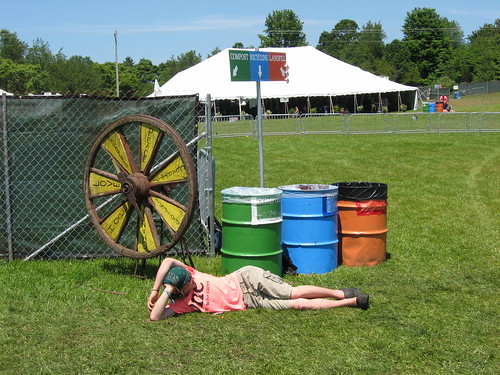
Rothbury really shined when it came to taking out the trash, mostly by doing everything they could to make sure there wasn't nearly as much trash in the first place. A crew of more than 500 volunteers manned hundreds of waste stations, each with three different-colored bins for compost, recyclables, and landfill.
A volunteer hard at work manning the waste stations.
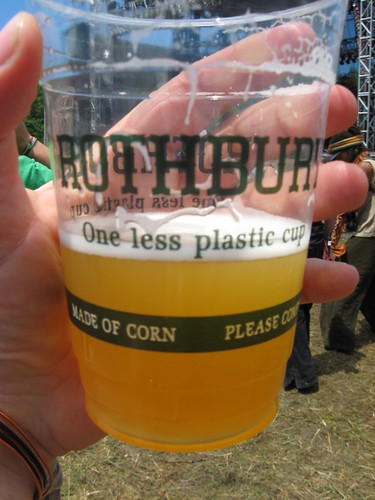
The volunteers were there to make sure that patrons knew which bins to use for things that might not normally be associated with compost. Every vendor was required to purchase compostable cups made from corn, compostable plates made from wheat, and compostable silverware made from rice. All of the beer was either draft or served in aluminum bottles (and by the way, having a couple of non-Bud options was a well-received plus). There were at least 3 or 4 sources of free water in the grounds and patrons were encouraged to bring refillable water bottles. Those of us who chose to purchase $3 bottles of water were served Earth Water, which gives 100% of profits to the UN Refugee Agency to provide clean drinking water to the developing world. And outside of food and beverage items, what is there really to dispose of inside the festival gates?
As the picture above indicates, the volunteers manning the bins looked pretty bored most of the time because organizers made sure from the get-go that everyone knew the deal. The back of the folded festival guide/map, which was itself far smaller than the books given out at other festivals and presumably printed on postconsumer recycled paper, was entirely devoted to a simple graph detailing what belonged in each bin, and once people had been gently instructed by the first volunteer what they should do, they pretty much got it.
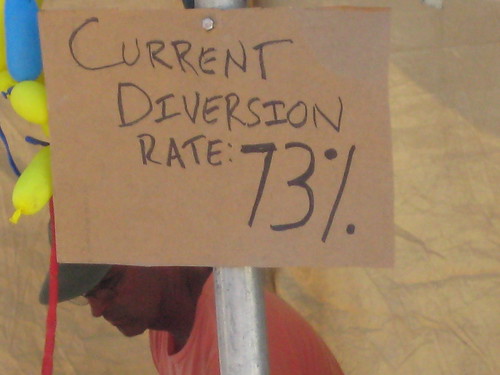
All this attention to managing waste paid off, as Sarah gleefully announced a diversion rate of more than 80% at a press conference dedicated to the green aspects of the festival. When we visited the waste collection area the next day, this was down slightly to 73%. Sarah explained that as they moved between waste collection in the campgrounds and the festival grounds, the figure fluctuated but that they were hoping to end up with over 80% of the waste diverted. Speaking of campground waste, the festival collected all of the discarded tents, coolers, shoes, and anything else of value and donated them to local charities instead of tossing them.
While the volunteers manning the waste stations were happily underworked, the volunteers behind the scenes at the waste station couldn't make any such claims. When a small army of journalists showed up in golf carts to check out composting in action, we found about 10 very industrious volunteers laboriously sorting the contents of every bag of trash, recycling, and compost to make sure that everything ended up in the right pile. The workers seemed to be in high spirits, with Phish blaring from a boombox and once-per-shift cash prizes given to the lucky winner who found the most unusual or humorous piece of refuse. One thing that surprised me was that the compost pile didn't smell nearly as bad as I expected it would, although it certainly wouldn't have passed for perfume. Unfortunately, we were too early to see the giant grinder Sarah had commissioned to mulch the compost arrive to perform its work.
Sarah Haynes in front of the compost pile, holding a bottle of Earth water.
Even the bags that held the compost are biodegradable!
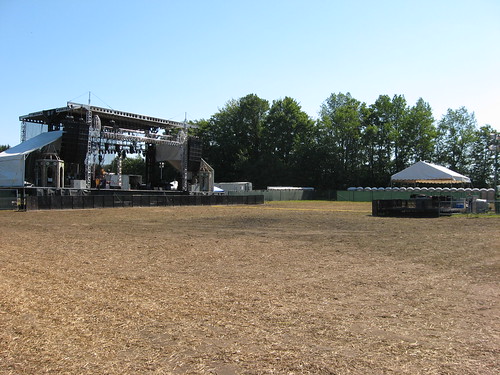
Perhaps the best part about all of this was that the festival grounds were always spotless after fans left. People really seemed to get into the spirit, and there were far fewer discarded water bottles and cups than I've come to expect at the end of most sets. I even had a volunteer walk up to me while I was chatting with one of the festival artists after a set and relieve me of a beer cup I'd been planning to compost later. The crew at Madison House told me that they needed far fewer people to clean up after each set than at other festivals--as few as 7 in one instance, compared to perhaps 150 at a similar event elsewhere. And it showed--in the picture below, you won't see anything at all, not a cup or bottle or even a bottle cap. The organizers even handed out matchbox-sized personal ashtrays, which while certainly not 100% effective might have helped a bit.
Not a speck of trash!
So what went right and what went wrong? This is an easy one--waste collection and diversion was the festival's most visible and obvious success. The only hiccup I found was that we weren't given either trash bags or recycling bags when we entered the festival, although that might have been related to the whole snafu when we entered the festival.
Water and Sanitation
One of the things that can make or break a festival is adequate drinking water and decent restroom facilities. The water stations at this year's Langerado were abysmal on the one occasion when I could actually find water, and the toilets at the 2004 Bonnaroo were among the most disgusting things I've ever witnessed in a long and depraved career, Fear Factor times 10 (the toilets at last year's Bonnaroo were much improved).
So I was very pleased to see that the water stations in the campgrounds seemed to be well laid out. They used the shipping container approach that Bonnaroo pioneered, with trough sinks and a floor to keep you out of the mud, and all the water going to a big frac tank. Showers, reportedly sometimes hot, could be had for $10 with very short lines, and there were a smattering of free water stations inside the festival gates.
The restrooms, standard plastic portolets, were in general as clean as I've seen them at any festival, although we were a bit spoiled by our underused car-free camping restrooms. Some of the restrooms even had mirrors and a shelf for your beer! I can't recall waiting more than one minute for a restroom at any point during the weekend, and by and large the restrooms were located under a light source, one of those simple but often-overlooked touches that really helps keep the filth quotient down.
All in all, the festival did a nice job with these essentials. What went right? Good water services in the campgrounds, free water refills in the festival, and clean and numerous toilets. I can't say anything went wrong, but I'd really like to see the festival break new ground in the US festival scene and push for some really nice compostingtoilets. I'd also like to see a sink of some sort outside some of the larger banks of restrooms for handwashing, or at least a tub of antibacterial gel. I'd also like to see a few more drinking water stations scattered around the festival grounds.
Feeding the Masses
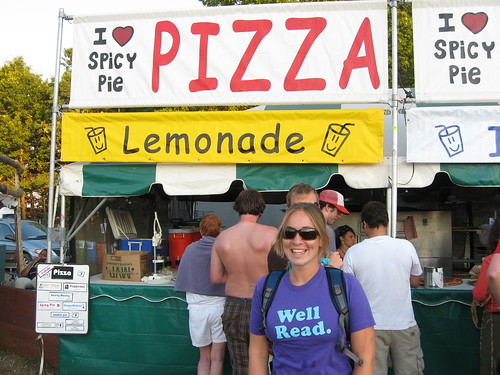
What would a festival be without Spicy Pie? The food here was more of the same--$10 burritos, $5 slices, and so on, but I can't really complain. It was hot and fresh and to be honest, I really do love Spicy Pie.
Anna Whalen lovin' the pie.
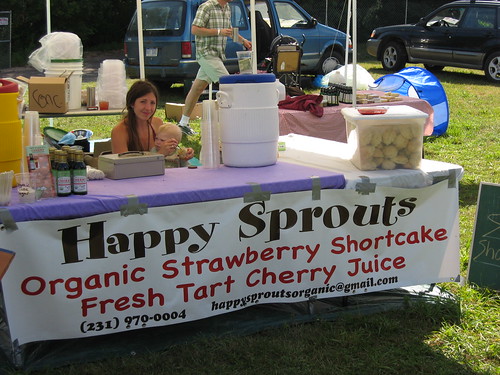
But still, I was hoping for more. After all, we were promised Michigan's largest organic Farmers' Market! And while there was, it's true, a farmers' market, it was tucked off in an out of the way corner, behind the ecovillage and well off the beaten path. Some of the farmers seemed a little non-plussed by their location. After talking to Madison House staff, it seems that two factors contributed to the situation. First, they had to reconfigure the main gates after heavy rains the day before the show opened, and this left the market out of the original flow of traffic. Second, this was the first festival experience for most of the farmers, who didn't want to stay later than perhaps 11:30 PM. This meant that they had to group the farmers' booths in a place where it wouldn't look like the festival was closing up shop early--no one wants to walk by a bunch of tarped up booths during a 24-hour party.
The real disappointment was that the farmers brought stuff that might make sense at a normal farmers' market--things like loaves of fresh bread, quarts of fresh strawberries, and blocks of cheese. But they were located INSIDE the festival grounds, not in the campgrounds. What on earth is a person about to spend six or eight hours bouncing around from Thievery Corporation to Michael Franti to Primus to Dave Matthews (I know, they didn't play in that order) supposed to do with a quart of strawberries or some raw milk cheese that needs immediate refrigeration? I was begging for a really delicious sandwich made from fresh local ingredients, but all I got were instructions to buy a loaf of bread, a round of cheese, and some meat and make my own sandwich. Not exactly what I had in mind.
About the only portable food at the farmers' market.
In the general store, which I had been assured would have all of my camping needs and plenty more at prices below that of Whole Foods, I found dozens of loaves of fresh, locally made "English Muffin Bread" for $5 each, along with (glass) jars of jam from a local purveyor, also for $5. Unfortunately, the bread was all marked "best when toasted," and I'm guessing that even in RV-Land, there weren't many toasters to be found here. Otherwise, prices were a bit higher than I'd been promised--$2 for an apple or banana on the first day (later marked down to $1), $3 for a bag of ice, and so on. But they weren't too far out of line, and they also had locals in the general store serving what looked like really good coffee to appreciative caffeine-freaks.
So what went right and what went wrong? Well, we didn't starve, and they never ran out of spicy pie. But I had hoped for much better integration of the farmers' market, and slightly lower prices in the general store. Chalk it up to inexperience on the part of the farmers and first-year jitters. Hopefully, next year farmers will get the message that they should have portable food, like sandwiches, ready for our consumption and be ready to stay late or partner with other vendors who are already planning on all-night service. Another option might be to move the market out to the campgrounds and integrate it into the general store. All in all, a great idea that I hope to see again, but one that needs a bit more polish to be fully functional.
Education
One of the most important things a festival like this can do is introduce green concepts to the masses. Demystifying green issues like composting or solar power can go a long way to fostering change in the public at large. Unfortunately, most festivals have relegated their green efforts to poorly done "green villages" filled with leftover hippies and other sixties burnouts selling patchouli and handing out photocopied fliers railing against the evils of cell phones. Maybe you make a tour through the green area, sign a petition, get preached to a bit, and move on to have some fun, but that's about the extent of it.
Rothbury, on the other hand, took its educational opportunities to heart. Sure there was something of an ecovillage, with info on solar panels, a biodiesel powered school bus, and a bookstore run by the most excellent Better World Books selling books on climate change. But there was nary a hippie to be seen in the ecovillage, and hip organizations like RVL7 selling some pretty fashionable t-shirts kept people engaged. As far as ecovillages go, it wasn't bad.
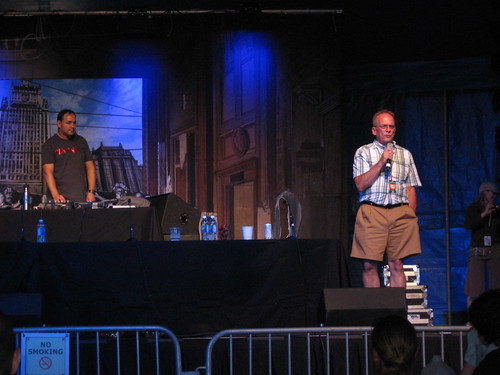
But my problem with ecovillages -- even good ones like this -- is that they marginalize the green movement. If we're going to get this whole sustainability thing down, we're going to need a lot more integration into the mainstream. And that's where Rothbury really ramped things up. After all, it billed itself as a "party with a purpose." It's not like fans didn't arrive knowing they were going to be expected to think about sustainability for at least a few minutes. And Rothbury did a good job of trying to expand the boundaries of what a fun weekend could be with lots of intimate Think Tank sessions. These sessions, curated by Dr. Steven Schneider, one of the IPCC Nobel laureates, covered a really broad array of topics and all involved at least one of the musicians performing at the festival. It was somewhat incongruous to see Hunter Lovins of Natural Capitalism fame sharing a stage with Ken Jordan from the Crystal Method, but it somehow worked. All of the seats at the event I attended were full, and the audience seemed interested and was asking some good questions when I ran off to get to my next show.
Award-winning journalist Bud Ward and Ken Jordan of the Crystal Method
But that was the problem--as interesting as the Think Tank sessions looked, they were up against some top quality music, music that people had paid hundreds of dollars and travelled thousands of miles to see. Even a dedicated greenie like me could only find time to attend two of the events during the weekend, partly because the sheer size of the festival grounds made it impractical to keep bouncing back to the venue at the main gate where many of the Think Tank events were held. So as sincere as the effort was, I'm not sure how much difference it made. Still, kudos to the organizers for going with a risky idea--lectures at a music festival? -- and for getting some really top-notch names to participate.
One area that seemed more successful was in artist education. All of the Think Tank sets had at least one musician, which speaks to the level of commitment that many of these performers on the festival circuit have for the environment. And in my conversations with artists backstage, every single one of them was happy to be part of a festival that was promoting a good social cause. I could see the lightbulbs going off for some artists when I was asking them about greening their tours, while other artists seemed really relieved that a festival organizer was finally getting to their level of thinking on these issues. At the end of the day, artists will have far more sway with the general public than organizers at a festival, so it was really heartening to see such a positive response to the message from the performers.
What went right? The overall mainstreaming of the message was a definite success. Artists and fans both seemed to get into the green theme, and Think Tank sessions seemed well attended despite some ferocious competition. Again, I can't say that anything went wrong, but in future years I'd like to see the Think Tanks placed in a more central location and/or scheduled earlier than the music so that we don't have to make such tough choices. I'd also like to see the ecovillage concept, like the farmers' market it shared a space with, moved to a more visible area.
Public Art
Um, yeah.
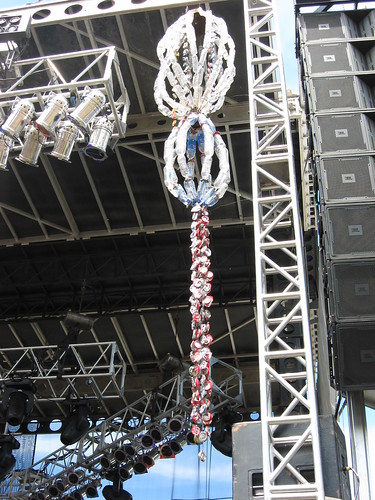
I'll keep this one short, since I know least about it. We were told that all of the art was made of reclaimed or otherwise green materials, and my observations seemed to bear this out. But what was more refreshing was that there was a pretty significant amount of public art in the first place. Some of it, like the giant chandelier-like effects made of plastic water bottles and cans at the Sherwood Court stage, didn't quite work. But on the other hand, the piece de resistance for the entire festival was without a doubt Sherwood Forest, a truly magical place covered in lights, hammocks, a secret stage, with lots of paths to draw you in and places to get lost (but not too lost!). Sherwood Forest, more than any one performance, was the highlight of the festival for me, and I suspect for many others, too. Kudos to the artists who put it together, and I hope that you're able to do something even more exciting with the space next year!
The forest was most impressive at night, but it was also very difficult to photograph. This rather jittery YouTube clip does it a bit of justice, though. Still, you absolutely had to be there. I'm told by my Burning Man friends that this was as close to that event as anything they'd been to.
What went right? Sherwood Forest! What went wrong? Really, nothing--I can't wait to see what they dream up next year!
Community Relations
Big festivals like Rothbury and Bonnaroo have to make sincere and significant efforts to make friends in their host communities from the very beginning or risk being banished. Done right, it can be a real win-win. Done wrong, it can end up with the festival not happening at all--does anyone really think Vineland still has a chance now that the neighbors have formed an alliance dedicated to stopping it?
Rothbury took its green message to the village of Rothbury in some significant ways. The most visible was the donation of $50,000 of solar panels to a nearby school. The panels, put up by Black Rock Solar of Burning Man fame in collaboration with a Michigan-based solar installer, will be augmented by more panels funded by the voluntary $4 donations that thousands of fans chipped in. And Rothbury went to great lengths to make sure that the money that would have gone to paying the electric bill stays in the school to make life better for the students.
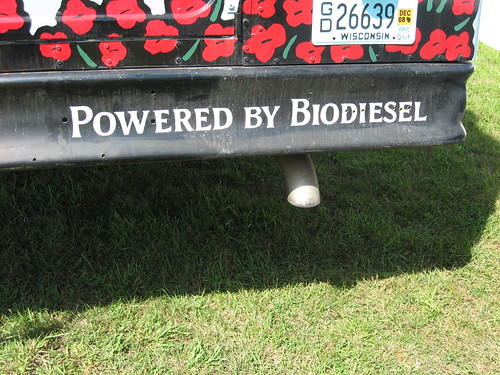
The festival also bent over backwards to find local sources for as much as possible, including a local biodiesel company that produced the fuel from local waste animal products, the farmers in the farmers' market, and even semi-local artists like Betty Lavette, who gave one of the most inspired performances of the weekend.
Betty Lavette belting it out.
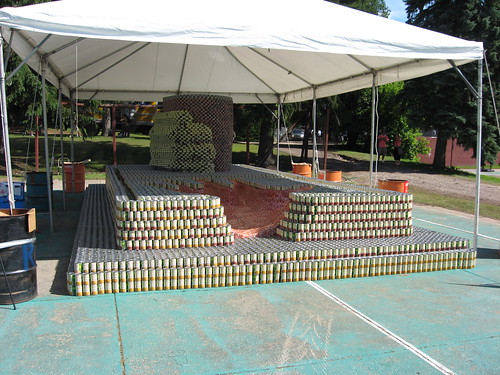
Beyond that, the festival worked with Conscious Alliance on a food drive and organized a new world-record for the largest canned food sculpture ever, with more than 50,000 cans in the shape of one hand giving a can to another. I heard through the grapevine that the food drive was the most successful ever for the group, with more than 40 bins of food collected the first day alone. All of the food collected went to local food banks.
This is what 50,000 cans of beans look like.
Finally, as I mentioned above, the festival worked diligently to keep useful goods left behind by patrons out of the landfill, setting up a "free yardsale" for local charities to reuse the myriad of shoes, chairs, and tents left behind.
Wrap up
All-in-all, it was a fantastic weekend. The music was perfect, the vibe was uber-relaxed and friendly, and people really seemed into the idea of a socially conscious festival. Aside from a few very minor quibbles, everything went flawlessly, and all I can say is that I can't wait to go back next year!
Jazz Fest may still be pulling folks into Montreal, but I've already switched gears and am now getting ready for the big event of my summer...Rothbury! Rothbury has been billing itself as the most environmentally focused festival of the year, and with such big claims I've got my work cut out for me. I'll be on the ground from Thursday night to Monday morning, reporting on all the green goodness I can in daily blog posts.
The festival organizers have scheduled a great variety of environmental-themed events, from lectures and etown radio broadcasts to the installation of solar panels (PDF link) on a local school and the inclusion of a local farmers' market to feed the masses. With so much going on, there's no way I can possibly cover all of it, but I'm going to give it my best shot without missing too much of the great music. I've blocked out performances by Rodriguo y Gabriela, Snoop Dogg, State Radio, Panjea with Michael Kane, Mike Gordon, and Trey Anastasio (and if we're lucky, Mike and Trey together!). Other than those, all bets are off and I'll be running around like a madman trying to get all the details for you, dear readers!
To get you ready, here are some essential links about the festival:
For background, read this excellent interview with Brian Lipsitz, the young man who made this festival happen at his parent's ranch.
Next up, check out the lineup, or even better use JamBase's superior RothburyBase version for easy reading and scheduling. If only we could make deciding who to see easier!
If you still need a ride, check out Mr. Busdriver (I'll be catching a lift with them to and from the airport), try the rideshare boards listed on the Rothbury website, or check the fairly active rideshare board over at Rothfest.com.
And if all this greenness at a US festival gets you excited, check out what's going on in the mind-bogglingly huge UK festival scene (450 festivals this summer!)....compostable tent pegs, composting toilets, deposits on beer cups, and even (gasp!) a festival that only books UK-based bands to cut down on artist travel.
OK, sports fans--get ready! My next post will be Friday sometime, from deep within the confines of the Double JJ Ranch...see you there!
Continuing our coverage of Rothbury, here's a press release about the solar schools initiative they're doing. I touched on this a bit in my interview with Sarah Haynes but didn't go into the details. Briefly, Rothbury decided not to offset fans' carbon emissions and instead spent the money putting a solar project on a nearby school. They are doing this with the help of Black Rock Solar, an offshoot of Burning Man, which brings down the price of solar considerably by using volunteer labor where it can. And to make sure that this really helps the school, they wrote it into the contract with the school district that the savings on the electric bills will remain in the school budget for other purposes, not just disappear, leaving the schools no better off than before.
STELLAR MUSIC, SOLAR POWER: ROTHBURY ANNOUNCES DETAILS FOR SOLAR SCHOOLS PROGRAM PRESENTED BY RE:VOLVE APPAREL ROTHBURY PARTNERS BLACK ROCK SOLAR AND BAUER POWER TO BUILD FREE SOLAR POWER FOR LOCAL SCHOOL THE SUSTAINABLE FESTIVALCELEBRATING MUSIC, ART AND ACTIONHAPPENS JULY 3 - 6, 2008 IN ROTHBURY, MICHIGANROTHBURY, the nation's first around-the-clock music and camping festival to implement maximum sustainability, near zero-waste initiatives and facilitate dialogue about climate change and clean energy solutions, is also giving back to the community with ROTHBURY's Solar Schools Program presented by RE:VOLVE APPAREL. Some of the nation's noted "Green Heroes" who are dedicated to shrinking society's carbon footprint on the environment will be teaming up with this innovative music festival to help outfit Shelby High School in Shelby, MI with a free solar panel system. ROTHBURY, together with RE:VOLVE Apparel, Black Rock Solar and Grand Rapids-based Bauer Power, has committed to donating a minimum of $50,000 worth of solar power to Shelby High."We were looking for creative ways to offset our carbon footprint," explains Jeremy Stein, ROTHBURY's Event Producer. "Our Solar Schools Program is exciting to me because it will provide tangible, lasting benefits for the school." Today ROTHBURY's Greening Chief, Sarah Haynes of the Spitfire Agency, has connected ROTHBURY to Black Rock Solar, who will oversee the execution of ROTHBURY's Solar Schools Program. Black Rock Solar's Executive Director Tom Price was recently chosen as one of three American "Environmental Heroes" by PEOPLE Magazine. "It is a tremendous honor to be chosen by PEOPLE Magazine, but it is our partners that are my heroes - conscious organizations like ROTHBURY and The Spitfire Agency, and Michigan's own Bauer Power, who will build and install the solar panel system, enable us to get the job done," says Price. The free solar power system will be benefiting the school for decades to come, drawing warm praise from school officials. "It's a wonderful opportunity for the school to teach the importance of renewable energy, like reducing greenhouse gasses. We're very grateful to the ROTHBURY community for helping make this possible" said Dana McGrew, Superintendent of Shelby Public Schools.Anyone can help - additional funds for ROTHBURY's Solar Schools Program are being collected via ROTHBURY's Green Ticket options. ROTHBURY's Green Ticket offers attendees an easy 'one click' opportunity to offset the environmental impact of their own festival participation, as well as directly contribute to the Solar Schools Program. Doing so aids Shelby High School by significantly reducing their energy bill, thus freeing up funding to be put toward school programs. About ROTHBURYROTHBURY's goal is to harness the unique energy of the live music community into a durable social movement toward an important cause: Climate Change and Clean Energy Alternatives. Under the direction of Greening Chief Sarah Haynes (President/Founder of The Spitfire Agency), ROTHBURY is dedicated to achieving maximum sustainability and near zero-waste via multiple initiatives, including: personal pocket-sized ashtrays to minimize litter, a Green Team work exchange program for festival goers dedicated to ROTHBURY's sustainability mission, the use of only compostable products, recycling and composting programs, carbon offsetting and the use of multiple clean energy options to help power the four day festival. In addition to a diverse and stellar lineup of over 70 bands including Dave Matthews Band, Widespread Panic, John Mayer, 311, Phil Lesh and Friends, Primus, Thievery Corporation, Snoop Dogg , Modest Mouse, Michael Franti and Spearhead, Gov't Mule, Slightly Stoopid, STS9, Colbie Caillat, Rodrigo y Gabriela and many, many others, ROTHBURY will host an Energy Fair and a Think Tank. The Think Tank, featuring curator Dr. Stephen Schneider and participants including Dr. Eban Goodstein, L. Hunter Lovins, and Winona LaDuke , offers attendees access to various buzz sessions that will address the topics of Climate Change and Clean Energy Solutions and will be geared toward conversations related to corporations, government/policy makers, and the individual. The ROTHBURY Energy Fair will allow attendees to engage hands-on with cutting edge, sustainable technology and products and experience both scheduled and surprise activities and interactive workshops aimed at arousing discussion and implementing change. On July 4th weekend 2008, ROTHBURY emerges as a new American celebration. Hosted at the one-of-a-kind Double JJ Ranch in Rothbury, Michigan on July 3- 6, 2008, the four day, environmentally sustainable music and camping festival promises to be an inspiring cultural assembly; one where music fans, artists and progressive thinkers gather to celebrate much more than music. With over 70 bands on 8 stages and unprecedented efforts at achieving 100% sustainability and energy efficiency, ROTHBURY is truly a "Party with a Purpose."For more information about ROTHBURY and the Solar Schools Program powered by Black Rock Solar please visit http://www.rothburyfestival.com/.
After reading this post on PSFK, I felt bad for yelling at my ink jet printer so much.
The implications of being able to print solar panels with similar technology to printing newspapers is huge--not only for people in the Western world, but also people in developing countries. It stands to dramatically lower the cost of solar because one of the main cost drivers that makes solar so expensive are the manufacturing processes. Also, it makes the technology more accessible and able to be produced (at least in part) locally, a production model that has served the wind industry well (geek out on that here).
Massachusetts-based Konarka Technologies have apparently manufactured the first ever solar cells by inkjet printing. This major advancement has the potential to drastically reduce the cost of production by eliminating the need for clean rooms.
By developing a new breed of flexible photovoltaic material, solar panels can not only be produced at a lower cost, but can be printed or coated onto a variety of surfaces using roll-to-roll manufacturing, similar to how newspaper is printed on large rolls of paper.
“Demonstrating the use of inkjet printing technology as a fabrication tool for highly efficient solar cells and sensors with small area requirements is a major milestone,” commented Rick Hess, president and CEO at Konarka. “This essential breakthrough in the field of printed solar cells positions Konarka as an emerging leader in printed photovoltaics.”
The dudes from Call and Response told me about a tour van rental company in the Bay Area that rents vans with video gaming consoles built in--pretty great for those long drives across Wyoming after the scenery doesn't do it for you anymore. On a related note, BoingBoing, posted a solar-powered gaming device today that would be great to stick next to the window of your van and use to play video games or charge your phone or ipod. From the pictures, it looks a little like a Speak-n-Spell, but hopefully sounds better.
"This knock-off "MP4 Player" not only plays music and video, it can emulate the NES and Game Boy Color. But even better, it can be recharged with built-in solar panels. That's right: you can play Faxanadu until the sun explodes.
It comes with 2GB of memory built in, which is plenty for NES and GB ROMs, although perhaps not music and movies, and can be expanded up to another 2GB with an SD card. Oh, and it's got a USB out to which other gadgets can be connected—not for data, but to be recharged from the solar panel."
As a lowly renter, I've long advocated for not letting home ownership stop people from purchasing renewable energy. Many renters go the route of Green-e certified renewable energy certificates. I purchase them for my apartment, JamBase purchases them for their office space--they are a cost effective way to minimize your impact on the environment. However, while I get a very sexy decal to stick on my window to smugly point to when company comes over, gesturing to a beautiful array of solar panels on my roof might bring more "oohs" and "aahs" from dinner guests.
While, to my knowledge, a full array of renter-grade solar panels does not exist yet, Collin Dunn of Treehugger.com posted an interesting story today about a new table that's hit the market. It is similar to the overhead projector your professor used to use in class with the electrical strip embedded in the side. The difference is that the table doesn't plug into a wall socket, it generates power from the solar paneled top. While the sticker price is a little high--$3600 smackers, I have a hunch that in a few years a similar product will hit a Target near you.
While this item does not carry the same environmental benefit as offsetting your full electricity load, it definitely has sex appeal. Also, this would be a great item to bring on the road, instead of idling your tour bus to check your email, just set this baby up next to the bus and send some solar powered emails.
Enter Sun Table, a project of Brooklyn-based Sudia Design Labs, as the happy medium. The outdoor table is small enough to take home with you, but attracts enough rays to power your laptop and various other home office peripherals, and even a television and DVD player.
Like many of the other solar gadgets designed for home use, the solar panels charge a nickel metal hydride battery, which, in turn, power your gadgets. The battery's max storage is 13 amp hours at 12 volts (that's 156 watt hours), with a max output of 150 watts; the system charges in 3 hours in full sunlight. Depending on the exact specs of your gadgets, those numbers translate to about three hours of laptop use, and a couple hours of television (if watching TV outside is your thing...) thanks to the included inverter that provides 120V AC (that's what everything in your house plugs in to, in case anyone was wondering).
A handy LED display (pictured below) tracks the battery's charge level for you, and the inverter beeps at you if you load it up with more than 150 watts, making it easy to both track your battery's performance and keep it from getting overloaded. The table itself is mostly aluminum (for easy recycling at the end of its life) and comes flat-packed in recycled materials, making it easier and more compact to ship and store.
About the table, designer Devang A. Shah (who created the table along with Michael Low) says they wanted to create '"A product that pushes people to spend more time outdoors will be beneficial for humanity. Let's get rooted in nature again, even if it's in a 21st century kind of way." We think it's a great example of combining technology and design to create a forward-looking product; lots of tech ideas (like solar) that are difficult to integrate into our daily lives, and it can be very helpful and meaningful to be shown that it actually works.
In this case, the table brings context and a personal connection to solar power, bringing it down from the heavens to your backyard, with the potential to change the way your life works every day. Imagine shifting your home office to the sunny patio for a few hours every afternoon, or having to apply sunblock and wear sunglasses while sending emails (and reading TreeHugger). In the midst of the cold, dark winter, that sounds pretty great to us.
Such fun and convenience won't come cheaply. The table, available for pre-order now (it'll ship in March 2008), will cost $3600. But can you really put a price on something that allows you to get a tan at your desk job?
This is old news by now, but New York's Rockefeller Center, home of Radio City Music Hall (where moe. will be playing new year's eve, unfortunately without me in the audience), has gone all green for Christmas, according to just about everybody, including the ever-reliable Daily News.
So what does it mean for Rock Center to "go green?"
Well, efficient LED lights on the tree, for one thing. And NYC's largest solar private solar installation on the roof, which is good. And a thermal storage system that will make ice during off-peak nighttime hours, then use that ice to reduce the load on the building's air conditioners during the peak daytime hours. All good things, to be sure. But I have to ask...is cutting down a tree with a handsaw really that much greener than cutting down a tree with a chainsaw?
Basically, it works just like a solar-powered garden light, but sits inside on your windowsill. Perfect for cold winter nights and a great substitute for those plug-in electric candles people put in their windows this time of year.
Solar panels have found a promising new place in the sun on canopies above parking lots that surround commercial and industrial buildings, Donald Shoup, a professor of urban planning at the University of California, Los Angeles, writes in a San Francisco Chronicle Open Forum piece.
To increase the use of solar on parking garages, cities can incorporate solar panels into the parking requirements for commercial developments. The legal basis for requiring solar panels atop a parking lot, according to Shoup, is similar to the basis for requiring the parking lot itself - to mitigate an impact. If a development increases the demand for scarce energy during peak hours, the solar requirement for the parking lot will help to meet this peak-hour demand.
Shoup says that California’s Million Solar Roofs program provides generous subsidies for solar panels, and the federal government offers additional tax credits, so developers won’t have to pay the full cost of a city’s solar requirement.
In addition Shoup says solar arrays are highly visible evidence of a company’s commitment to the environment.
Google has installed solar canopies on its parking lots to satisfy 30 percent of its headquarters’ power demand.
Envision Solar is just one of the companies providing such services. See their site for more info on “solar groves” over parking lots.
One of my friends once lamented about a time he toured and kept holding his laptop up in the tour van to get a wireless signal while driving through Utah. When he finally got a signal, his battery died. Enter:
Solar Powered WiFi Repeater by Matthew Sparkes, London, UK on 06. 4.07 Science & Technology (electronics) Meraki Networks have released a solar powered outdoor WiFi repeater, which can cover entire neighborhoods with Internet access. This of course makes it perfect for developing countries where electricity supply is scant or unreliable. Sanjit Biswas, CEO and co-founder of Meraki, said, 'To change the economics of Wi-Fi access across the globe, there’s got to be a simple, efficient and inexpensive method for sending the signal long distances outdoors. The Meraki Solar and Meraki Outdoor will play an important role in our efforts to bring the next billion people online in the coming years.' Of course, the device is also a perfect way to extend WiFi signals into your garden or to neighbours, without using any electricity. A very green way to surf; outdoors, and solar powered. :: Meraki.net





 Massachusetts-based Konarka Technologies have apparently manufactured the first ever solar cells by inkjet printing. This major advancement has the potential to drastically reduce the cost of production by eliminating the need for clean rooms.
 The dudes from Call and Response told me about a tour van rental company in the Bay Area that rents vans with video gaming consoles built in--pretty great for those long drives across Wyoming after the scenery doesn't do it for you anymore. On a related note, BoingBoing, posted a solar-powered gaming device today that would be great to stick next to the window of your van and use to play video games or charge your phone or ipod. From the pictures, it looks a little like a Speak-n-Spell, but hopefully sounds better.


 I stumbled upon this cool little light fixture on Charlesandmarie.com and thought it was perfect for GreenBasers.
 One of my friends once lamented about a time he toured and kept holding his laptop up in the tour van to get a wireless signal while driving through Utah. When he finally got a signal, his battery died. Enter:


